Portuguese
  Spanish


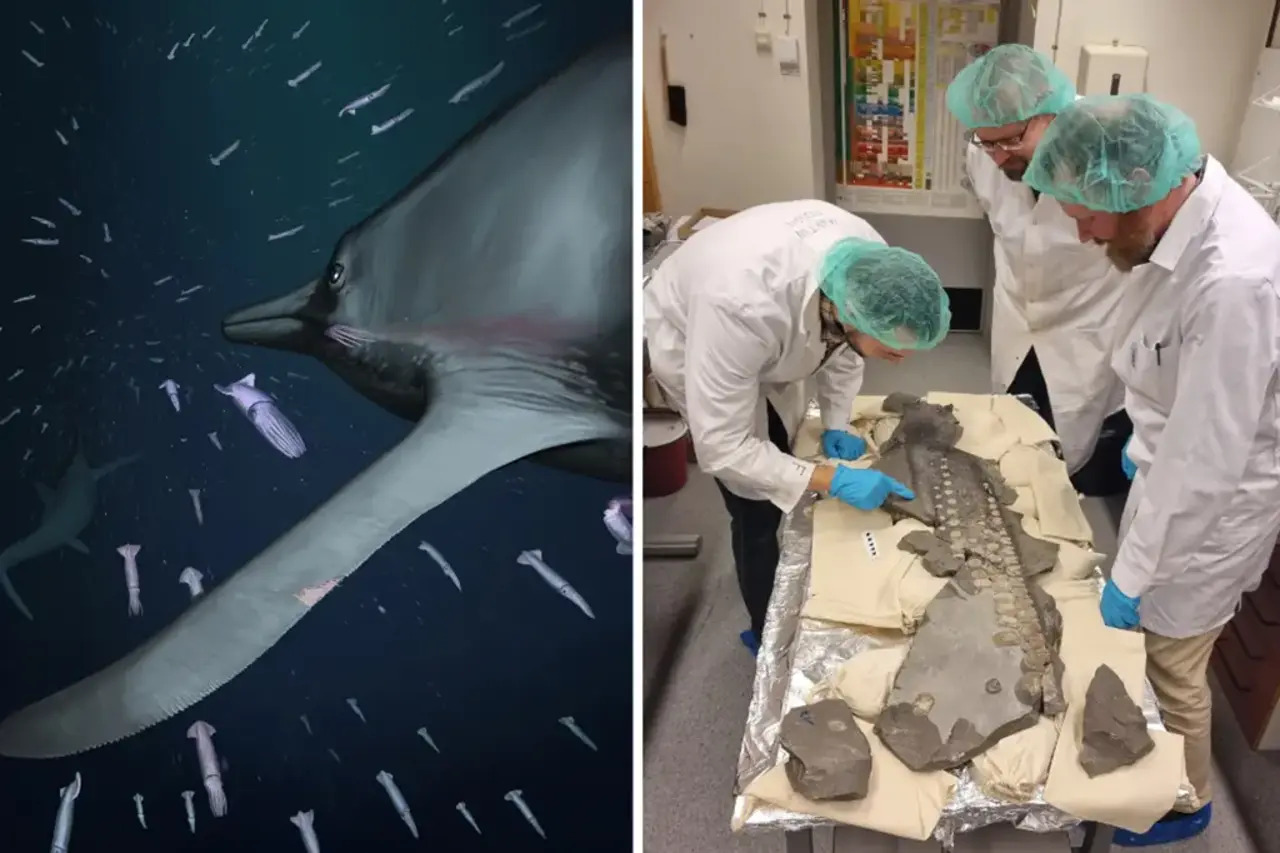

Rare Ichthyosaur Fossil Found in Germany Reveals Fin with Unique Cartilages That Muffled the Sound of Swimming
A rare fossil found by chance in southern Germany is changing the way paleontologists view ancient marine reptiles. The piece, part of the fin of a giant ichthyosaur, showed a body structure never seen before: cartilages adapted to reduce the sound of movement in the water. The discovery was published this Tuesday (16) in the journal Nature.
Unique Fin with Preserved Soft Tissues
The fossil belongs to a Temnodontosaurus, a reptile that lived between 183 and 181 million years ago. It measured over 10 meters in length and had eyes the size of footballs.
The analyzed piece is a front fin about one meter long. It was found during a road construction project in the town of Dotternhausen.
-
Indian Inventor, 58, Develops Steering Wheel-Free Agricultural Machine Operated by Levers, Offering Cost-Effective Alternative to Expensive Tractors

-
Scientific Breakthrough: Bacteria Found in a Rio de Janeiro Lagoon Guide Mars Research After Scientists Identify Similarities to Extreme Environments, Expanding Understanding of Extraterrestrial Life Possibilities

-
Brazilian Mechanic Wins Indian Presidential Award for Inventing Fuel-Efficient Agricultural Machine

-
Brazilian Polilaminin Reaches 100 Spinal Cord Injury Patients Through Compassionate Use, Shows Progress After 6 Months, Highlighting UFRJ’s Role in Experimental Regeneration Research




Collector Georg Göltz discovered the piece and took the material to paleontologist Sven Sachs of the Bielefeld Natural History Museum.
The surprise came soon after the initial analysis: in addition to the bones, the fin preserved fossilized soft tissues, something extremely rare, especially in large animals like this.
Aerodynamic Shape and Different Structure
The team led by Johan Lindgren of Lund University (Sweden) identified an unprecedented anatomical pattern.
The fin had serrated edges and ended without bones, resembling a wing. The structure is similar to owl feathers, known for allowing silent flight.
This similarity led scientists to propose a similar function: to reduce the sound during movement.
The analyzed tissue showed ripples formed by thin, elongated cartilages. These structures, called “chondroderms,” had never been documented in any other animal.
They resemble osteoderms, which are bony deposits in reptiles and amphibians, but are made of mineralized cartilage.
Impressive Fin: Silent Movement in Water
To understand the function of these structures, scientists created simulations based on the anatomy of the fin and typical swimming speeds of these animals.
Since the fossil was flattened, researchers used the fin of a pygmy whale, which also has an elongated shape, as a reference.
The tests showed that the ripples helped modify the water flow and muffled the sound of movements.
The conclusion was that the ichthyosaur could swim silently to approach its prey without being noticed.
The method is reminiscent of how modern sharks hunt, moving slowly until the attack.
International Team Highlights the Impact
Paleontologist Dean Lomax from the University of Manchester has been involved with the fossil for six years. For him, the piece represents a milestone in the study of marine reptiles.
“I have never seen anything like it. This discovery could change the way we interpret similar fossils,” he stated.
Paleontologist Lene Liebe Delsett from the Norwegian Center for Paleontology also commented on the discovery.
Although she did not participate in the study, she emphasized the significance of the find. “It shows how preserved soft tissues can enhance our understanding of sensory adaptations in extinct animals,” she told Science News.
Practical Relevance Today
Scientists believe that the discovery not only helps understand the past but can also inspire solutions for the present.
The noise caused by human activities in the ocean—such as maritime transport, military sonars, and offshore wind farms—negatively impacts marine animals.
The structure of the ichthyosaur fin may serve as a basis for developing technologies that reduce this type of noise pollution.
Link to the History of Paleontology
Interestingly, the fossil found in Germany belongs to the same type of ichthyosaur described over two centuries ago by British paleontologist Mary Anning.
She was the first to find fossils of Temnodontosaurus. For Dean Lomax, the new find completes a cycle initiated by Anning.
“We are still finding fossils that connect to her work. This could be one of the greatest fossil discoveries ever made,” he said.
Even after millions of years buried, a nearly lost fossil reveals incredible details about life in ancient seas—and perhaps, also helps protect today’s oceans.
With information from Super Interessante.