






 Portuguese
  Spanish


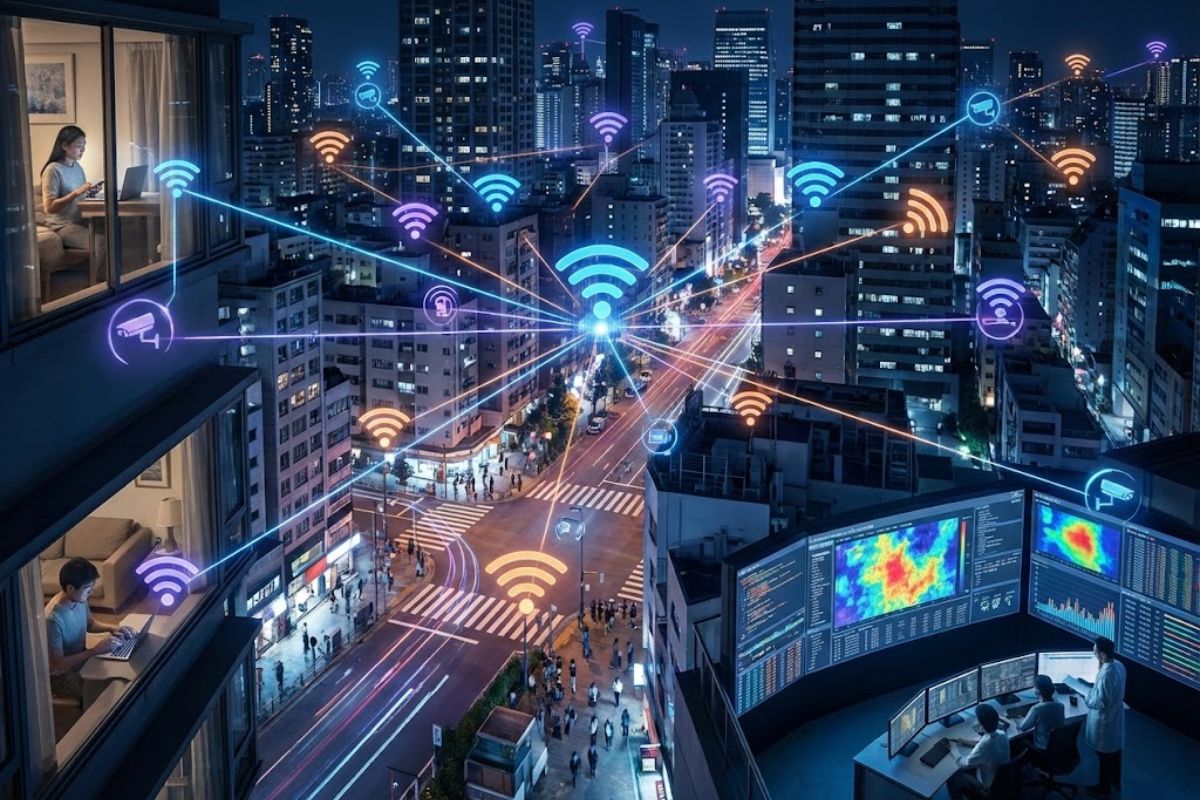


In Karlsruhe, Researchers from KIT Show That Everyday Wi-Fi, When Exchanging Beamforming Data, Can Map the Environment Like a Camera, Identify People Without Cell Phones and Without Cameras, and Transform Each Router into Silent Observers, Pressuring to Change the IEEE 802.11bf Standard by 2026
The Wi-Fi that seems like just “internet in the air” is being described as a new layer of reading the physical world. Through normal communication between router and connected devices, signals start to carry traces of bodies in space and may enable recognition of people in just a few seconds, even when they carry no devices.
The warning comes from researchers at the Karlsruher Institut für Technologie in Germany, who describe how radio patterns can become a kind of “image” of the environment. The debate is not theoretical: the discussion is already touching the future IEEE 802.11bf, where privacy and standardization clash with the promise of new applications.
Routers as Silent Observers Without Cell Phones and Without Cameras
The premise of the method is uncomfortable precisely because it is banal. Instead of dedicated sensors, it relies on the existing ecosystem: Wi-Fi networks in homes, offices, cafes, and public spaces.
-
China Builds Underwater Wall After Discovering Technology That Could Shift Military Balance in the Pacific, Study Reveals Why the Asian Power Reacted Now

-
After Over 8 Months in a Simulated Mars Habitat in Houston, 4 NASA Volunteers Communicate Almost Silently and Will Exit in October
-
Natural Phenomenon Turns Black Sea Turquoise Blue Due to Billions of Microscopic Organisms

-
Scientists Develop Innovative Material That Converts Visible Light to Ultraviolet, Unlocking New Possibilities for Optical Equipment and Advanced Communications


The person does not need to be connected or have Wi-Fi turned on, because what matters is the field of radio waves that passes through the location.
When these waves encounter obstacles, walls, furniture, and people, they undergo measurable changes.
The team describes that by observing the propagation of the waves, it is possible to form representations comparable to images, with the difference being that the “sensor” is radio, not light. The practical result is that turning off one’s own device does not solve the problem if other devices in the vicinity continue exchanging signals.
What Are BFIs and Why Do They Matter for Everyday Wi-Fi
The central technical point lies in the so-called beamforming feedback information, known as BFI.
In operational terms, this data appears as part of the normal functioning of the network, feedback that helps optimize how the signal is directed between transmitter and receiver.
According to the study’s description, this feedback can be transmitted without encryption and therefore can be read by anyone within radio range.
The implication is straightforward: a passive observer collects BFI, transforms the set into inputs for a model, and reconstructs patterns of the environment from multiple perspectives, without requiring “special hardware” beyond a standard Wi-Fi device.
Recognition in Seconds and High Accuracy: What the Study Says, Without Exaggeration
The team reports that, after training a machine learning model, identification can occur in just a few seconds.
The result presented is almost 100% accuracy in a study with 197 participants, with performance described as consistent regardless of perspective and even walking style.
These numbers are the kind of data that change the level of conversation: it is not just about detecting “presence” or “motion,” but about inferring identity.
The cited study is “BFId: Identity Inference Attacks Using Beamforming Feedback Information,” authored by Julian Todt, Felix Morsbach, and Thorsten Strufe, with reference to CCS 2025 and DOI 10.1145/3719027.3765062.
Privacy, Authoritarian States, and the Real Dispute Over 802.11bf
The researchers place privacy at the center and point out a specific risk in repression scenarios: the observation of protesters and the identification of people in public places, without the social visibility that cameras usually have.
The advantage of Wi-Fi, from a surveillance standpoint, is being invisible, integrated into everyday infrastructure and, therefore, less contested by common sense.
It is in this context that IEEE 802.11bf comes in, referred to as the “future standard” where safeguards should be considered.
The technical dispute becomes a political and regulatory dispute: on one side, maintaining compatibility and network resources; on the other, reducing the surface for passive collection and preventing performance feedback from turning into raw material for identification.
What Changes in Practice for Homes, Cafes, and Businesses
For residences and businesses, the discomfort is not just “someone filming me.” It is the possibility of a space with active Wi-Fi becoming a collection environment, even when no one notices and even when there is no visible camera.
In routine places, such as always passing by the same café, the mentioned concern is subsequent recognition based on previously captured patterns.
For businesses, the topic crosses security and governance: who has access to the radio environment, who controls routers, who audits configurations, and what policies exist for network data that, in practice, can carry signals about people.
Wi-Fi ceases to be just connectivity and enters the field of “sensing”, and this repositioning of responsibility falls on manufacturers, administrators, and regulators.
The work from KIT places Wi-Fi at the center of a new friction: essential infrastructure versus the potential for invisible surveillance.
The described technology relies on something already present in everyday life, using network feedback to build representations of the environment and reaches the point of inferring identity quickly, pushing the debate into the 802.11bf arena.
In your routine, where is Wi-Fi more “ubiquitous” and less questioned: at home, at school, at work, or in cafés? If you could choose a mandatory protection in the 802.11bf standard, would you prioritize BFI encryption, public alerts of “radio sensing,” or technical limits that prevent identity recognition?


