






 Portuguese
  Spanish


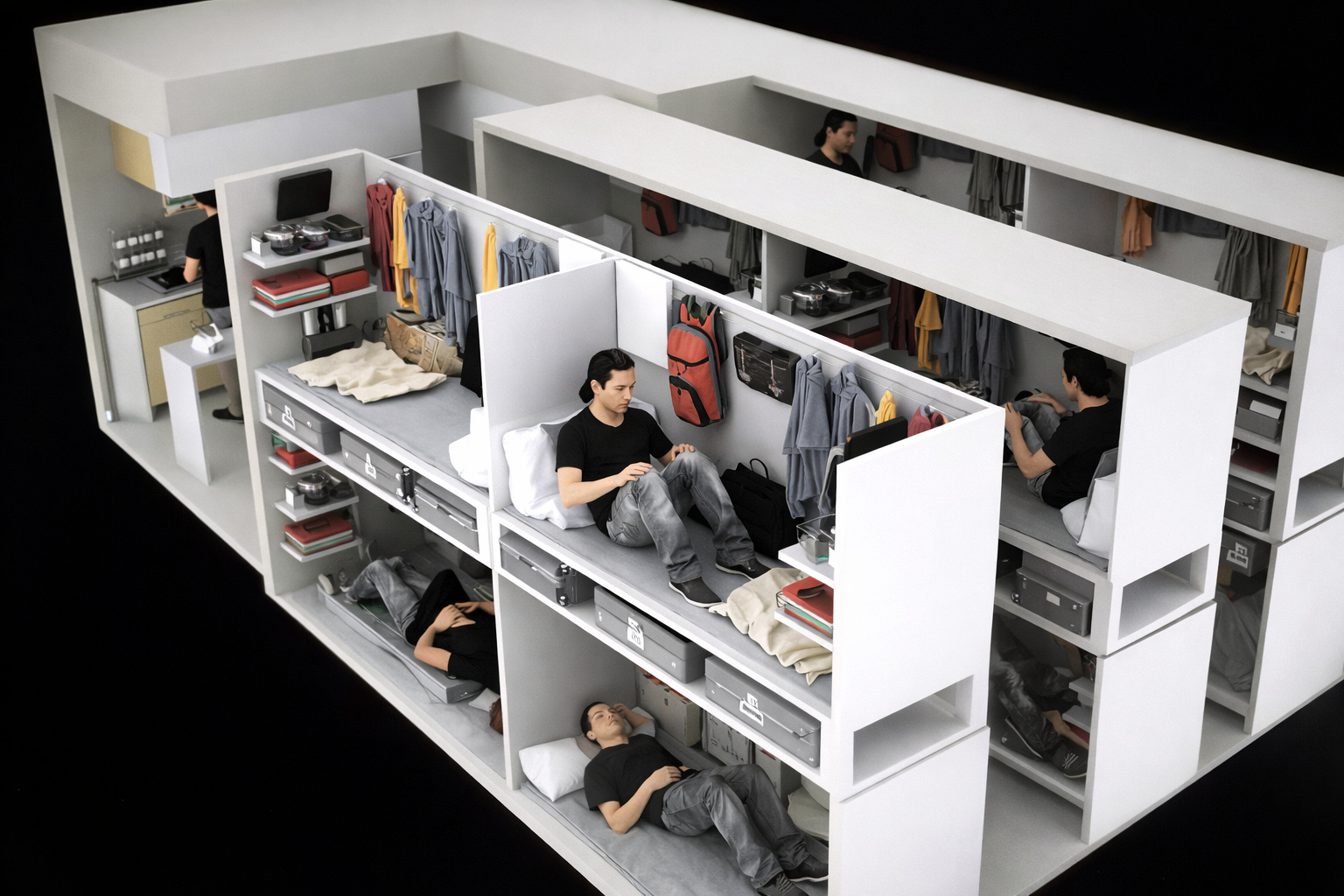


Away From The Comfort, Privacy, And Even Natural Light, People Living In Micro Apartments Report How The Extreme Housing Crisis Pushed Them Into Cubicles Where It Is Hardly Possible To Stretch Their Legs
It is still early when many residents of Hong Kong wake up in spaces that resemble compartments rather than homes. Even before dawn, they are already sitting or lying in tiny cubicles, surrounded by narrow walls, bags, personal belongings, and beds pushed against the ceiling. In one of the most densely populated cities on the planet, the routine begins inside so-called “coffin apartments”, properties so small that they hinder simple body movements.
Along these narrow corridors, residents survive in windowless micro apartments, with mini bathrooms and, in some cases, shared kitchens. More than numbers or statistics, these are human stories marked by loss of comfort, shattered expectations, and forced adaptation to an extreme reality. The investigation was conducted in the field, in different buildings across the city, revealing the invisible daily lives of those living on the margins of the luxury real estate market that dominates the urban skyline.
Life Happens In Few Square Meters And The Routine Is Marked By Constant Adaptation
Before the city’s movement gains momentum, residents already face the physical limits of the spaces. The logic is simple: every inch matters. Sitting, lying down, storing items, or changing clothes requires planning. Even so, the wear and tear is constant. Without adequate ventilation, many environments do not receive natural light, turning the day into a sequence of identical hours.
-
How Many Outlets Should Each Room Have? Guidelines Suggest 6 to 10 in the Kitchen, One Every 3.5 Meters in Living Rooms, and Specific Recommendations for Bedrooms, Bathrooms, Laundry Rooms, and Outdoor Areas

-
Family Turns Homemade Cheese Bread Recipe into a $17 Million Frozen Foods Business with 200 Tons Monthly Production and Over 1,400 Clients

-
Ancient 4,000-Year-Old City in Brazil Grew Wealthier and Reduced Inequality, Study Finds
-
Lost Page from Archimedes Palimpsest Resurfaces in French Museum After Decades, May Reveal Hidden Mathematical Calculations with X-ray and Multispectral Imaging




It is in this scenario that Miss Lee tries to reorganize her life. Inside the cubicle, she lives with bags, small mementos, and her little dog Bibi. The emotional impact is direct. “Living there is devastating”, she asserts. According to her, the longing for her old home and childhood is constant. Despite the conditions, the cost is high. The monthly rent is around R$ 1,400, even in a space where it is impossible to stretch one’s legs completely.


Forced Coexistence, Absence Of Bonds, And Neutrality Among Neighbors
In the buildings that concentrate these micro apartments, coexistence happens without closeness. Gam-Tin Ma, another resident, describes the environment as functional and distant. “We are just random people in the same place”, he reports. There are no frequent conflicts, but there are also no bonds. Thus, collective life sustains itself on a fragile balance, where each one tries to preserve the minimum possible privacy within walls that are almost glued together.
Luxury Skyscrapers And The Inequality That Shapes The Housing Crisis
Meanwhile, outside, Hong Kong maintains one of the most expensive real estate markets in the world. Skyscrapers over 100 meters tall are multiplying across the city, aimed at a restricted audience. The contrast is unavoidable. On one side, high-end properties, spacious and valued. On the other, coffin apartments, which become the only alternative for thousands of people.
According to experts, the origin of the crisis lies in the combination of real estate speculation and precarious labor. Professor Betty Xiao Wang from The University of Hong Kong issues a direct warning. According to her, cities like London and New York deal with visible homeless individuals. In Hong Kong, many end up housed inside coffin houses. The professor questions where these people would go if those properties were entirely prohibited.
Dreams Reduced To Basics And Survival As A Priority
Finally, Mr. Tang, who shares a space of only nine square meters, envisions the future simply. He wishes for a bathroom where he can enter facing forward, a functional kitchen, and a small space for a chair and a table next to the bed. Thus, in this extreme context, daily life ceases to revolve around comfort or social ascension. It shifts, above all, to breathing, resisting, and surviving.
In light of this reality, to what extent does living in such a restricted space still represent a choice, and at what point does the absence of alternatives turn these cubicles into the only possible way to continue existing in one of the wealthiest cities in the world?






Uai, sim foi o **** do Mendes que disse ama o modelo de governo chinês?
Hong Kong é uma cidade autônoma, tem regras próprias. Nas cidades chinesas normais 90% da população tem casa própria pq não existe especulação imobiliária, o governo não permite.
Devemos amar preservar nosso meio ambiente, nosso Brasil e generoso Gentil,acolhe estrangeiros,a nossa realidade não é fácil mas é mais humanizado
Surreal. O Brasil é o melhor país do mundo. Quanto sofrimento pra esses moradores.