Portuguese
  Spanish


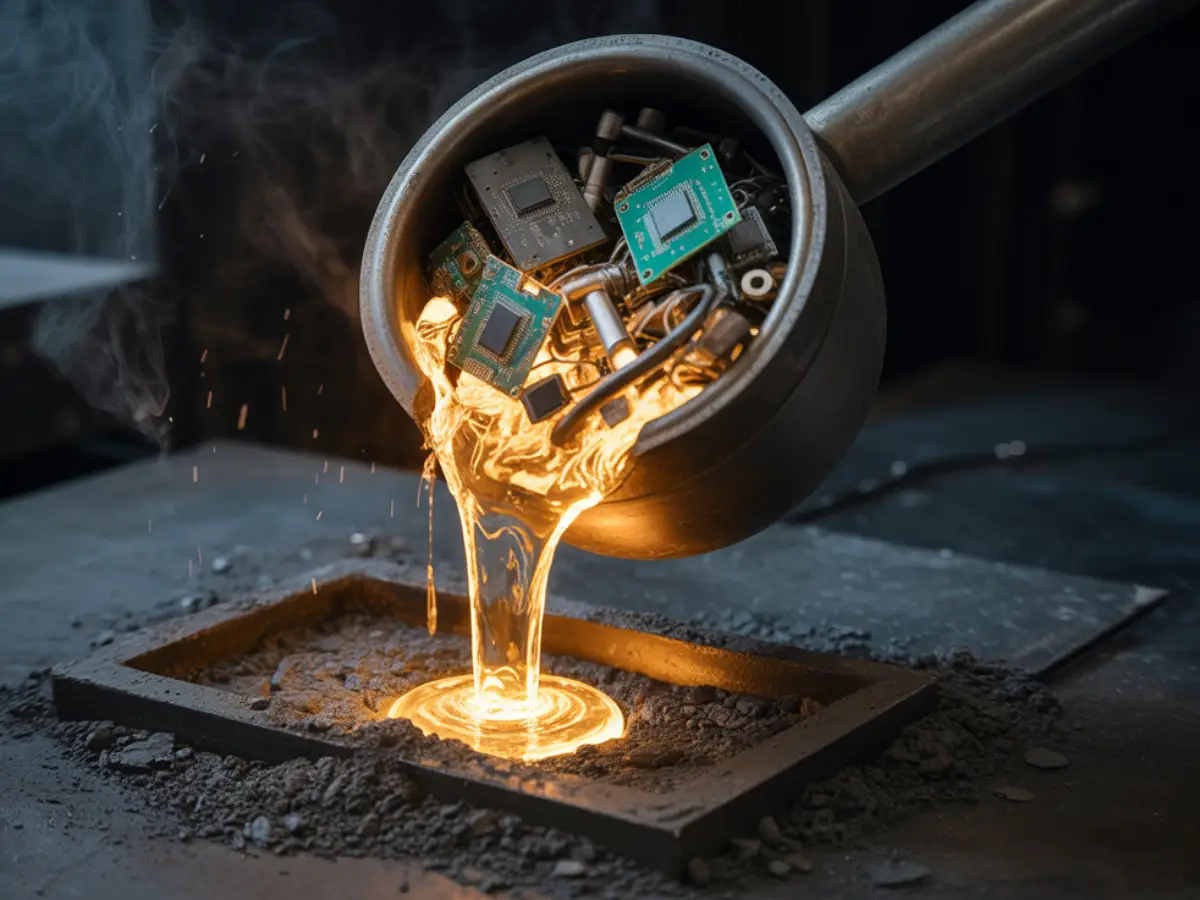

Graphene Recovers Gold Without The Risks Of Mercury, Promises To Revolutionize Mining And Reduce The Environmental Problem Of Electronic Waste Worldwide.
It may seem like magic, but it is pure science. A group of researchers discovered that 1 gram of graphene can extract almost all the gold present in discarded electronic equipment, without having to use toxic products or high temperatures. This technique, in addition to being extremely efficient, can transform the way we deal with electronic waste and open a new chapter in urban mining.
Graphene, The Philosopher’s Stone That Extracts Gold From Waste
The study that revealed this feat was conducted by scientists from Tsinghua University and the Shenzhen Advanced Technology Institute, both affiliated with the Chinese Academy of Sciences (CAS), in partnership with The University of Manchester in the United Kingdom. They found that a membrane of reduced graphene oxide can attract and retain gold dissolved in liquid solutions derived from electronic waste processing.
And the most impressive part: this happens in just a few minutes and with high selectivity. Graphene ignores other metals and goes straight for the gold, even when it is present in minimal concentrations, such as 1 part per billion.
-
Brazilian Student Invents Low-Cost Rainwater Harvesting System Using Recycled Materials, Showcased at World’s Largest Science Fair

-
Italy Considers Next-Gen Nuclear Reactors for Warships, Aiming to Boost Naval Autonomy and Join Elite Maritime Powers

-
Extreme Heat in Antarctica Sets Record 15.4°C at Esperanza Base in June, Raising Concerns Among Scientists with Temperatures 20°C Above Normal, Rain Instead of Snow, and Unusual Melting Transforming the White Continent’s Landscape
-
UFG’s Innovative Use of Air Conditioner Drip Saves 400 Liters of Water Daily in Brazilian Public Building


According to Dr. Yang Su, the lead author of the study:
“This apparent magic is essentially a simple electrochemical process. Unique interactions between graphene and gold ions drive the process and also produce exceptional selectivity. Only gold is extracted, without other ions or salts.”
How Does Gold Extraction With Graphene Work?
The process begins with crushing the discarded electronic equipment. Then, this material is dissolved in a chemical solution. This is where graphene comes in. When the reduced graphene oxide membrane is added, it starts to attract and capture the gold, which accumulates on its surface within minutes.
After collection, the membrane can be burned, leaving behind pure gold. With just 1 gram of graphene, it is possible to recover more than 95% of the gold from a sample. And since graphene is a material with applications in various fields – from medicine to engineering – this opens up possibilities for cross-uses of this technology in strategic sectors.


An Environmental Problem Of Electronic Waste That Promises To Turn Into Opportunity
Currently, the disposal of electronics is one of the main sources of solid waste in the world. According to the Global E-waste Monitor, over 59 million tons of electronic waste were generated globally in 2022 alone, and only 17% were recycled properly [UN | E-Waste Monitor].
A significant portion of this waste contains gold, silver, copper, and other valuable metals, but recovering them in an economic and clean way is a challenge. Traditional methods use mercury or cyanide, hazardous and highly polluting substances.
The use of graphene offers a sustainable solution. It can be reused, does not generate toxic by-products, and does not require excessive energy consumption. This makes the technique ideal for integrating circular economy policies and precious metal recycling, as well as reducing the need to extract ores directly from nature.
Promising Technology Is Already Attracting Market Attention
With the advancement of this research, interest from the industry in ways to enable the use of graphene at scale is growing. Technology and mining companies are beginning to study how to adapt this method for the large-scale recovery of metals, especially in countries with high volumes of electronic waste disposal, such as Brazil.
It is worth noting that graphene is not exactly a novelty, but its practical application still faces challenges, mainly related to production costs. However, recent innovations, such as those developed by startups like Graphene Flagship and research centers like the National Graphene Institute, have been reducing these costs [Graphene Flagship].
If the technique is improved and adopted globally, we could see a scenario where old electronics become true urban gold mines, instead of just accumulated waste.
A Future Where Gold And Technology Meet
The possibility of extracting gold with graphene is an example of how science can offer creative and sustainable answers to urgent problems. This discovery not only represents an advance for electronic recycling, but can also help preserve natural resources and reduce the environmental impact of traditional mining.
If you found this discovery as impressive as we did, leave your comment below or share this article with someone who will also be surprised by the power of graphene. Let’s spread knowledge and encourage technological solutions that truly make a difference!