Portuguese
  Spanish


Fire on Cherne-1 Platform Leads IBP to Suspend Petrobras Inspections in Campos Basin; Unit Has Been in Operation for 40 Years, Twice the Expected Useful Life.
A recent fire on the Cherne-1 platform, located in the Campos Basin of Goytacazes (RJ), led the Brazilian Institute of Oil and Gas (IBP) to temporarily suspend the Equipment Inspection Management System (SPIE) of Petrobras in the Campos Basin Business Unit (UN-BC).
The measure, although temporary, imposed immediate restrictions on state operations until the causes of the accident are investigated, the severity of which has reignited discussions about the structural integrity of offshore units that have surpassed their planned useful life.
Cherne-1 Platform Structure Exceeds Safe Operating Limit
Preliminary technical reports indicate that the Cherne-1 platform, originally designed to operate for 20 years, has been active for four decades—twice the expected duration.
-
Brazil’s ANP Opens 86 New Oil Blocks in the Equatorial Margin, Expanding the Amazon River Mouth Frontier

-
OPEC+ Boosts Oil Supply by 188,000 Barrels per Day in July 2026, Leading to Price Drop from $112 to $89 per Barrel in Under Two Months

-
TotalEnergies Signs 20-Year Deal to Purchase 2 Million Tons of LNG from Alaska, Boosting Project Viability
-
Turkey Deploys Çağrı Bey Drilling Ship to Explore New Oil Frontier Off Somalia’s Coast


This discrepancy between the planned useful life and the operational reality is one of the main concerns of the technical committee investigating the accident.
The structural deterioration of the unit is being meticulously analyzed, focusing on possible failures that may have contributed to the fire.
Meanwhile, the IBP is requiring Petrobras to provide a corrective action plan to resume full certification.
IBP Implements Suspension Based on Technical Standards
According to item 4.16 of the guidelines regulating the SPIE, a precautionary suspension can be determined whenever an expanded accident occurs, such as the one registered at Cherne-1.
The measure was adopted based on the opinion of the Certification Commission (ComCer), which will deliberate on the maintenance of the certificate between May 13 and 15.
Item 11.5 of the standard also states that the SPIE certificate must remain suspended until a conclusive investigation report is presented to the Product Certification Body (OCP).
The final decision by ComCer will also consider information forwarded by regulatory bodies of the Ministry of Labor and Employment (MTE).
Petrobras Maintains Operational Routines and Safety Onboard
In an official statement, Petrobras reported that the precautionary suspension “is an administrative measure and does not impact inspection and maintenance activities already underway on the platform.”
The company emphasized that the established routines continue to be followed “to maintain the habitability and safety conditions of Cherne I, in compliance with current regulations.”
Furthermore, the state-owned company highlighted that it was formally notified by the IBP and is awaiting the conclusion of the investigation report for ComCer’s deliberations.
Three Workers Remain Hospitalized in Stable Condition
The incident also left injuries. According to Petrobras, three workers remain hospitalized, being clinically monitored, with their health condition considered stable.
The case of the Cherne-1 platform reinforces the need for greater oversight of aging structures in the oil and gas sector.
The continuation of operations on platforms that exceed their useful life without adequate modernization can pose increasing risks.
See Some Images at the Time of the Fire
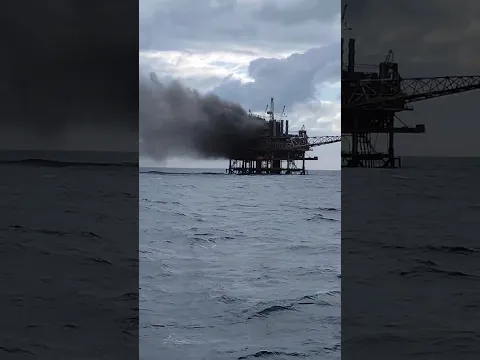

R7 and SindiPetroNF