Portuguese
  Spanish


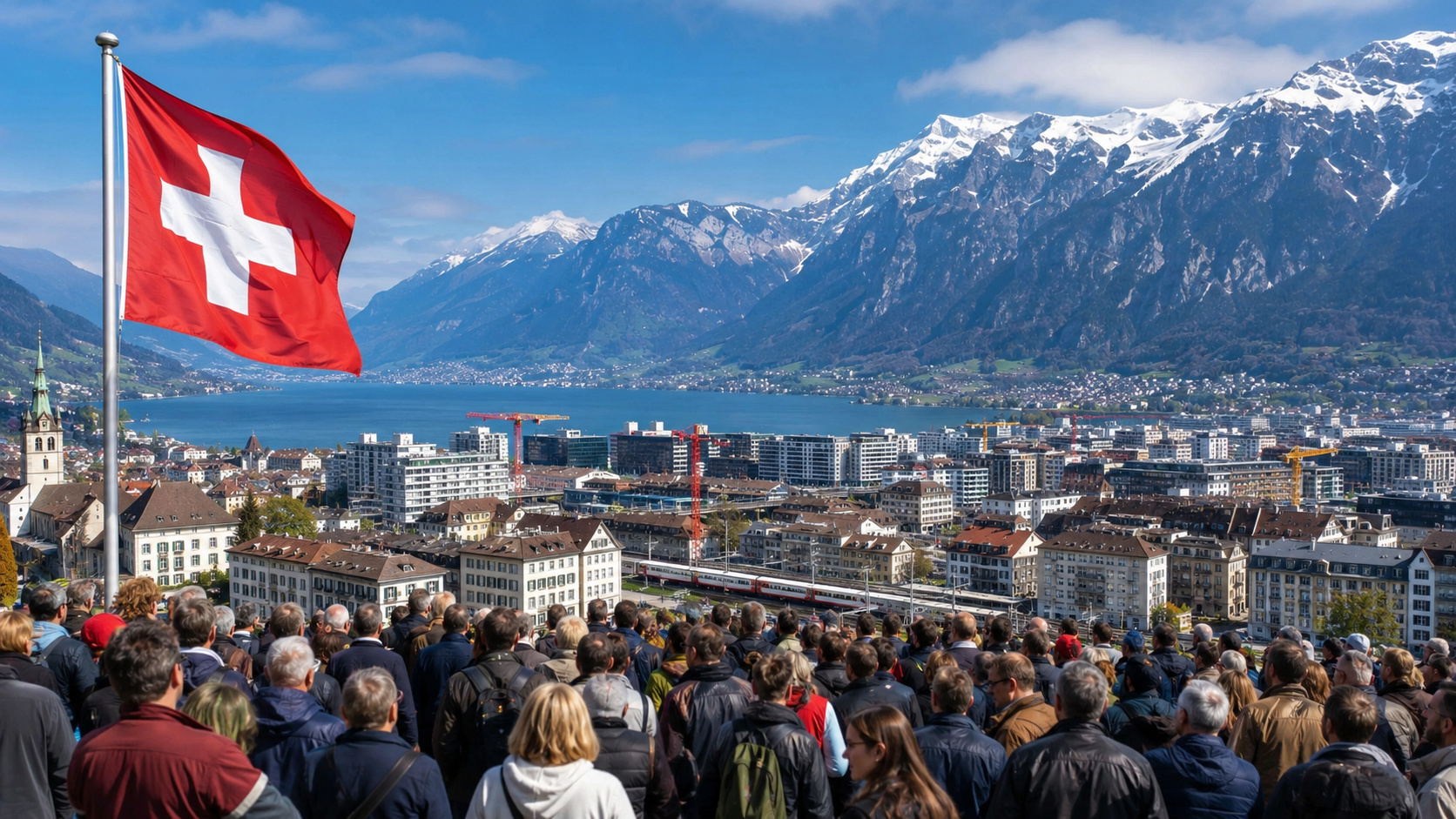

The rise in rents and lack of housing have helped turn immigration into a central issue
Switzerland continues to be seen by millions of people as one of the most desirable places to live. The country once again appeared among the top ten in the World Happiness Report 2026, maintaining its reputation for safety, high income, institutional stability, and quality of life. But behind this image of prosperity, an increasingly intense debate is dividing the country. On June 14, 2026, the Swiss were called to vote on a proposal known as “No to a Switzerland of 10 million”, an initiative that aims to limit the country’s permanent population to 10 million inhabitants by 2050.
The issue gained momentum after years of population growth driven mainly by immigration, rising housing prices, and increasing pressure on public services and infrastructure.
The Swiss population grew by almost 2 million people in just over two decades
Population growth is at the heart of the discussion. According to the Swiss government, about 9.1 million people lived in the country at the end of 2025, and the population grew by approximately 1.7 million since the introduction of free movement of people with the European Union in 2002. Reuters also contextualized the debate by informing that the Swiss population rose from 7.3 million in 2002 to 9.1 million in 2025.
-
For nearly 35 years, a famous luxury hotel in the United States concealed a secret bunker with a 25-ton door, over a thousand bunks, a dining hall for 400, and space designed to save the entire Congress from nuclear war.

-
China Invested 17 Billion Yuan to Build a Desert City with Museums and Theaters for 1 Million, but Only 28,000 Moved to Kangbashi Initially

-
Mother and Daughter Convert Small Garage into Full Apartment to Save Money and Stay United
-
Woman Leaves Restaurant Job to Become a Builder in Brazil, Launches Her Own Construction Brand “Construcida”




The Swiss government states that much of this growth is linked to immigration and the need for workers to sustain the economy.
As the country has one of the lowest unemployment rates in Europe and a highly specialized economy, companies often turn to foreign professionals to fill positions in areas such as technology, engineering, healthcare, finance, and industry.
Currently, more than 27% of the Swiss population is composed of foreigners, one of the highest proportions in the European continent.
The increase in rents and the lack of housing have helped make immigration a central issue
Although Switzerland remains one of the strongest economies on the planet, finding housing has become increasingly difficult in various regions.
Reuters reported that the problem is particularly visible in economically dynamic areas like the canton of Zug, where accelerated population growth has pressured the real estate market and significantly raised prices.

In some localities, residents claim that the supply of new housing cannot keep up with the speed of arrival of new residents. This has increased competition for properties and driven up rents.
The housing issue has become one of the main arguments for supporters of population limits. They claim that the country is approaching its physical capacity in certain urban areas.
Roads, schools, hospitals, and public transport have entered the center of the national debate
The issue does not only involve housing. Proponents of the proposal argue that accelerated population growth is putting pressure on roads, railways, hospitals, schools, and other public services.
According to them, the problem is not necessarily the current number of inhabitants, but the speed of growth.
The initiative provides that if the permanent population exceeds 9.5 million inhabitants before 2050, the government will be obliged to adopt measures to control this growth. Among the areas mentioned are rules related to immigration, family reunification, and asylum policies.
For supporters, limiting population growth would be a way to preserve the quality of life that has made Switzerland internationally famous.
The Swiss government says the proposal threatens the country’s economy
The federal government takes an opposing stance. Swiss authorities have urged voters to reject the initiative, arguing that it could harm the economy, reduce the supply of skilled workers, and weaken strategic relations with the European Union.
The main concern involves the free movement of people agreement between Switzerland and the European Union.
The proposal foresees that, if necessary to comply with the population limit, the country will abandon this agreement. According to the government, this could generate significant economic consequences because the European Union is Switzerland’s main trading partner.
Businesspeople, unions, and cantonal governments have also expressed concern about possible impacts on the labor market.
Many Swiss fear repeating tensions that other European countries have faced
The Swiss debate takes place in a broader context. Several European countries have been facing similar discussions on immigration, housing, and population growth. In some cases, these tensions have significantly altered the national political landscape.
Reuters noted that some critics of the proposal see parallels with debates that occurred in the United Kingdom before Brexit. The fear is that abrupt changes could generate economic consequences that are difficult to predict.
At the same time, supporters argue that ignoring population growth could also create long-term problems for infrastructure, the environment, and quality of life.
Polls showed a country divided over the future of immigration
Polls conducted throughout 2026 revealed a significant division among voters. In April, a survey cited by Reuters showed that 52% of respondents supported or tended to support the proposal, while 46% were opposed.
By June, another survey indicated a change in the scenario, with 52% of respondents declaring opposition to the initiative and 45% in favor.
The fluctuation illustrates how the topic mobilized different groups in Swiss society and became one of the country’s most important political debates in recent years.
The paradox of one of the richest and happiest countries on the planet
The Swiss case draws attention because it involves one of the world’s highest-rated countries in quality of life indicators.
The per capita income is among the highest on the planet. Unemployment remains low. Public services are widely recognized for their efficiency. Political stability is considered one of the most solid in Europe.
Even so, a significant portion of the population shows concern about the pace of demographic growth.
The debate shows that economic prosperity does not automatically eliminate concerns related to housing, infrastructure, immigration, and urban planning.
The result of the vote may influence the future of Swiss migration policy
Regardless of the outcome, the discussion has already left important marks on the Swiss political scene. The mere fact that a proposal to limit the population to 10 million inhabitants reached a national vote shows that the issue has become a relevant concern for a significant portion of voters.
At the same time, the resistance from the government, the business sector, and various institutions demonstrates the economic weight of international relations and immigration for modern Switzerland.
The question that remains is the same that divides the country: how to continue growing economically without compromising the infrastructure, housing, and quality of life that have made Switzerland one of the most admired places in the world?