






 Portuguese
  Spanish


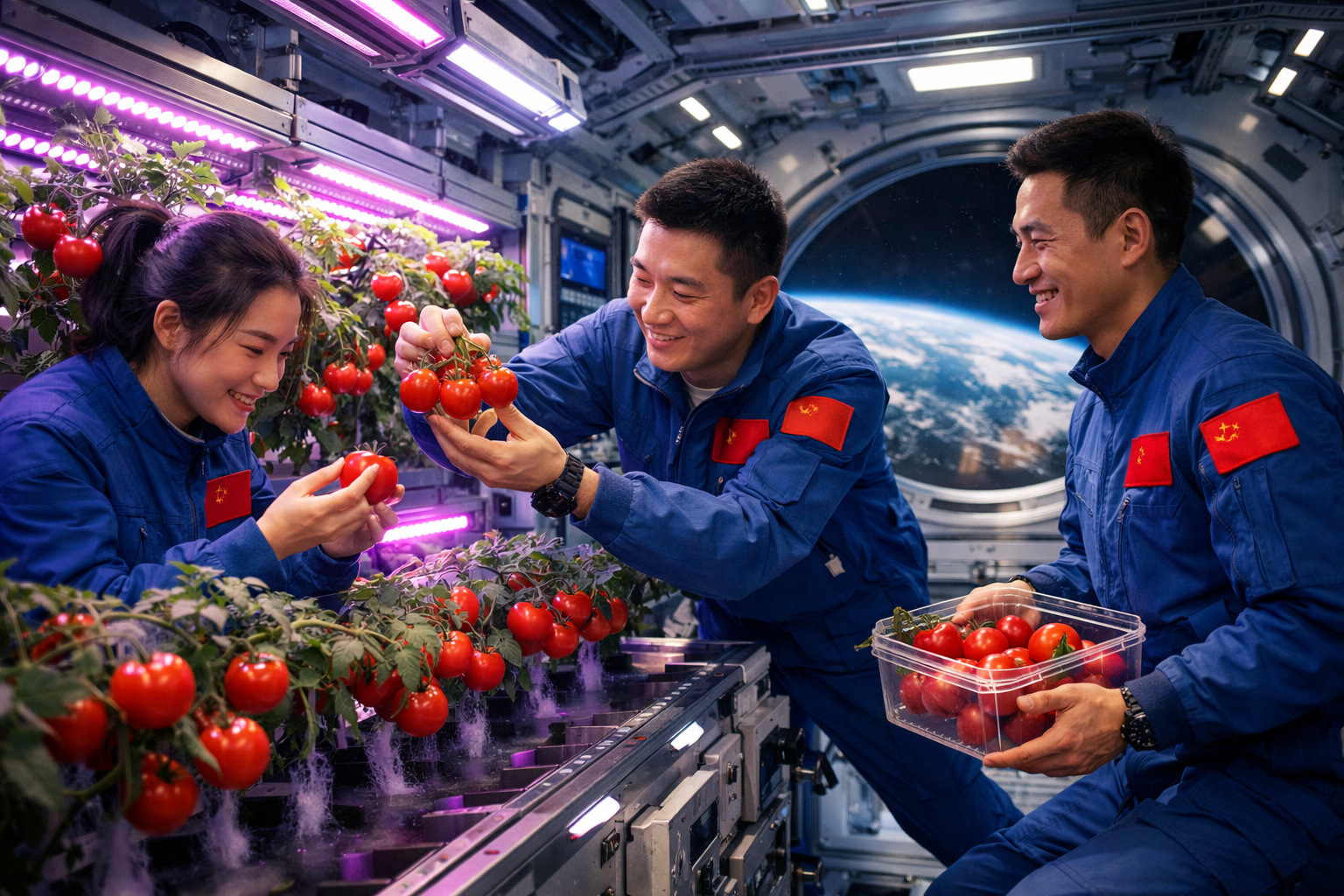


Shenzhou-21 Mission Crew Transforms Space Station Into Living Laboratory for Orbital Agriculture With Advanced Aeroponic System and High-Efficiency LED Lighting
While China celebrated the 2026 Spring Festival on Earth, the crew of the Shenzhou-21 mission celebrated an equally symbolic achievement, but at hundreds of kilometers in altitude: the harvest of tomatoes grown in space, inside the Tiangong space station. After more than 100 days in orbit, the Chinese astronauts witnessed the success of an experiment that could redefine the future of space agriculture and long-duration missions.
The information was released by “Xinhua,” the official Chinese news agency, based on a report aired by China Media Group (CMG), which detailed the progress of the so-called “space garden” installed aboard the Tiangong. The experiment is not just symbolic: it represents a strategic step in the development of bioregenerative life support systems for future crewed missions beyond Earth’s orbit.
In a video released on Wednesday, astronaut Zhang Hongzhang presented to the public what he called the space station’s “therapeutic corner.” In this space, the tomatoes grown in microgravity exhibited vigorous growth, demonstrating that it is possible to keep productive plants outside of Earth’s atmosphere.
-
Six Helicopters to Drop 550 Tons of Poison on Island Near Antarctica to Eradicate Mice Threatening Albatrosses and 19 Seabird Species.

-
Russia Unveils Poseidon: A 20-Meter Nuclear Torpedo-Drone with 10,000 km Range, 185 km/h Speed, and 100-Ton Capacity Threatening Coastal Cities with Radioactive Waves
-
Brazilian Innovator Converts Old Car into Electric Vehicle Using Laptop Batteries and Forklift Motor, Achieves Nearly 90 km/h in Urban Settings

-
Samsung Unveils Smart Oven with Built-In Camera, AI Food Recognition, and Real-Time Monitoring via Smartphone.




Aeroponic System Sent by Tianzhou-9 in July 2025 Validates Efficient Cultivation in Microgravity Environment
The cultivation of tomatoes in space was made possible thanks to an aeroponic growing system developed by a team from the China Astronaut Research and Training Center. Unlike traditional methods, the system works by vaporizing water into a fine mist, which significantly increases the efficiency of water resource usage— a critical factor in the orbital environment.
Moreover, the equipment uses a specially designed LED lighting spectrum to optimize plant growth and enhance energy efficiency. According to Zhang Hongzhang, this technological combination is responsible for the healthy tomatoes observed in the Tiangong space station.
The aeroponic device was transported to orbit by the Tianzhou-9 cargo spacecraft in July 2025. Its main objective is to validate key technologies for the efficient cultivation of plants in a microgravity environment, as highlighted in the CMG report. Thus, the experiment goes beyond scientific curiosity: it prepares the way for long-duration space missions.
The data collected during the growth of the tomatoes in orbit will be essential for future space explorations, where bioregenerative life support systems may be vital. This includes not only food production but also atmospheric regeneration and environmental balance within space habitats.
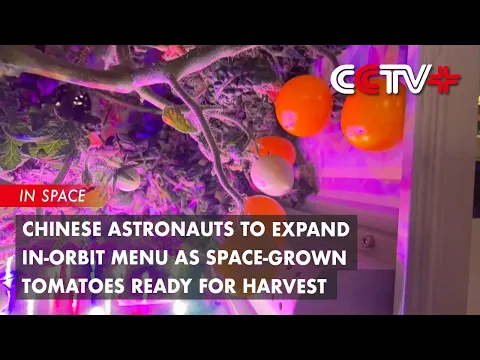

Space Agriculture Advances With Plans for Wheat, Carrots, and Medicinal Plants at the Tiangong Station
The experiment with tomatoes is just the beginning. According to the report released, future plans for the Tiangong “space garden” include aeroponic tests with wheat, carrots, and species of medicinal plants. Thus, the diversity of sustainable crops in the orbital environment is expected to progressively increase.
At the same time, scientists on Earth are using the orbital facility to investigate multiple aspects of space agriculture, such as more efficient cultivation methods, productivity of fruits and vegetables, the capacity of plants to regenerate the atmosphere, and optimized crew management protocols. Therefore, the project involves both agronomic analysis and physiological and operational assessment.
Meanwhile, the astronauts’ routine includes daily care of the plants and detailed recording of growth data. According to astronaut Wu Fei, each stage of the tomato development is monitored precisely. He emphasized that this information will be a valuable reference for food cultivation in space in the future.
Aside from the technical aspect, there is also a significant psychological impact. Wu Fei described the fresh aroma of ripe tomatoes as a true sensory gift amid the metallic environment of the space station. And astronaut Zhang Lu stated that seeing a “vibrant touch of green” in the vast spatial scenery has a therapeutic effect and strengthens the team’s confidence to fulfill the upcoming experimental tasks.
Launched on October 31, 2025, the Shenzhou-21 crew mission has already surpassed 100 days in space. According to the China Manned Space Agency, all tasks—including scientific experiments, equipment maintenance, and astronauts’ health management—are progressing steadily and efficiently.
Thus, the harvest of tomatoes at the Tiangong station symbolizes more than an agricultural advancement. It represents a concrete step toward food self-sufficiency in long-duration space missions, consolidating China as a leading player in the race for sustainable space exploration.
Do you believe that space agriculture will be essential for human survival in future missions to Mars and beyond, or are we still far from making cultivation in space a sustainable reality?





O ser humano está descobrindo formas de sobrevivência e e outras formas de cultivo e extraçao de tudo que estiver no seu radar até vidas Estraterrestre estamos no caminho certo dentro de cem anos em 2100 eu acho que essa tecnologia vai apresentar resultados .
Como seria chamado uma criança que nascesse na Lua? Aqui na terra chamamos de terrestre, e na Lua.
Selenium.
Si nace en luna , llamemosle lunático y cómo la fuerza de gravedad es menor es mas descansado llevarlo a upa
Sul global é uma definição Geopolítica.