






 Portuguese
  Spanish


Technology based on the armadillo creates an automatic barrier to protect electronic equipment from impacts and damage.
The armadillo has become a source of inspiration for one of the most innovative technological researches of recent times. Scientists from North Carolina State University in the United States have developed a system capable of protecting sensitive electronic equipment against physical impacts — and the great differential is that it acts on its own, without relying on any human instruction.
The study was published in the scientific journal Science Advances and paves the way for applications in areas such as space exploration, search and rescue, and wearable technology.
The proposal, presented by specialists from the Department of Mechanical and Aerospace Engineering at the institution, may in the future be applied to robots, wearable devices, and equipment intended for extreme environments.
-
Pennsylvania Mine Creates Ice in Summer Heat and Melts in Winter, Turning a Mountain Crevice into a Reverse Natural Refrigerator

-
China Accelerates Global Expansion of Robotics: From Smart Vacuums to Industrial and Humanoid Machines, Millions Exported to Over 150 Markets
-
Polar Air Mass to Hit Brazil: Temperatures to Plummet in Nine States, Near Freezing in the South with Frost Risk Until Monday
-
Chinese “dark factories” produce electric cars 24/7 with minimal human intervention, as Zeekr assembles 800 units daily, raising concerns in Brazil.




How did the armadillo inspire the new technology?
The starting point of the project was the survival strategy used by the armadillo in the face of predators and other threats.
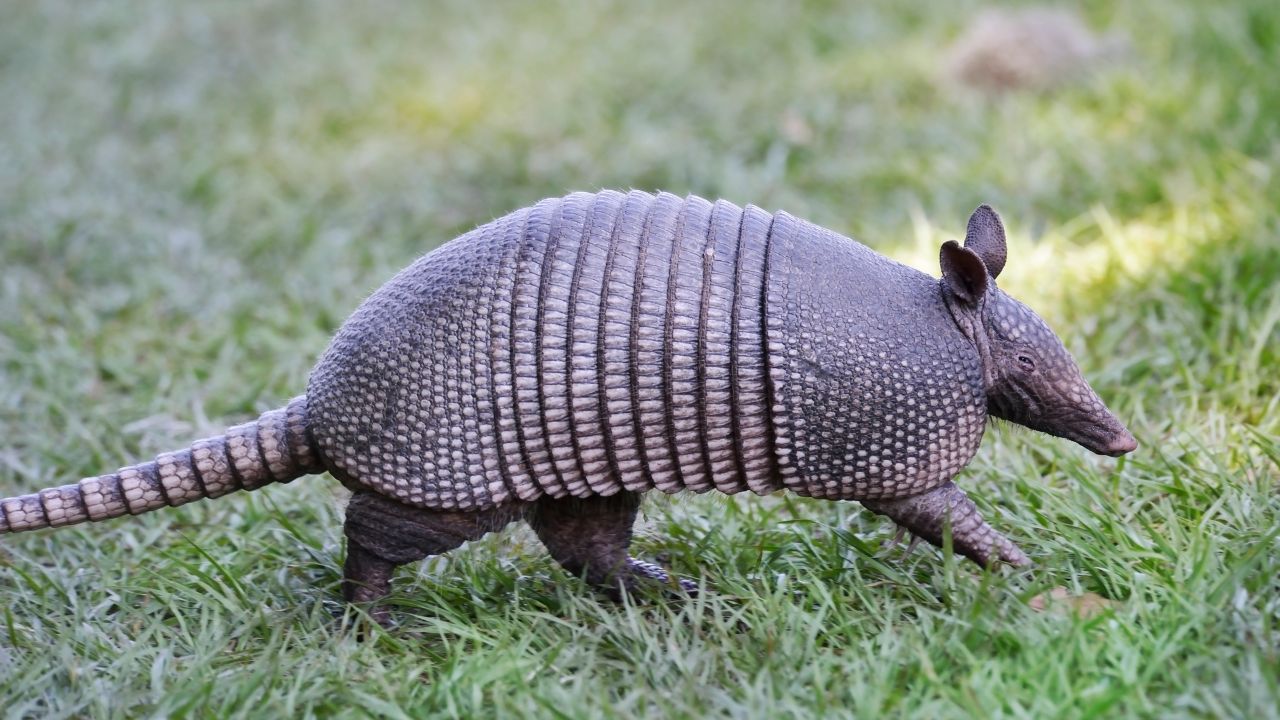
When it senses danger, the animal quickly changes its body position until it forms a sphere protected by external rigid plates. At the same time, its internal structure helps maintain the closed shape, reducing the exposure of the most vulnerable parts.
From this observation, the researchers sought to reproduce the same principle in an artificial system capable of protecting sensitive electronic components.
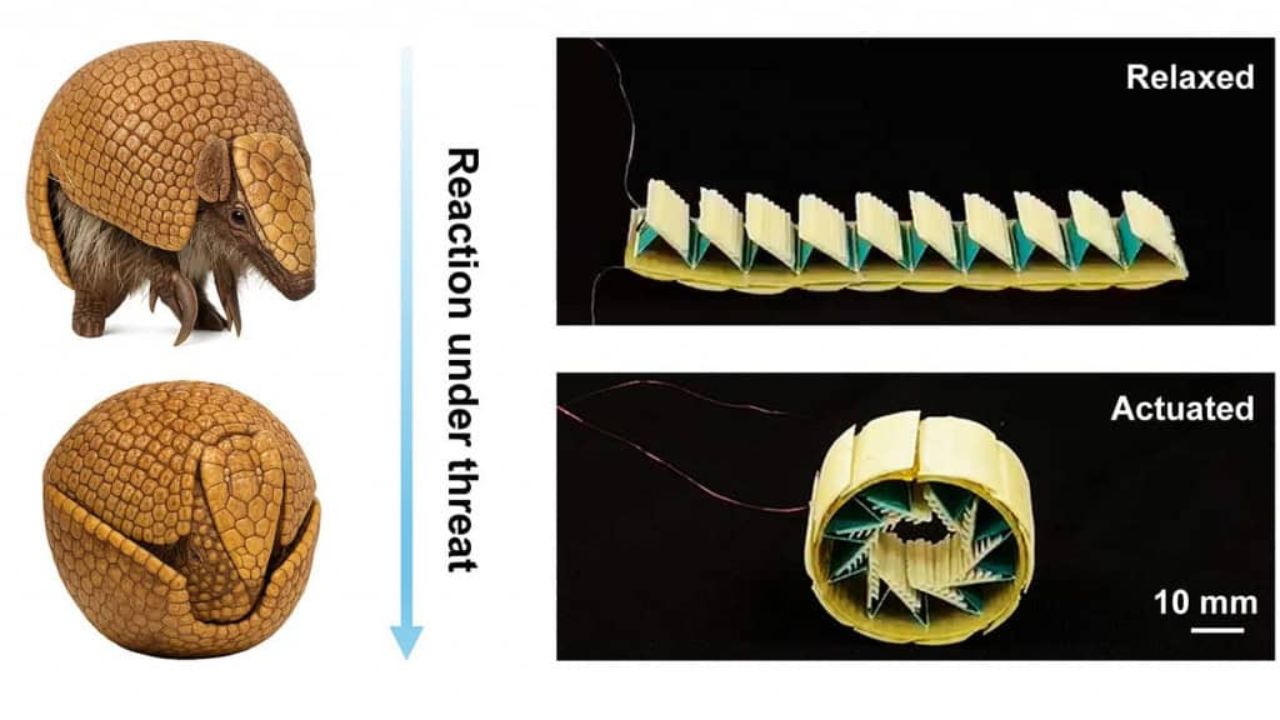
The result was the development of a mechanism called a morphologically interlocking protection module, designed to change its shape automatically when subjected to an external force.
Structure combines sensors and movable components
To reproduce the behavior observed in the armadillo, the team combined different elements into a single solution.
The system integrates:
- Sensors capable of identifying impacts;
- Structural components responsible for protection;
- Elements that promote the automatic movement of the structure;
- Control and power supply devices.
The external part is made up of segments produced by 3D printing using resin. In tests conducted by researchers, a set composed of ten of these pieces withstood about 10 newtons of force, a value equivalent to approximately 1.02 kilograms in terms of mass.
Meanwhile, the interior of the equipment houses the mechanisms responsible for detecting threats and initiating the protection response.
How the system reacts to impacts
The operation of the technology occurs in fast and integrated stages. Initially, a deformation sensor identifies the application of force on the equipment. This sensor was developed with elastic polymer and silver nanowires.
After detecting the impact, a controller activates a power source connected to an internal heating system. This set also includes materials such as liquid crystal elastomer, Kapton tape, and a conductive fabric responsible for generating heat.
The change in temperature causes alterations in the internal components. As a result, the entire structure gradually bends until it assumes a configuration similar to the sphere formed by the armadillo when it protects itself.
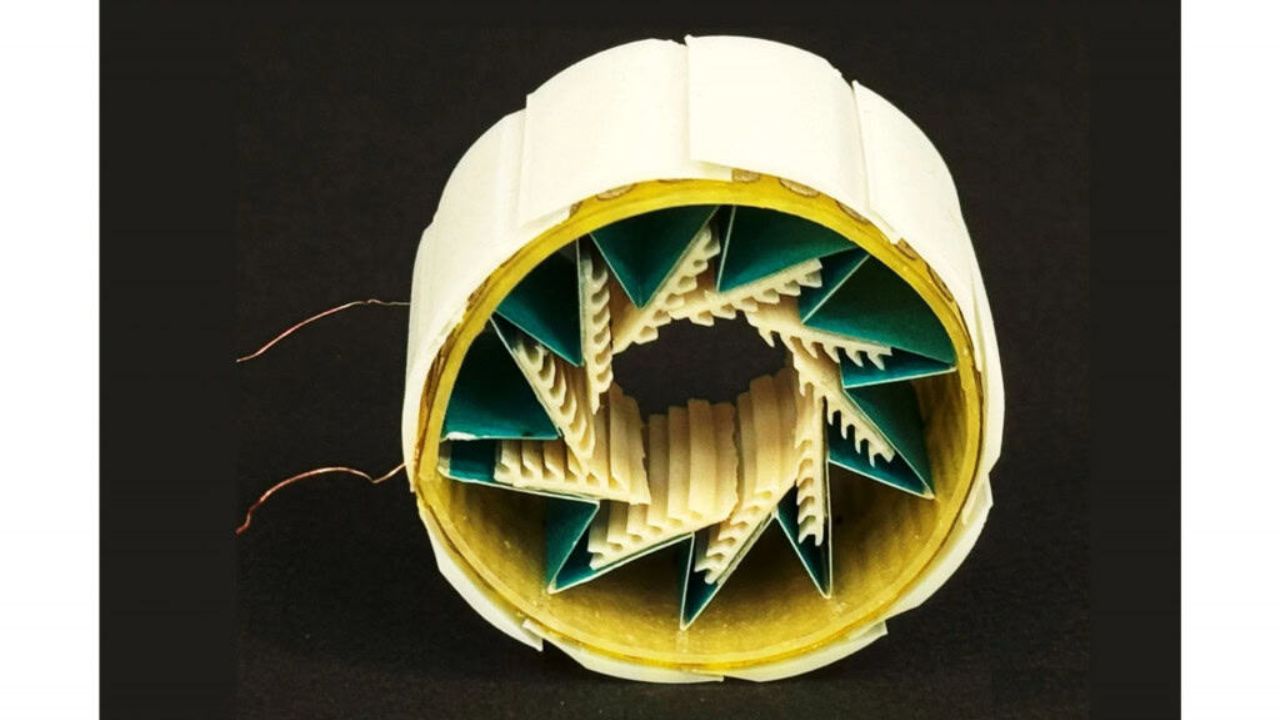
In this way, the equipment gains an additional physical barrier against external damage.
Challenges faced during development
The researchers had to deal with obstacles that do not exist in nature. In the armadillo’s organism, the internal structures remain organized in a way compatible with the complete closure of the body.
In an electronic device, however, various components need to remain separate to allow adequate movement during the transformation of the structure.
For this reason, the team had to find a solution that maintained enough space for the movement of the internal parts without compromising the operation of the protection mechanism.
According to the project leaders, this was one of the most important challenges during the development of the technology.
Tatu-bola and the potential for use in extreme environments
The tests conducted in a controlled environment indicated that the system can perform the proposed function efficiently.
However, the researchers emphasize that there are still steps to be completed before the technology can be used on a large scale.
Among the main challenges identified are:
- Ensuring sensor performance in extreme temperatures;
- Maintaining system stability in high humidity locations;
- Ensuring proper functioning in environments with a large amount of dust.
Additionally, the team intends to expand the communication capacity between the system components.
Next steps of the research
One of the future goals involves improving wireless communication resources. The researchers are studying ways to integrate technologies like Bluetooth to enhance the exchange of information between sensors and control systems.
This evolution could expand the versatility of the solution and facilitate its application in different types of equipment. According to the team, the technology inspired by the tatu-bola shows potential to be used in sectors that require resistance, lightness, and quick adaptation to adverse conditions.
Among the areas mentioned by the researchers are space exploration, search and rescue operations, and the development of wearable protective equipment.
Although further advances are still necessary, the results obtained so far indicate that the defense strategy used by the tatu-bola can serve as a basis for a new generation of systems capable of protecting electronic devices automatically and efficiently.
Source: Olhar Digital






