Portuguese
  Spanish


A recent study detected an invisible object passing near the Milky Way in an event that lasted about an hour, named Phoebe. It could be a primordial black hole in the galaxy’s halo or a wandering planet in the nearby Large Magellanic Cloud.
Astronomers spotted something invisible and unknown crossing the surroundings of the Milky Way at extremely high speed. The phenomenon, named Phoebe, lasted only about an hour and is described as one of the fastest and lowest mass signals ever detected in the history of astronomy.
The detection was made with a high-resolution camera installed in Chile, which captured the brightness of a star increasing smoothly and symmetrically for about 60 minutes. The object is so faint that it could not be seen directly: scientists only noticed its passage by the effect of its gravity on the light, a phenomenon called gravitational microlensing. The hypotheses range from a primordial black hole to a wandering planet.
How Phoebe was detected near the Milky Way
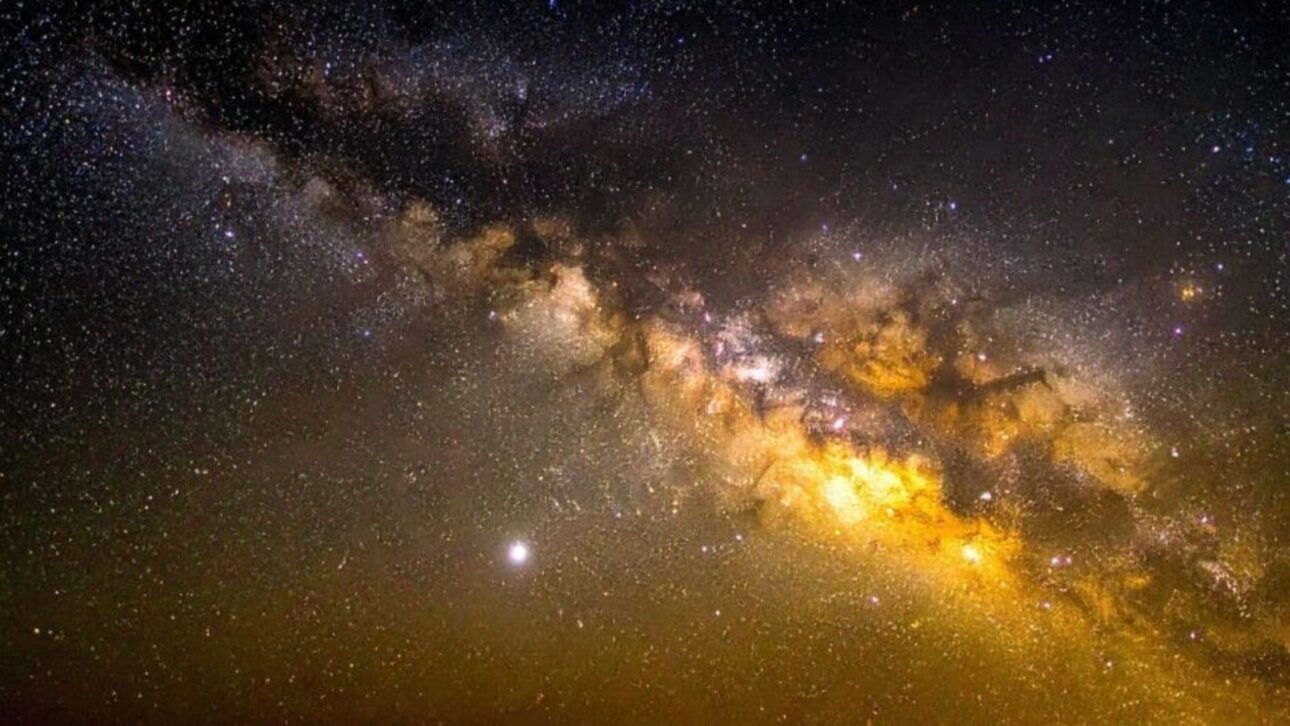
The sighting happened in December 2019, when an international team used the DECam camera, installed on the four-meter Blanco telescope at the Cerro Tololo Observatory in Chile.
-
Ultrasound Body Scanner Promises Full-Body Mapping in 60 Seconds Without Radiation or Contrast, Enhanced by AI for a Faster, More Comfortable Preventive Exam Experience

-
In the US, researchers attached iPhones to a $25 grabber, turning 22 homes into a database to teach robots to open drawers and handle objects like humans.

-
IBM Breaks 1-Nanometer Barrier with 0.7 nm Chip Featuring Nearly 100 Billion Transistors and 3D Architecture, Promising AI Revolution

-
Apple Raises MacBook and iPad Prices as Memory Costs Surge by Up to 98%, Losing Edge Over Rivals and Highlighting AI Boom’s Impact on Consumers


For five nights, the researchers photographed about 10 million stars in the Large Magellanic Cloud every minute, searching for small increases in brightness that would indicate the passage of an invisible object. It was in this way that, on a single night, they found Phoebe.
The event was quick and did not repeat. According to the study, published in the Monthly Notices of the Royal Astronomical Society (MNRAS) and led by researcher Renee Key, it is one of the fastest and lowest mass microlensing signals ever recorded, with a characteristic duration of about 60 minutes.
The name Phoebe is not by chance: it combines the English acronyms for “free-floating planet” and “primordial black hole,” precisely the main hypotheses about what crossed the surroundings of the Milky Way.
A primordial black hole in the halo of the Milky Way?
The statistical analysis provides a strong clue. According to the authors, the object is five orders of magnitude, or about 100,000 times, more likely to belong to the dark matter halo of the Milky Way than to the star content of our galaxy or the neighboring one.
Therefore, the main hypothesis is that Phoebe is a primordial black hole, considered by scientists to be the best candidate ever found for this type of object.
A primordial black hole is a hypothetical object that would have formed in the first moments of the Universe, right after the Big Bang, and not from the collapse of a star. It is one of the main candidates to explain the mysterious dark matter.
In this scenario, Phoebe would have a mass equivalent to about three times that of our Moon, or just 0.032 times the mass of the Earth, and would be among the oldest objects ever detected, wandering in the dark for billions of years.
Or a wandering planet in the Large Magellanic Cloud?
According to information from the NSC portal, there is, however, an alternative explanation. If Phoebe is located in the Large Magellanic Cloud, a neighboring galaxy situated about 163,000 light-years away, its mass would be much greater, around 0.1 times that of our Sun.
In that case, it could be a wandering planet, meaning a world that does not orbit any star and roams alone through space, or a low-mass object.
This possibility would also be historic. If confirmed as a wandering planet in the Large Magellanic Cloud, Phoebe would be the first extragalactic exoplanet discovered by this method.
The decisive clue lies in the duration of the event: the lighter the object, the faster it crosses the line of sight and the shorter the flash, which helps scientists estimate which scenario it approaches.
Why it is difficult to confirm and why it matters
The big problem is that microlensing events like this do not repeat, making it almost impossible to confirm with certainty the nature of Phoebe.
Before arriving at the hypotheses, the team needed to rule out equipment failures, stellar explosions, and contamination from other stars. Even so, it is still a single episode, observed for about an hour, near the Milky Way.
Caution is advised: the primordial black holes have long been considered a fringe idea and have come back into fashion as searches for dark matter remain unanswered, but concrete evidence of their existence is still scarce.
On the other hand, a Japanese team recently reported 12 similar events in the direction of the Andromeda galaxy, some possibly caused by similar objects in the halo of the Milky Way.
If confirmed, Phoebe could help understand what dark matter is made of, whether as a rogue planet or as an ancient primordial black hole.
An invisible object traversing the Milky Way, which could be either a black hole from the beginning of time or a rogue planet, is the kind of mystery that shows how much there is still to discover in the Universe.
Tell us in the comments which hypothesis about Phoebe you find most likely and what else you would like to understand about dark matter.