Portuguese
  Spanish


With 90 years of history and 100% Brazilian capital, Grupo Zaffari uses the experience accumulated in supermarkets to compete in the billion-dollar shopping mall market. The gaucho network earned R$ 8.8 billion just from markets in 2025 and bets on proximity retail to face large national administrators.
The secret of Grupo Zaffari to face the giants of shopping malls is not in copying them, but in something the gaucho network has been doing for nine decades: operating supermarkets. According to a report by Exame, the company transformed the accumulated knowledge in monthly shopping into a strategy to compete in one of the most concentrated markets in the country.
The logic is simple to state, but difficult to copy. Instead of treating the supermarket only as an anchor to generate flow, Zaffari places it at the center of the shopping experience, betting that the modern consumer wants to solve several tasks in one place. It was this retail vision that helped the network differentiate itself in a sector dominated by large administrators.
A 90-year-old gaucho network that became a national force
With 90 years of history and fully Brazilian capital, Grupo Zaffari employs about 12,000 employees and operates 43 stores in Rio Grande do Sul and São Paulo, including supermarkets, wholesale clubs, and shopping malls. It is a structure built over decades, with food retail always at the heart of the business.
-
As Homeownership Becomes Unattainable in Brazil, Japanese Municipalities Offer Abandoned Houses for as Low as $3,000 to Revitalize Aging, Emptying Cities

-
Job Market in 2026 Welcomes High School Graduates: Logistics, Retail, and Construction Hire Without College Degrees; Quick Courses in Forklifting, Building Electricity, and Welding Boost Salary Prospects

-
Brazil’s ANP Reforms Natural Gas Market, Opens LNG Terminals and Pipelines to More Companies, Raising Hopes for Lower Future Bills

-
Brazilian Government Allows Workers to Use Severance Fund as Loan Collateral, Caps Interest at 1.99% Monthly


The numbers reinforce the weight of the operation. The company closed 2025 with a turnover of R$ 8.8 billion only in supermarket activity, according to the ranking of the Associação Gaúcha de Supermercados (Agas). The revenue generated by the shopping malls is not disclosed by the company, but the basis of everything remains the sale of products on the supermarket shelves.
The entry into São Paulo as a major test
When Zaffari arrived in São Paulo in 2008, the move seemed like just the natural expansion of a southern network. Almost 20 years later, director Claudio Luiz Zaffari revealed to Exame that there was a greater objective behind it: to test, in another state, a shopping mall model built from the retail logic of its own supermarkets.
The chosen venue was a historic property in the Pompeia neighborhood. The former Matarazzo Shopping, built in the 1970s and connected to the city’s old industrial zone, had been purchased by the group at the end of the 1990s. After more than a decade of planning and construction, Bourbon Shopping São Paulo was born, with the Zaffari supermarket as the main anchor, a feature that would help differentiate the group in the São Paulo market.
A Shopping Center Designed from the Consumer’s Perspective
The transformation of Bourbon São Paulo began long before its inauguration. It took 11 years between the acquisition of the former development and the opening in March 2008. The project expanded a structure of about 40,000 square meters to a complex of 200,000 square meters of built area, now with 44,600 square meters of gross leasable area, 200 stores, and an average flow of 1.2 million people per month.
More than just size, the bet was on reading the future. Zaffari states that it was not enough to create a shopping center for the opening day, but rather to understand what that community would need from then on, following the transformation of Pompeia into one of the most valued hubs in the west zone. To win over the São Paulo public, the group brought its supermarket DNA, with strong value on the product, service, and environment, and added convenience, services, and entertainment.
Gastronomy and Entertainment as Differentials
Adapting to São Paulo required going beyond the supermarket. The group installed the Bradesco Theater in the development, with 1,439 seats, and the first IMAX theater in Brazil, betting that culture and leisure would be part of the routine for those who frequent the space. The intention was for people not just to shop, but to address various aspects of their day.
Gastronomy became another pillar. According to Zaffari, São Paulo residents have an intense relationship with restaurants and the habit of dining out, which required a different offering from the shopping centers in the south. Today, alongside the supermarkets, the complex includes establishments like Outback, Coco Bambu, Abbraccio, Almanara, and Andiamo, as well as fashion and retail brands like Zara, Renner, C&A, Sephora, and Fast Shop.
A Billion-Dollar and Highly Concentrated Sector
The market in which Zaffari decided to invest moves enormous figures. According to the Brazilian Association of Shopping Centers (Abrasce), the sector earned R$ 200.9 billion in 2025, the highest volume ever recorded, with 658 developments in operation, 18.3 million square meters of gross leasable area, and about 471 million visitors per month.
This is a field dominated by large groups like Iguatemi, Multiplan, and Allos, owners of some of the country’s main assets. It is against this platoon that the gaucho network decided to compete, not by the number of square meters, but by the accumulated experience in supermarkets and by understanding the behavior of those who do the monthly shopping.
The logic of the supermarket inside the mall
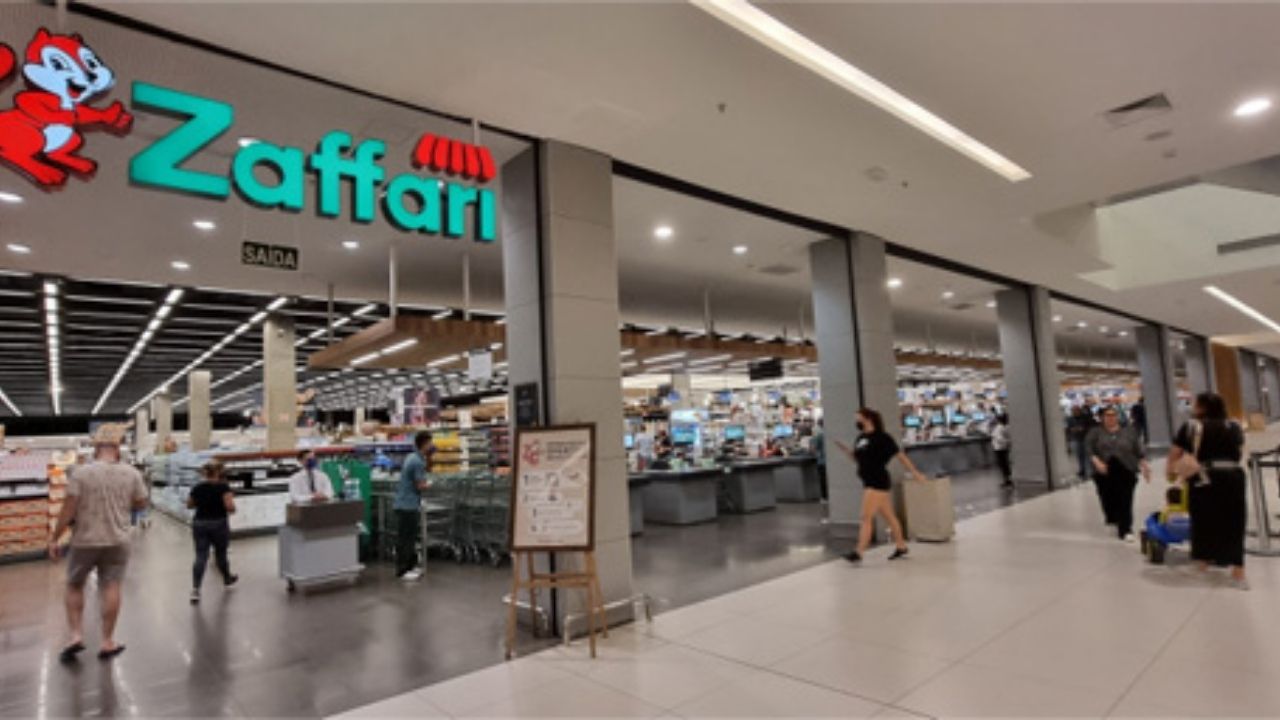
The big difference in the Zaffari model lies in how it views the role of the market. In many sector groups, the supermarket is just an anchor to attract people. At Zaffari, it is a central part of the value proposition. For the director, the combination of market and mall responds to a change in consumer behavior, who has little time and wants to find a supermarket, pharmacy, food, services, and leisure in the same place.
This concept reappears in the company’s new projects. The Bourbon Carlos Gomes, inaugurated last year in Porto Alegre, follows the same line by bringing together supermarkets, stores, restaurants, and corporate towers. For Zaffari, there is no ready-made formula: each location requires its own reading of the surroundings and the community living there. Today, the group manages 14 malls, 12 under the Bourbon brand, in addition to Moinhos Shopping and Shopping CenterLar.
Expansion and the dispute for space in Pompeia
The consolidation of Bourbon São Paulo paved the way for new steps. The company bought more than 20 plots in the region and is preparing an expansion of the complex, with commercial spaces on the other side of Palestra Itália Avenue, connected to the mall by a walkway. The move shows the group’s ambition to qualify the entire surrounding area.
The plan even involves a neighborhood symbol: the traditional Pastelaria Brasileira, founded in 1975 and known for its hustle on Palmeiras game days at Allianz Parque. To enable the construction, Zaffari negotiated a swap, and the establishment will gain a new, larger unit a few meters from the current address, preserving the operation in the neighborhood. For the executive, a mall does not live on what it did yesterday and needs to reinvent itself every day, the same principle that governs its supermarkets.
Now we want to know your opinion. Do you prefer malls with an integrated supermarket, solving everything in one place, or do you find this model tiring? Can regional brands like Zaffari really take on the national giants?
Comment below what you think, tell us about your relationship with supermarkets, and share this article with those who follow Brazilian retail.