Portuguese
  Spanish


The job market in 2026 favors candidates with high school education in logistics, retail, and civil construction. Quick courses in forklift operation, building electricity, and welding can improve the competition for jobs, reduce competition in basic roles, and pave the way for higher salaries without requiring a university degree in formal Brazil.
The job market in 2026 continues to open up opportunities for professionals who have only completed high school, especially in sectors such as logistics, retail, civil construction, general services, and administrative support. This movement occurs in Brazil, in a scenario where companies still seek operational workforce to maintain inventories, deliveries, customer service, and production routines.
According to the Market Monitor, in June 2026, the difference is that just having basic education no longer guarantees an advantage in all selection processes. With automation in repetitive tasks and the expansion of national logistics, workers who take quick courses in areas such as forklift operation, building electricity, and welding can compete for better positions, reduce direct competition, and increase the chances of earning above the simplest jobs.
High school still opens doors, but does not work alone
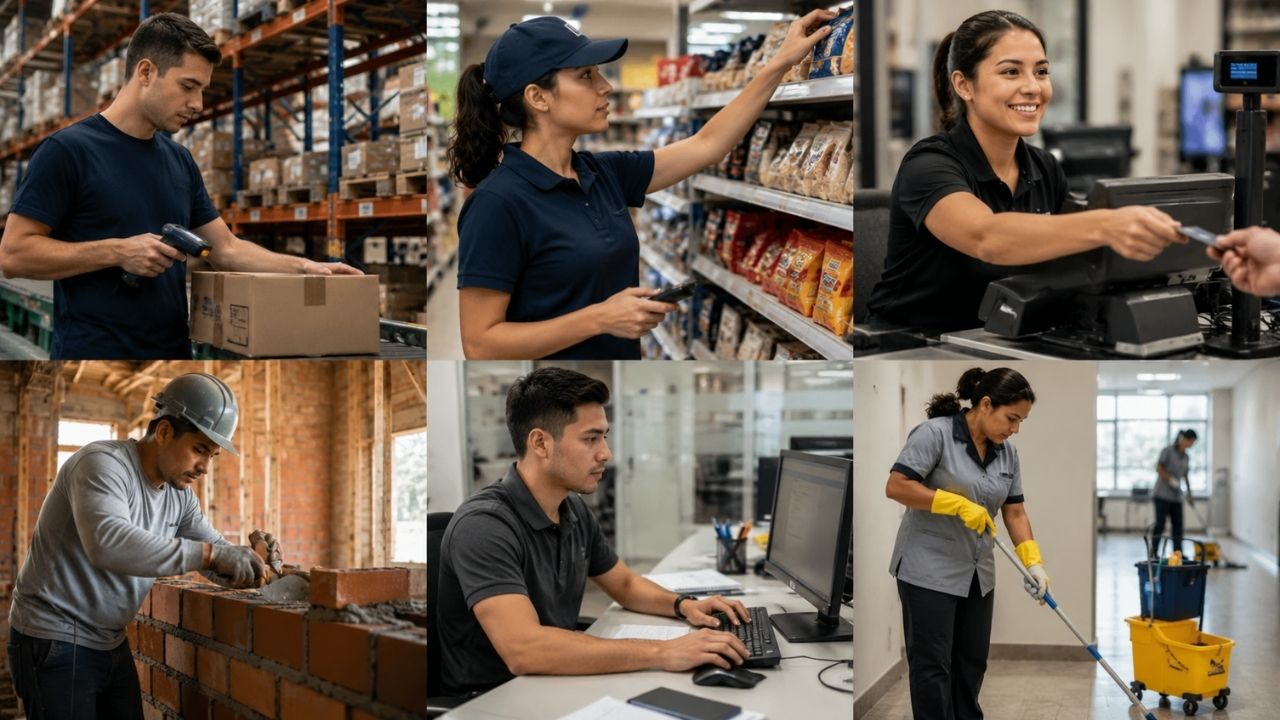
Having a complete high school education continues to be a sufficient requirement for various operational roles. Logistics assistant, checker, stocker, cashier, construction helper, administrative assistant, and general services worker are examples of occupations that usually appear in selection processes without requiring a university degree.
-
As Homeownership Becomes Unattainable in Brazil, Japanese Municipalities Offer Abandoned Houses for as Low as $3,000 to Revitalize Aging, Emptying Cities

-
Brazil’s ANP Reforms Natural Gas Market, Opens LNG Terminals and Pipelines to More Companies, Raising Hopes for Lower Future Bills

-
Brazilian Government Allows Workers to Use Severance Fund as Loan Collateral, Caps Interest at 1.99% Monthly
-
Brazil to Enforce New Rules on Betting Ads for 2026 World Cup, Mandating Warnings on Addiction and Financial Risks


But the job market has changed the way it evaluates candidates. Companies not only look at education but also behavior, agility, organization, communication, and the ability to learn practical tasks. Those who demonstrate readiness for the company’s real routine tend to get ahead, even when competing for positions with people who have similar qualifications.
Logistics grows with demand for inventory, delivery, and transportation
Logistics appears as one of the strongest areas for those with a high school education. The sector needs assistants, checkers, and professionals capable of handling inventory control, merchandise separation, cargo handling, warehouse organization, and transportation support.
This type of position usually requires attention, discipline, and responsibility with deadlines. In larger companies, advancement can occur within the operation itself, with the worker moving from basic functions to roles in checking, team leadership, or yard control. The routine can be demanding, but it also creates practical experience valued by other companies.
Retail still absorbs many people without a college degree
Retail continues to be an important entry point in the job market, especially for those seeking their first job or trying to return to formal activity. Cashiers, stockers, attendants, and store assistants remain common roles in supermarkets, stores, shopping centers, and service networks.
In these positions, communication and agility are crucial. The worker needs to deal with customers, store pace, internal goals, product organization, and pressure for quick service. Even without requiring a college degree, the sector values professional demeanor. Those who learn to solve problems, provide good service, and maintain consistency can advance to supervisory roles.
Civil construction maintains demand for operational roles
Civil construction also remains a path for those with a high school education or even basic schooling, depending on the role. Helpers, bricklayers, laborers, construction assistants, and support professionals are still needed in renovations, residential works, commercial projects, and maintenance services.
In this sector, practical experience counts a lot. Workers who learn to handle tools, safety, site pace, and teamwork tend to gain value over time. Construction can start as an entry-level position, but qualification in electrical work, welding, or basic project reading can change the professional level.
Short courses can improve the competition for salary
Short-term courses act as differentiators because they connect the worker to specific skills. Forklift operation, building electricity, and welding are examples cited as training that can expand opportunities in operational and technical areas.
These courses do not replace a degree, but they can be faster, cheaper, and more objective for those who need to work soon. In the job market of 2026, this practical training can help the candidate avoid highly competitive positions where everyone presents the same basic profile. Short specialization creates a concrete reason for the employer to look more closely at the resume.
Forklift, electrical, and welding have practical appeal
Forklift operation is valued in distribution centers, warehouses, carriers, and industries. As it involves load movement and safety, the role requires specific training and responsibility. For those already working as logistics assistants, this qualification can open up a more interesting professional stage.
Building electricity and welding also appear as paths with potential. Electricity connects to maintenance, construction, and renovations; welding can serve industry, construction, and technical services. These are skills that solve practical problems, so they tend to have more value than generic training without direct application.
Free programs can bring candidates closer to job openings
Educational institutions, public agencies, and partnerships with industrial unions can offer free or low-cost courses for young people and adults. These training paths help those who need to enter the job market faster, especially when the classes simulate real company tasks.
The main point is to seek training with clear application. A course that delivers certification, practice, and contact with regional demands tends to be more useful than training without connection to local job openings. When the qualification aligns with the needs of companies, the resume ceases to be just education and starts to show preparedness.
Lack of college does not prevent growth, but requires strategy

Not having a university degree does not mean staying at the bottom forever. In logistics, retail, and construction, many careers begin in simple roles and advance with experience, confidence, and performance. Store supervisors, stock leaders, and construction managers often know the operation because they started in it.
However, evolution does not usually happen by chance. The worker needs to accumulate practice, maintain a good reputation, learn internal processes, and seek small certifications. In the job market, growth without a college degree depends heavily on consistency, delivery, and the ability to take on responsibility.
Automation changes tasks, but does not eliminate all jobs
Automation has transformed operational processes, especially in logistics, retail, and administrative areas. Inventory systems, digital checkouts, control software, and support machines reduce some repetitive tasks but also create the need for workers capable of operating, monitoring, and resolving simple failures.
Therefore, the best strategy is not to ignore technology but to learn to coexist with it. Those with basic knowledge of systems, digital organization, and professional communication tend to adapt better. The worker who combines manual skills with a minimal understanding of technology is less vulnerable to changes.
What to consider before choosing an area?
Before seeking a job or course, it’s worth looking at the reality of the region. Cities with distribution centers tend to drive logistics. Places with real estate expansion may open more space in construction. Strong commercial areas usually demand retail, customer service, and support services.
It’s also important to evaluate personal profile. Those who like movement and organization may fit better in logistics; those who are good with the public may go into retail; those who accept physical and practical routine may find space in construction. Choosing an area compatible with one’s own profile increases the chance of staying and growing.
The resume needs to show role, skill, and availability
For those with high school education, the resume should be straightforward. Instead of just listing education, it’s better to highlight quick courses, practical experience, availability, basic knowledge in systems, ease of service, organization, and roles already performed.
The job market values clarity. A recruiter needs to quickly understand where that candidate can be placed. If the person is seeking logistics, they should highlight inventory, checking, movement, or forklift course. If seeking construction, they should highlight work, maintenance, tools, or electrical. A resume that is too generic can make the candidate disappear among many similar ones.
In 2026, high school still opens doors, but the best chances tend to appear for those who combine basic education, a quick course, and professional demeanor. Logistics, retail, and construction remain relevant for those without a college degree, but the key is to demonstrate readiness for practical roles and a real possibility for growth.
Do you believe that quick courses can replace part of the importance of college in some areas, or does a university degree still carry more weight when hiring? Tell us in the comments if you have already managed to improve your position or salary after a short qualification.