Portuguese
  Spanish


The Simple History narrative explains the secret base of 100,000 soldiers in Vanuatu, the 3 post-war options, and the morning when tractors pushed a fortune into the ocean
On a quiet morning in September 1945, the residents of a remote Pacific island woke up to a scene they would never forget: American soldiers using tractors to push mountains of valuable equipment straight into the sea. According to the Simple History channel, in a video published in August 2025, tanks, trucks, jeeps, crates of rifles, artillery pieces, typewriters, sewing machines, new boots, and even shiny bottles of Coca-Cola rolled down the sands of Espiritu Santo, in the Vanuatu archipelago, and sank into the blue of the Pacific.
To the astonished locals, the war winners seemed to have gone mad. The dumping site would be named Million Dollar Point, a reference to the millions of 1940s dollars swallowed by the waves, an inconceivable fortune in today’s values, as narrated by Simple History. The explanation for the apparent madness is a lesson in war economy.
The Buttons base: 100,000 soldiers on a jungle island
To understand the waste, one must understand the previous excess. According to Simple History, between 1942 and 1944, in the island-hopping campaign against Japan, the USA and its allies dumped an almost absurd amount of war material on Espiritu Santo, a jungle island with turquoise blue water that became one of the most supplied points in the entire Pacific theater.
-
WHO Warns of Unnecessary Interventions in Natural Births Worldwide, Advocates for More Human-Centered Care, Reigniting Debate on Medicalization

-
World War II American Bombs Discovered in German City Prompt Evacuation of 20,500 Residents

-
World’s Largest Ice Cave Extends 42 km Beneath Austrian Alps, Revealing a Vast Frozen Realm Preserved by Natural Air Currents

-
Volcanic Soils from Destructive Eruptions Turn into Million-Dollar Crops: Ashes Nourish Grapes in Lanzarote, Bananas in the Canary Islands, Blood Oranges on Mount Etna, and Cacti in Mexico, Showcasing How Lava-Formed Lands Sustain Rare Harvests in Seemingly Barren Regions


The base nicknamed Buttons was born from nothing. The Americans cleared the jungle, paved several runways, erected barracks, mess halls, and even a cinema, with a shipyard that managed 100 naval vessels and a force of 100,000 soldiers at its peak, as described by Simple History. Throughout the war, half a million American military personnel passed through the island, which was bombed only once, with a single casualty: a cow named Bossy.
The post-war problem: return, dismantle, or sell
When the guns fell silent in 1945, the question that no one wanted to answer remained. According to the Simple History channel on YouTube, there were 3 options for the tropical island cluttered with equipment: take everything back, dismantle it on site, or sell it to whoever wanted it.
Each path had a veto. Taking it back was prohibitively expensive, with scarce ship space, months of operation, and the risk of the flood of jeeps and cheap tools crushing the American industries returning to civilian production; dismantling was too slow, because tanks and trucks were too robust; and selling became the fastest way out, as Simple History explains. Buyers from Australia, New Zealand, and New Caledonia managed to take tools, generators, and even armored vehicles at rock-bottom prices, to the delight of the soldiers, who with each sale were closer to home.
The wrong bet of the English and French
The dramatic outcome was born from a colonial arm-wrestling. According to Simple History, the British and the French, who administered the then New Hebrides, now Vanuatu, received the offer to buy everything for 6 cents on the dollar of value, a total liquidation price.
Greed overcame common sense. The Europeans stalled, betting that the Americans would eventually give up and leave the equipment for free, and the calculation proved to be a gigantic mistake, as Simple History recounts. On the other side, troop morale plummeted, letters from families piled up, and some soldiers even refused to work until they were repatriated. The pressure to resolve the surplus was no longer just logistical: it was political.
The D-day of waste: the birth of Million Dollar Point
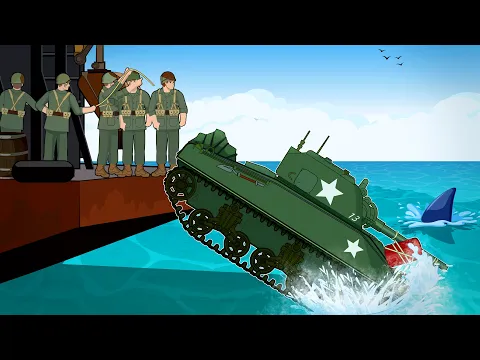
The American response came in the form of a spectacle. According to Simple History, on a clear morning in September 1945, tractors roared and, one by one, trucks, jeeps, tanks, cranes, and even sealed boxes of Coca-Cola were pushed from the beach line into the Pacific, with the water bubbling as the sea swallowed the fortune.
The message crossed the ocean without needing a telegram. If you won’t buy, no one will get anything: that was the message to the Europeans, as Simple History summarizes. The locals, wide-eyed, watched history sink in front of them and gave the place the name that stuck: Million Dollar Point.
The disposal menu gives a measure of the absurdity. On the same day, combat vehicles that cost tens of thousands of dollars at the time, construction cranes, entire workshops in boxes, and the stock of soft drinks that would supply months of canteen, all practically new, went to the bottom. No battle destroyed as much American material on the island as that single morning of peace.
The spoils that transformed Vanuatu
Not everything went to the bottom. According to Simple History, the Americans left behind airstrips, docks, and roads, a gift of infrastructure that transformed the islands for decades after the war, in addition to civilian goods donated to the locals.
The local population made their own economic salvage. Materials were repurposed for fishing, house construction, and business openings, jeeps turned into agricultural equipment, and metal parts became tools, as recorded by Simple History. While the sea kept the tanks, the local economy kept what the tide didn’t take, a bounty that helped shape modern Vanuatu.
The pattern that repeated across the Pacific
The case of the island of Vanuatu was not isolated. According to Simple History, the American military repeated the process throughout the Pacific: part of the surplus ended up in the Philippines, Vietnam, and China, where vehicles were repurposed, but many islands saw their lagoons filled with jeeps, tractors, and even tanks.
Time gave the waste an unexpected ending. The rusted hulls turned into artificial reefs, attracting corals and a kaleidoscope of species, from starfish to turtles and reef sharks, transforming war machines into vibrant ecosystems, as described by Simple History. Marine biologists discovered that these structures stabilize sandy bottoms, prevent erosion, and help recover coral populations: accidental conservation projects built with war waste.
From waste to reef: the legacy and the 1972 law

The practice evolved from improvisation to policy with rules. According to Simple History, the Pentagon realized over the decades that ocean dumping was cheap and strategically useful, sinking obsolete armor as reefs or using them as live-fire targets, until warnings about lead, oil, and other chemicals led Congress to intervene in 1972 with the Clean Water Act, requiring complete cleaning and decontamination before any sinking.
The legacy today is both touristic and scientific. Divers from around the world swim through these underwater museums, filming jeeps covered in coral and gun turrets inhabited by clownfish and anemones, as shown by Simple History, and Million Dollar Point itself continues to receive visitors who descend into a surreal museum of war and waste. Brazilian readers are well aware of this vocation: wreck diving drives destinations like the coast of Pernambuco, proof that sunken iron becomes an attraction when the sea finishes the job.
The video reconstructs the Buttons base, the failed negotiation, and the morning when tractors pushed the fortune into the sea.
Million Dollar Point is the perfect involuntary monument to the post-war era: the meeting of military impatience, colonial greed, and an ocean that turned loss into a reef. Tell us in the comments: did the Americans do the right thing by sinking everything?