






 Portuguese
  Spanish


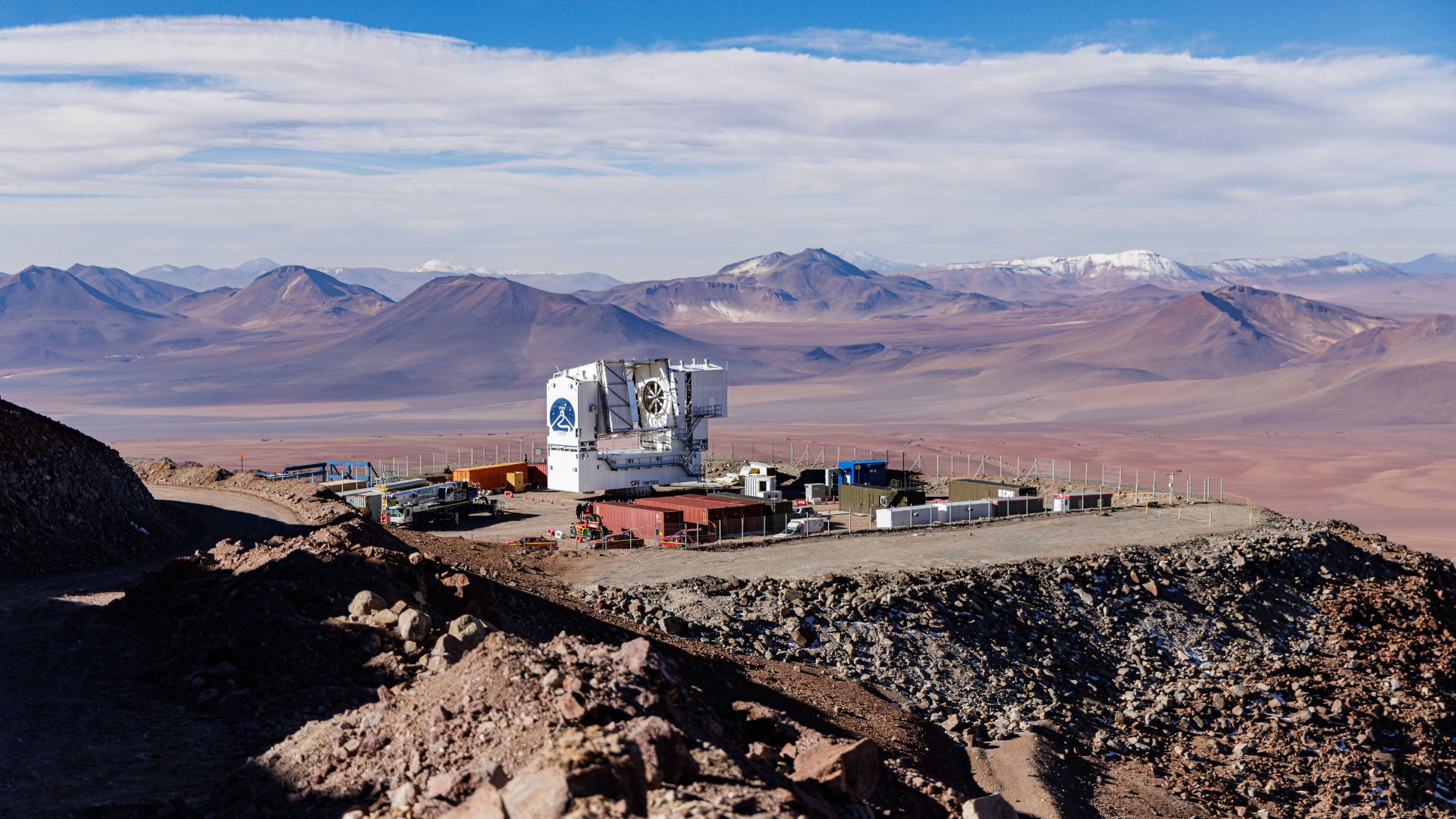


In one of the planet’s most extreme environments, a new generation of space observation emerges to capture invisible signals and reveal cosmic phenomena never before accessible to modern science
More than 5,600 meters above sea level, in the heart of the Atacama Desert, in northern Chile, a new chapter in global astronomy is beginning to be written. This is the Fred Young Submillimeter Telescope (FYST), considered the world’s highest submillimeter telescope, which is already in full operation and promises to revolutionize how we understand the universe.
The information was released by “Revista OESTE,” which detailed how this state-of-the-art instrument was installed on top of Cerro Chajnantor, one of the highest and driest points on the planet. This factor, incidentally, is not just geographical but strategic: the higher the altitude, the less interference from water vapor in the atmosphere — an element that can block extremely sensitive signals coming from deep space.
Furthermore, the arid environment of Atacama creates almost perfect conditions for astronomical observations, placing Chile among the world’s leading scientific hubs. Thus, FYST joins a select group of observatories capable of investigating the so-called cold universe, a cosmic region marked by extremely low temperatures and almost imperceptible signals.
-
James Webb Telescope Uncovers Unexpected Clues on Mysterious Moon, Potentially Redefining Planetary Origins

-
$1.5 Billion Sleipnir Vessel Transforms Ocean into Floating Construction Site with 12 Hybrid Engines and Capacity to Lift 20,000 Tons

-
23 Years After Tragedy, Brazil’s Alcântara Space Center to Launch New Suborbital Rocket in 2026 with South Korean SEBIT Project Targeting Near-Space Tests
-
Entrepreneur Turns Neighbor’s Coffee Grounds Waste into Eco-Friendly Pellets, Earning Up to $40,000 Monthly in Brazil


What makes the FYST submillimeter telescope a revolutionary tool in modern astronomy

First and foremost, it’s important to understand the central differential of this equipment: FYST is a submillimeter telescope, meaning it does not observe visible light like traditional telescopes. Instead, it captures radiation in the submillimeter to millimeter ranges, allowing it to analyze phenomena invisible to human eyes.
These frequencies are primarily emitted by extremely cold gas and dust, which are directly linked to fundamental processes of the universe, such as the birth of stars, the formation of galaxies, and even the remnants of the Big Bang.
With a mirror approximately six meters in diameter and a highly optimized optical design, FYST was developed to perform high-sensitivity mappings of large areas of the sky. This means it can identify large-scale cosmic patterns and structures, which is essential for cosmology studies.
Furthermore, its location above most of the atmosphere’s water vapor allows it to capture signals that simply would not be detected at lower altitudes. Consequently, the telescope significantly expands the ability to observe distant objects and ancient phenomena in the universe.
How FYST is helping to unravel the mysteries of the cold universe and cosmic formation

Unlike telescopes that focus on specific targets, FYST acts as a true “sky sweeper,” covering extensive areas and identifying regions that can later be studied in detail by other observatories.
In this context, the submillimeter telescope plays an essential role in providing initial data that guides deeper research. Among its main scientific objectives are:
- Investigating the formation of the first stars and galaxies, tracking signals from collapsing cold gas clouds
- Analyzing the cosmic microwave background radiation, which holds clues about the expansion of the universe
- Studying the distribution of dark matter and dark energy, elements still poorly understood by science
- Observing star-forming regions in the Milky Way, often hidden by dense dust clouds
Furthermore, these studies allow testing theories about the evolution of the universe based on increasingly precise observational data. Thus, FYST positions itself as a key piece in understanding cosmic history.
Integration with other observatories transforms Atacama into one of the planet’s largest scientific centers

Another crucial point is the integration of FYST with already established structures, such as the ALMA Observatory. While ALMA specializes in observing extremely small details with very high resolution, FYST excels at mapping large regions quickly.
This complementarity creates a true scientific ecosystem, where different telescopes analyze the same objects across various light bands — including radio, infrared, submillimeter, and visible.
As a result, scientists can obtain a much more complete view of the composition, temperature, and dynamics of celestial bodies. Furthermore, this collaborative approach enhances international observation campaigns and accelerates scientific discoveries.
International collaboration and educational impact strengthen global and Latin American science


Behind this ambitious project is a broad international collaboration involving institutions from Chile, Germany, Canada, and the United States, with partial leadership from Cornell University.
At the same time, the University of Chile plays a fundamental role in the telescope’s operation and in training new specialists. This includes training in areas such as instrumentation, data analysis, and scientific software development.
In addition, the project also promotes educational programs and opportunities for young researchers, especially in Latin America. In this way, FYST not only expands scientific knowledge but also strengthens the training of a new generation of scientists.
Finally, with its continuous operation, the telescope is expected to generate a massive volume of data, requiring multidisciplinary teams and consolidating the Atacama Desert as a true natural laboratory of the universe.


