Portuguese
  Spanish


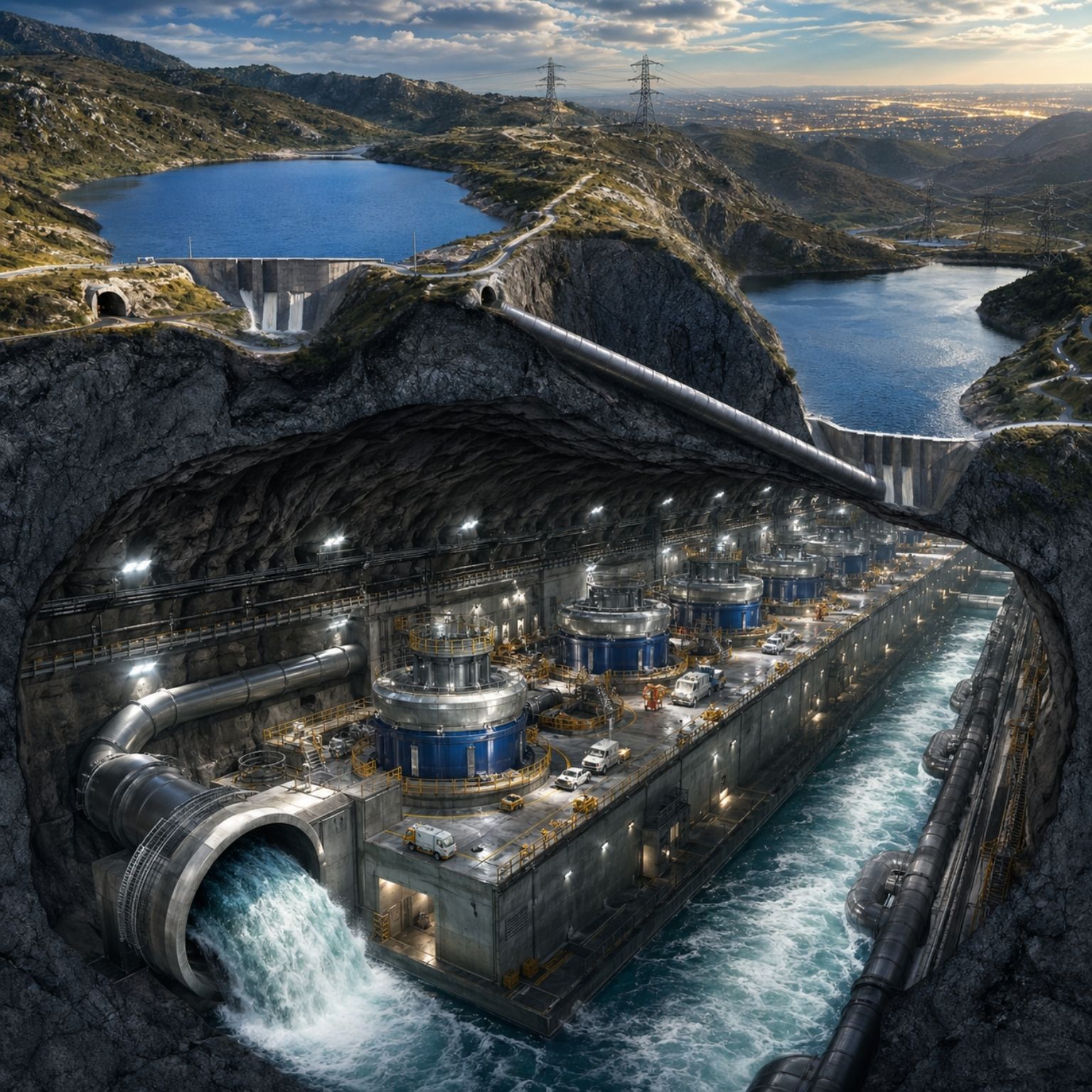

The Snowy 2.0 underground battery connects two dams over 27 kilometers of tunnels, installs a new hydroelectric plant about 800 meters below the surface, and prepares to become one of the world’s most ambitious energy projects, with long-duration storage essential for the expansion of wind and solar in the country
Australia is transforming two existing dams into a rare-scale underground battery in the electricity sector. The Snowy 2.0 project connects the reservoirs of Tantangara and Talbingo through 27 kilometers of tunnels and a new plant built approximately 800 meters deep in Lobs Hole.
The scale of the operation explains why it attracts so much attention. When completed, the structure will have 2,200 megawatts of capacity, deliver 350 GWh of storage, and be able to provide enough energy for 3 million homes for a week, functioning as a centerpiece of the Australian energy transition.
What is the underground battery that Australia is building
The Snowy 2.0 is the reversible pumped expansion of the historic Snowy Hydroelectric Scheme. In practice, the project functions as a large long-duration battery: it stores excess electricity generated by sources such as wind and sun and returns that energy to the grid during times of higher demand or when renewable production drops.
-
Cost of Installing Subflooring in 2026: The Importance of Proper Slope to Prevent Water Damage and Costly Repairs

-
New Offshore Borehole Mining Technique Extracts Lithium and Cobalt Without Damaging Ocean Floor
-
Vale Doubles Copper Drilling in Brazil’s Carajás, Plans to Drill 120 Kilometers of Rock by 2026
-
Innovative Vertical Cistern Becomes Water Tank in Container Home Amid Pressure Issues, Offering a Compact 1,000-Liter Solution Without a Tower or Underground Tank


This logic makes the project something different from a conventional power plant. Instead of just generating energy, it also stores electricity on a large scale, which helps stabilize the electrical system in a scenario with an increasing share of intermittent renewables.
How Snowy 2.0 will work in practice
The system will connect the reservoirs of Tantangara and Talbingo. At the center of the project, there will be a new underground plant equipped with six reversible turbines, capable of generating energy when demand is high and pumping water back to the upper reservoir when there is excess electricity from renewable sources.
This means that water will be continuously reused. It descends to generate energy during critical moments and rises again when the system has excess supply, forming a repeated cycle of storage and dispatch that transforms the two dams into a permanent support infrastructure for the grid.
The numbers that explain the scale of this project
The numbers of Snowy 2.0 place the project among the largest storage ventures on the planet. The capacity of 2,200 MW will be accompanied by 350 GWh of storage, a volume that represents more than half of the dispatchable storage needs projected by the Australian electricity market operator for the journey towards net zero by 2050.
Additionally, Snowy Hydro claims that the structure will have a lifespan of 150 years. This gives the project a weight that goes beyond the next decade, as it positions it as a strategic energy infrastructure asset for multiple generations.
Why the 27 kilometers of tunnels are so decisive
The 27 kilometers of tunnels are the backbone of the project. They will allow the hydraulic connection between the two reservoirs and the operation of the new deep plant, making it possible to move large volumes of water in a controlled manner between the two levels of the system.
Without this underground engineering, the concept of the long-duration battery would not exist. The tunnel transforms two separate dams into a single integrated energy arrangement, ready to store and release electricity as needed by the market.
What changes for the Australian electricity grid
The most direct effect of Snowy 2.0 will be to give Australia a source of long-duration storage and fast generation during critical moments. The plant has been designed to spring into action when energy supply is tight and also when intermittent renewable production is low.
In practice, this helps to keep the lights on in homes and businesses as more wind and solar parks enter the grid. The proposal from Snowy Hydro is precisely to allow a more reliable and lower-cost system, supported by deep storage instead of relying solely on instantaneous generation.
Why the project is treated as a central piece of the energy transition
Snowy Hydro itself defines Snowy 2.0 as essential for the renewable transition. The project was designed to absorb excess generation from wind and solar and return that energy at the times when the system needs it most, something that smaller batteries and shorter resources cannot always do at the same scale.
Therefore, the project appears as more than just a hydroelectric expansion. It serves as supporting infrastructure for an electrical system that will have an increasing share of variable sources, providing national-scale storage depth.
When the underground battery is expected to be ready


According to Snowy Hydro, the project is expected to be completed by the end of 2028. When this phase is reached, Snowy 2.0 is expected to become the center of the company’s on-demand dispatch power plants, enhancing energy supply and storage for homes and businesses.
This timeline also helps to gauge the scale of the project. It is not a quick intervention, but rather a megaproject of heavy engineering, underground and long maturation, designed to structurally change how Australia manages renewable energy and peak demand.
What makes Snowy 2.0 seem like a power plant and a battery at the same time
The comparison to a battery is not just rhetorical. The project combines typical energy storage attributes, such as storing excess electricity and returning it later, but does so using water, reservoirs, tunnels, and turbines instead of chemical cells.
At the same time, it maintains the scale and robustness of a large power plant. This combination is what makes Snowy 2.0 so relevant: it does not choose between generating and storing. It does both within a single large-scale underground infrastructure.
Why this project attracts so much attention outside Australia
Snowy 2.0 is described as one of the most complex and challenging engineering feats currently underway in the world. This is due not only to the depth of the plant and the size of the tunnels but also to the strategic role that the project aims to play in an increasingly renewable-dependent electrical grid.
When a single project promises to deliver 350 GWh, sustain 3 million homes for a week, and provide storage equivalent to tens of millions of residential batteries, it ceases to be just a national project and becomes observed as a global benchmark for long-lasting energy infrastructure.
In your view, are megaprojects like this underground battery the most realistic way to scale and stabilize renewable energy, or should the future rely more on smaller, distributed solutions?