






 Portuguese
  Spanish


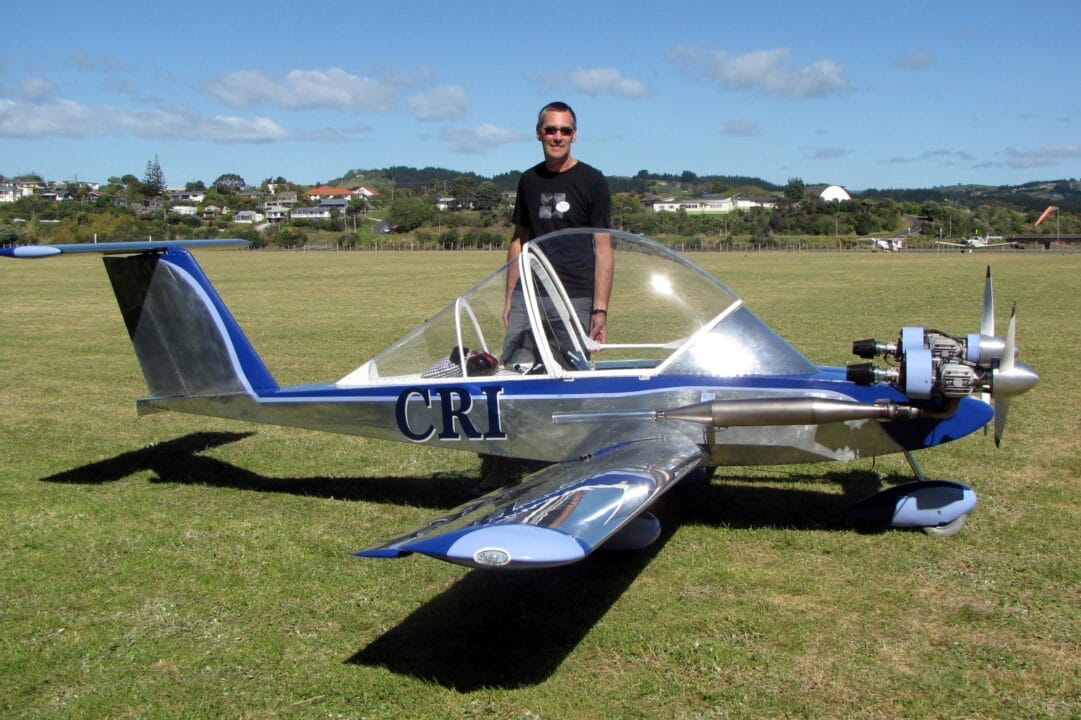
Meet the CRI-CRI Aircraft, the Smallest Twin-Engine in the World Capable of Reaching a Speed of 190 km/h. This Aircraft with a Motorbike Engine Weighs Only 72 kg.
Have you ever imagined building a plane with a motorbike engine and flying it? Even though it is smaller than some model aircraft, the CRI-CRI is a true aircraft, although its compact size may make it look like a scale model. This charming vehicle defies expectations and proves that size doesn’t matter when it comes to flying.
Understand How the Idea of the Aircraft with a Motorbike Engine Originated
Known for being the smallest twin-engine in the world, with a wingspan of 4.90 m and only 72 kg of empty weight, the CRI-CRI also has a cruise speed of 190 km/h and is capable of performing all acrobatic maneuvers that have positive G-forces.
The idea of developing something so simple and light came from aviation engineer Frenchman Michel Colomban, a fan of small aircraft, who wanted to build a homebuilt aircraft that was small and economical, with acrobatic performance.
-
Brazil Welcomes Spanish Wamos Air and Nigerian Air Peace, Potentially Transforming International Routes and Increasing Competition

-
Why can the crane operator only obey the correct signalman on the construction site: among dozens of workers, a hand raised by the wrong person can confuse the maneuver and turn a load of tons into an immediate risk.
-
What changes with the new public transportation rules that can reduce pressure on fares and pave the way for zero fare in Brazil?
-
Offshore air transport soars in Brazil, surpasses 2.5 million passengers, and reveals how oil has transformed Rio’s airports into key pieces of national logistics.







His initial idea in the 1950s was to develop a very simple and light single-seat aircraft (up to 180 kg), capable of carrying a pilot weighing 78 kg and 10 kg of fuel, equipped with a 20 hp engine.
His calculations proved that a wing area of four square meters was feasible. However, it was only in the early 1970s that Colomban arrived at a definitive design. The technological advancements of the time enabled various improvements over the imagined motorbike engine aircraft.
The new aircraft incorporated advanced laminar flow airfoils, low drag, extensive use of composites, and very thin metal sheets, which allowed for a drastic reduction in weight.
The lower weight allowed for a reduction in wing area to only 3.1 square meters. Thus, Colomban rethought the propulsion system and decided to use two Stihl chainsaw engines, each with 8 hp, instead of one 20 hp motorbike engine.
Where Did the Idea of Naming the Aircraft ‘CRI-CRI Plane’ Come From?
The construction of the first prototype took 1,500 hours of work between 1971 and 1973, with the aircraft presenting the final design with an empty weight of only 63 kg, a wingspan of 4.9 meters, and a length of 3.9 meters.
Designated MC-10, it flew for the first time on July 19, 1973, at the Guyancourt airfield, piloted by Robert Bussh. Because of its gracefulness, Colomban decided to name the new aircraft “CRI-CRI,” a diminutive of cricket, the nickname of his daughter.
Although it was attractive for its small size and low cost, what stands out most about the aircraft with a motorbike engine is its spectacular acrobatic performance.
The maximum speed in level flight was 125 mph, and the CRI-CRI can roll, thanks to its small wingspan, at 360 degrees per second. Any other type of maneuver can also be performed. With 15 hp engines, it can climb at 1,200 feet per minute.
Drawbacks of the Aircraft with a Motorbike Engine
Being a homebuilder, it became very popular among aviators, receiving numerous modifications to its original design, especially regarding the engine. The estimate is that at least 100 units were built in France alone. About another 30 are in the United States, and there are 20 more scattered around the world, especially in Australia, Canada, and Germany.
However, as not everything is perfect, the CRI-CRI has some drawbacks. Its relatively high stall speed and high sensitivity to controls made the aircraft unsuitable for beginner pilots.
Additionally, the range was very low, due to the small capacity of the tank, which holds only six American gallons. Nonetheless, its latest model is environmentally friendly. Developed in partnership by EADS Innovation Works, Aero Composites Saintonge, and the Green CRI-CRI Association, this model features an aircraft powered by four brushless electric motors, each driving a pair of counter-rotating propellers.









-

-

2 people reacted to this.