Portuguese
  Spanish


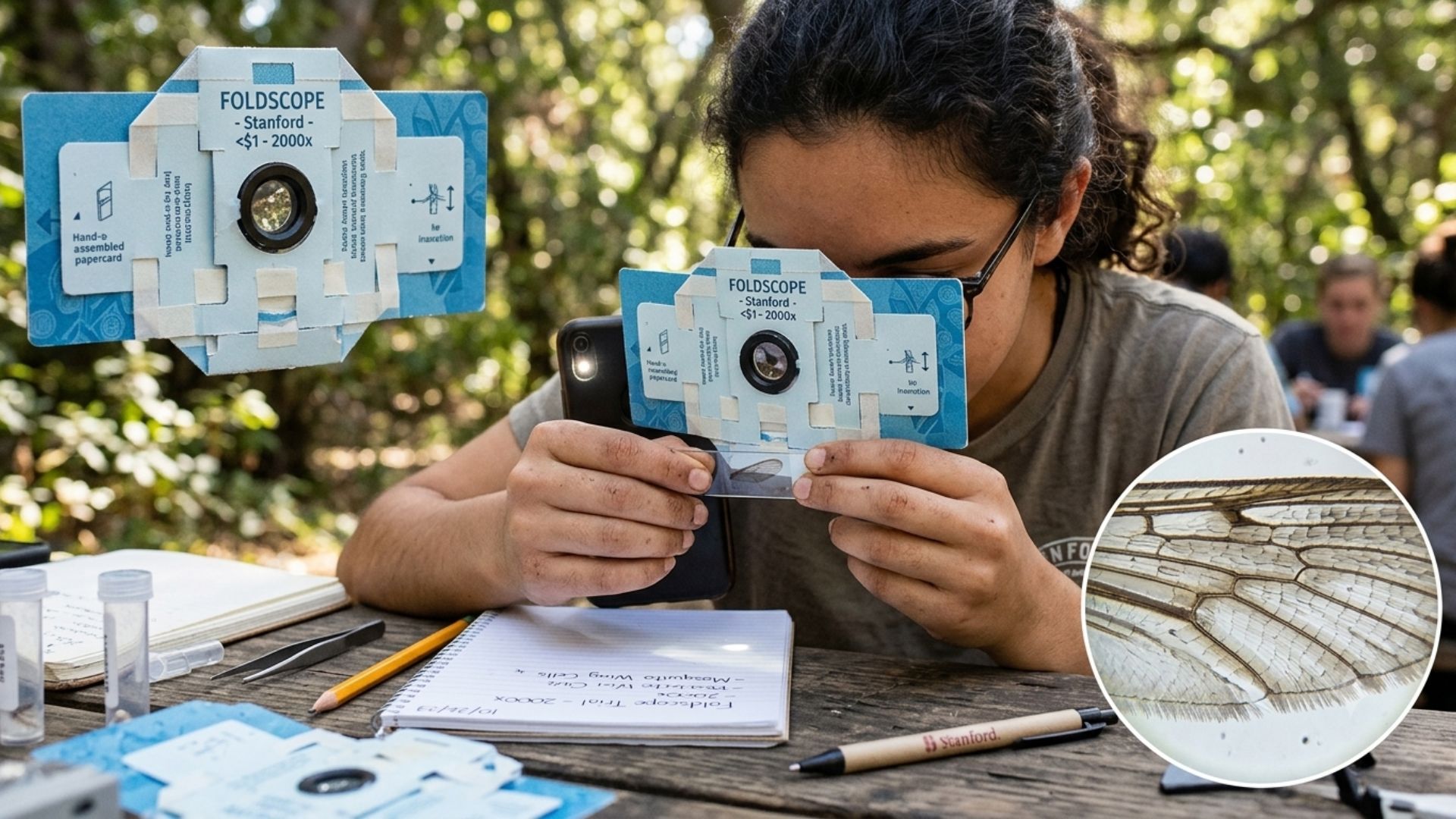

Created at Stanford, the Foldscope costs less than US$ 1, weighs only a few grams, and transforms folded paper into a microscope capable of magnifying objects up to 2,000 times.
For centuries, microscopes were expensive, delicate equipment practically restricted to universities, hospitals, and research centers. But a group of scientists from Stanford University decided to challenge this logic using an unlikely material: paper. The result was the Foldscope, a foldable microscope inspired by origami that costs less than US$ 1 to produce, fits in your pocket, weighs a few grams, and allows you to observe cells, bacteria, parasites, tissues, and small organisms practically anywhere in the world.
The project became one of the greatest symbols of so-called frugal science, which seeks to democratize access to scientific tools through simple and accessible solutions.
Created at Stanford, the Foldscope was born to bring microscopy to regions without laboratories and expensive equipment
The Foldscope was developed by Indian bioengineer Manu Prakash and researcher Jim Cybulski, both affiliated with Stanford University. According to the Prakash Lab, the idea arose after Prakash noticed that many laboratories in poor regions had expensive microscopes, but almost no one used them for fear of damaging them or due to lack of proper infrastructure.
-
Dog Walker in English Forest Uncovers 3,400-Year-Old Bronze Age Axe

-
Texas Blackout Inspires Student to Develop Bionic Leaf Catalyst for Converting Sunlight, Water, and Bacteria into Fuel

-
Brazilian Students Develop Process to Turn Styrofoam Waste into Water-Purifying Charcoal

-
Study Warns: Wi-Fi Routers Can Act as Invisible Radars, Identifying People with 99.5% Accuracy Without Cameras or Wearable Devices





The proposal was to create a cheap, durable, and sufficiently powerful device to allow basic diagnostics, educational activities, and field research in remote locations.
The first scientific article describing the Foldscope was published in 2014 in the journal PLOS ONE, presenting an origami-based approach to manufacturing microscopes on a large scale using extremely cheap materials.
The microscope is assembled from a sheet of paper and can magnify objects up to 2,000 times
According to the Prakash Lab, the Foldscope is constructed from a cut-out sheet of sturdy paper, a small spherical lens, an LED, and a simple battery. Once assembled, it is approximately the size of a bookmark.
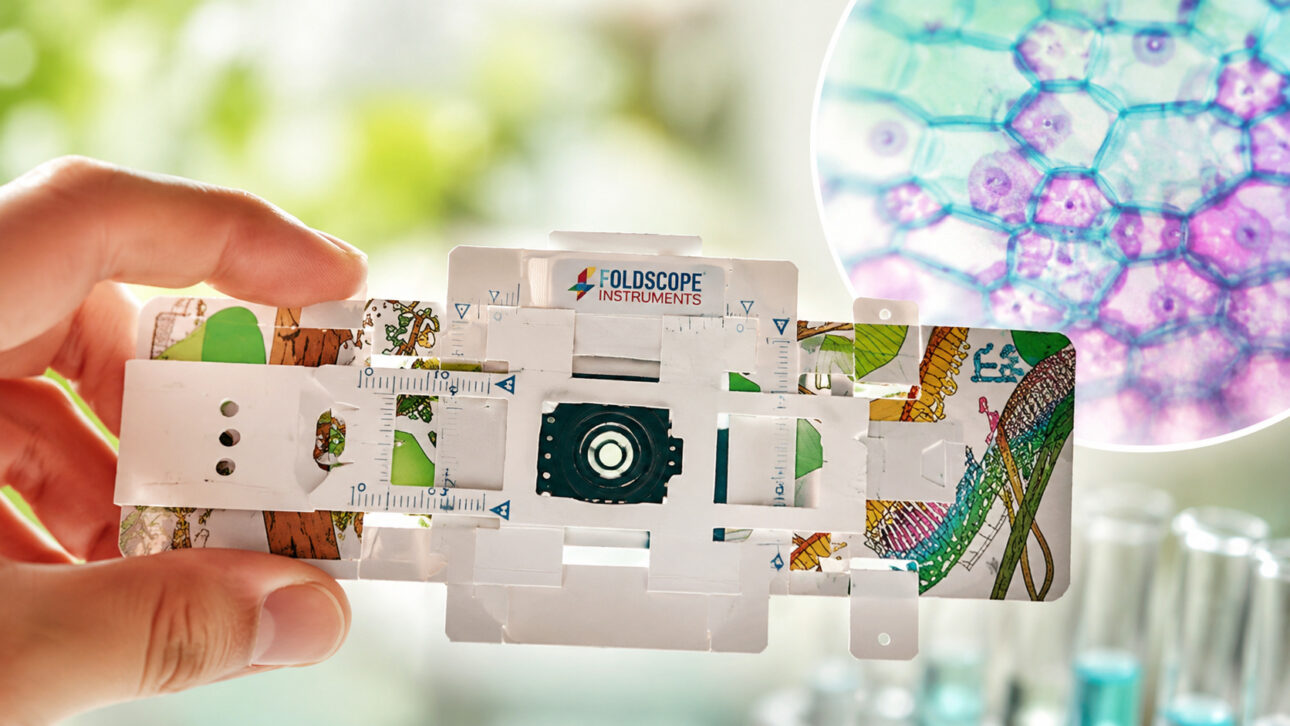
Despite its simple appearance, its capability is surprising. According to the project, some versions can achieve magnification of up to 2,000 times, sufficient to view individual cells, protozoa, bacteria, and microscopic structures invisible to the naked eye.
The equipment can also be connected to smartphones, allowing samples to be photographed, images to be shared, and collaborative databases to be created among students, researchers, and ordinary citizens.
The invention costs less than US$ 1 and has already reached more than 135 countries
According to the Prakash Lab, each unit of the Foldscope can be produced for less than US$ 1, while some estimates point to costs close to US$ 0.50 depending on the manufacturing process.

The distribution gained international scale through educational programs funded by scientific foundations. The laboratory reports that more than 70,000 Foldscopes have been sent to more than 135 countries in initiatives aimed at research, education, and public health.
In subsequent years, the movement grew even more, forming a global community of users who share microscopic images of insects, plants, water samples, fungi, and microorganisms found in different parts of the planet.
The equipment has already been used in research, scientific education, and disease identification
The Stanford team states that the Foldscope was designed not only for schools but also for practical applications in health and diagnostics.
According to the study published in PLOS ONE, the technology allows for the observation of organisms related to parasitic diseases, performing basic field analyses, and expanding access to scientific tools in regions without conventional laboratories.
The idea is part of the concept of Frugal Science, a movement led by Manu Prakash to develop robust, cheap, and scalable scientific equipment for populations with limited financial resources.
A sheet of paper that challenges the idea that science needs to be expensive
For a long time, observing the microscopic world was a privilege for the few. Today, thanks to a piece of equipment made of folded paper, a tiny lens, and extremely cheap components, children, teachers, farmers, students, and researchers can see invisible details of nature without needing to enter a sophisticated laboratory.
Perhaps the most impressive aspect of the Foldscope is precisely this: showing that some of the greatest scientific revolutions do not necessarily arise from gigantic machines or billion-dollar investments, but from simple ideas capable of literally putting science in the hands of anyone.