






 Portuguese
  Spanish


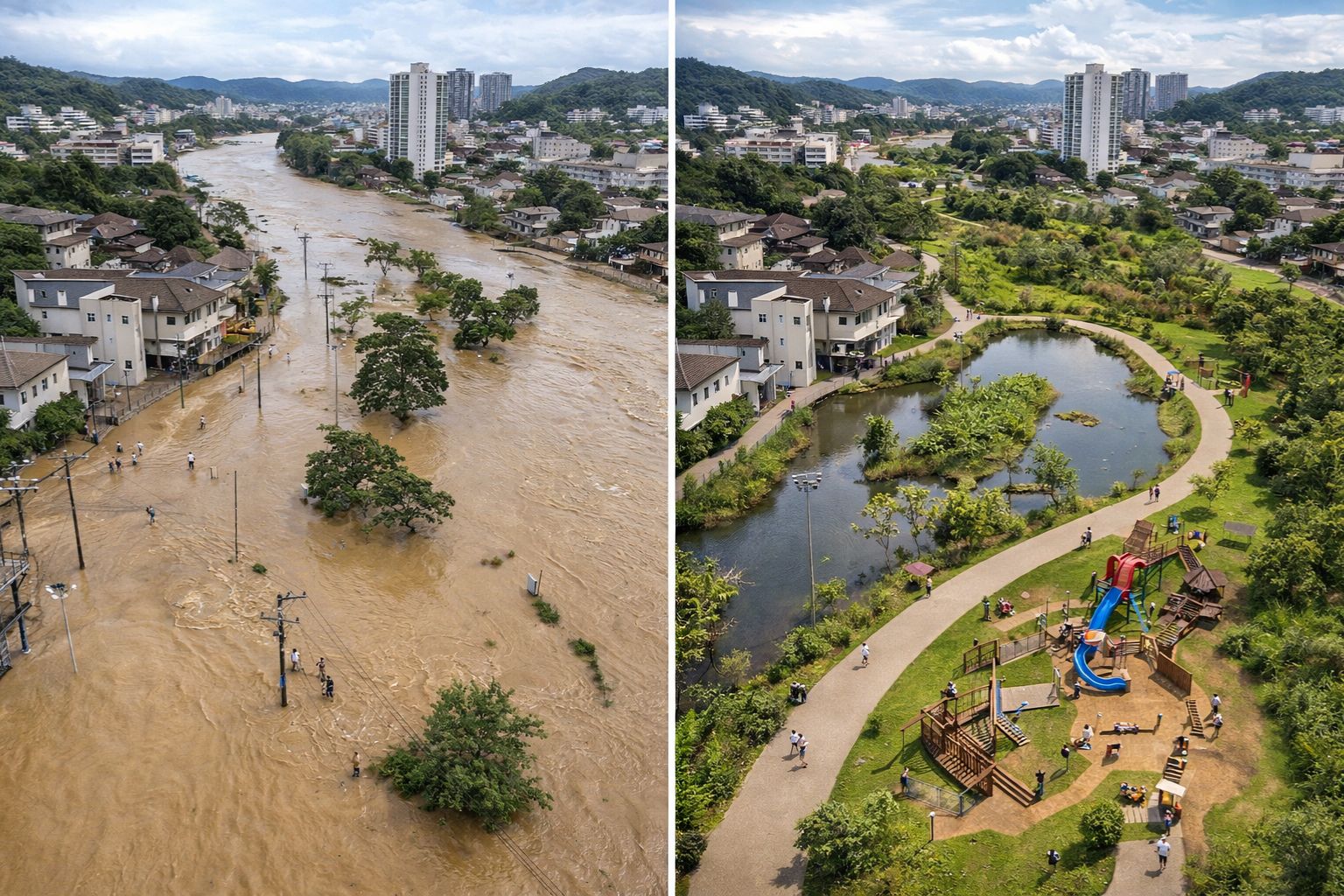

Blumenau is implementing the sponge city concept, inspired by Chinese solutions, to address chronic flooding in the Itajaí Valley. The city hall has already built the Parque das Itoupavas in an area that used to flood and plans an urban forest of 24.7 thousand m² in the Vila Nova neighborhood, replacing concrete with permeable pavements, green roofs, and floodable areas that absorb rain.
Blumenau, in the Itajaí Valley, has suffered from floods and inundations since the settlers founded the city on the banks of the Itajaí-Açu River. Now, the city hall is betting on the concept of sponge city to try to solve what decades of conventional drainage works have not been able to. The idea, created by Chinese architect Kongjian Yu in the 2000s, replaces concrete with permeable pavements, green roofs, and floodable areas, allowing nature to absorb, store, and purify rainwater instead of pushing it into drainage systems that cannot handle the volume. The first practical example of the sponge city in Blumenau already exists: the Parque das Itoupavas, built on land that was constantly underwater.
The sponge city concept changes the logic of dealing with water. Instead of trying to get rid of rain as quickly as possible through pipes and drainage systems, the model proposes that the city absorbs water like a sponge, retaining it in green spaces designed to flood in a controlled manner during rains and function as recreational parks for the rest of the year. The Blumenau city hall is already planning the construction of a second floodable park in the Vila Nova neighborhood, where 86% of the territory is residential and the area suffers from constant flooding during summer rains. The sponge city is not just a theory: it is already being built.
What is the sponge city concept and how does it work
According to information released by the portal ndmais, the sponge city is not a recent invention. The model was developed by Chinese architect and landscape designer Kongjian Yu in the 2000s as a response to China’s accelerated urbanization, which covered millions of square kilometers with impermeable concrete and created cities that flooded with every heavy rain. The solution proposed by Yu reverses the traditional approach: instead of building larger drainage systems to expel water, the sponge city creates spaces that absorb the excess volume.
-
Eight Artists Secretly Lived in a Hidden 70m² Apartment Inside a Shopping Mall in Brazil for Four Years

-
Artist Lives in Giant Wooden Egg Over a UK River to Observe Tides and Environmental Changes
-
Over 20 Metal Drums Repurposed into School Transport Train Boost Attendance in Australian Aboriginal Community

-
Abandoned Coal Crane at Copenhagen’s Old Port Transformed into Luxury Waterfront Retreat with Spa and Ship Views



In practice, the concept of a sponge city involves a combination of coordinated urban interventions. Permeable pavements replace conventional asphalt, allowing water to infiltrate the soil. Green roofs capture rainwater and gradually evaporate it. Controlled floodable areas function as temporary reservoirs that retain water during heavy rainfall and release it slowly afterward, preventing the volume from overwhelming the drainage systems and streams all at once. Several Brazilian cities such as Curitiba, Belo Horizonte, Niterói, and Recife already have floodable parks that fit this concept.
The Itoupavas Park: the first example of a sponge city in Blumenau

Photo: Franciele Cardoso/NDTV
The first concrete step of the sponge city in Blumenau was transforming a problem into a solution. The Alcântaro Corrêa Park, also known as Itoupavas Park, is located on 1º de Janeiro Street, one of the first streets affected by floods in the city. The land where the park was built was permanently flooded during rains, making it impossible to utilize for daycare centers, schools, hospitals, or any other public buildings.
The city hall chose to embrace the condition of the land instead of fighting against it. The space was transformed into a recreational park that operates normally for most of the year and was designed to flood in a controlled manner during heavy rain periods, serving as a temporary reservoir that reduces the impact of flooding on the surrounding streets and residences. The sponge city concept transforms what was waste into public utility: a piece of land that was unusable and caused damage became a park and protection against floods at the same time.
The new floodable park that Blumenau will build in Vila Nova

image: ndmais
The next step for the sponge city in Blumenau is ambitious. The city hall plans to construct an urban forest of 24,7 thousand square meters in the Vila Nova neighborhood, one of the most densely populated areas of the city that suffers from constant flooding during summer rains. The space, which has already been named Frederico Guilherme Busch Junior Park, in honor of the 23rd mayor of Blumenau, was designed to be both a recreational area and a sustainable drainage system.
The park will feature kiosks, decks, a lagoon, children’s recreation areas, walkways, sports courts, and a skate park. For most of the year, it will operate as a conventional leisure space. During heavy rains, the city’s sustainable sponge drainage system will allow the area to absorb and store water that, under the current model, overflows onto the streets of Vila Nova and invades homes and businesses. The Secretary of Urban Planning, Daniel Otávio Maffezzolli, explained that he sought specific solutions for Vila Nova “after so many interventions, but without the expected results for the population.”
Why Blumenau Needed a Chinese Concept to Solve a Two-Century Problem
The city has suffered from flooding since its founding in the 19th century, and decades of conventional drainage works have not solved the problem. The traditional model of urban infrastructure treats rainwater as an enemy that needs to be expelled as quickly as possible, building galleries, channels, and pipes to drain the volume. The problem is that as the city grows and more areas are paved with impermeable concrete, the volume of water that flows into the galleries increases, while the natural absorption capacity of the soil decreases.
The sponge city inverts this logic by recognizing that water is not the problem; impermeabilization is. When the surface of the city stops absorbing rain because it has been covered with asphalt and concrete, all the water goes to the streets and galleries at once, generating the flooding that Blumenau has faced for generations. Restoring the soil’s absorption capacity through permeable areas, floodable parks, and urban vegetation is what the sponge city proposes, and it is what Blumenau is beginning to implement in Parque das Itoupavas and the future park of Vila Nova.
The Other Initiatives That Blumenau Uses Along with the Sponge City
The floodable parks of the sponge city model are not a solution for all critical points in the city. Streets like Nereu Ramos and Araranguá suffer from recurring flooding in areas where there is no space for parks, and the city hall acknowledges that these areas need investment in galleries with greater capacity and maintenance of the existing ones. The creation of a Municipal Drainage Fund is also in the planning of the Planning Department to ensure continuous resources.
A businessman from Blumenau is also exploring the possibility of transforming the public area of a subdivision he manages into a floodable park to alleviate the situation in the Vorstadt region. The sponge city works best when adopted as a broad urban philosophy, not as an isolated project, and private sector participation in creating absorption areas can multiply the impact of public initiatives. For Blumenau, which created a drainage-focused directorate only in 2019 despite centuries of flooding, the sponge city represents the first real change in approach on how to coexist with water.
Blumenau bets on the Chinese concept of sponge city to end flooding by transforming floodable areas into parks. Do you think this model would work in your city? Have you suffered from floods? Leave your opinion in the comments.




