Portuguese
  Spanish


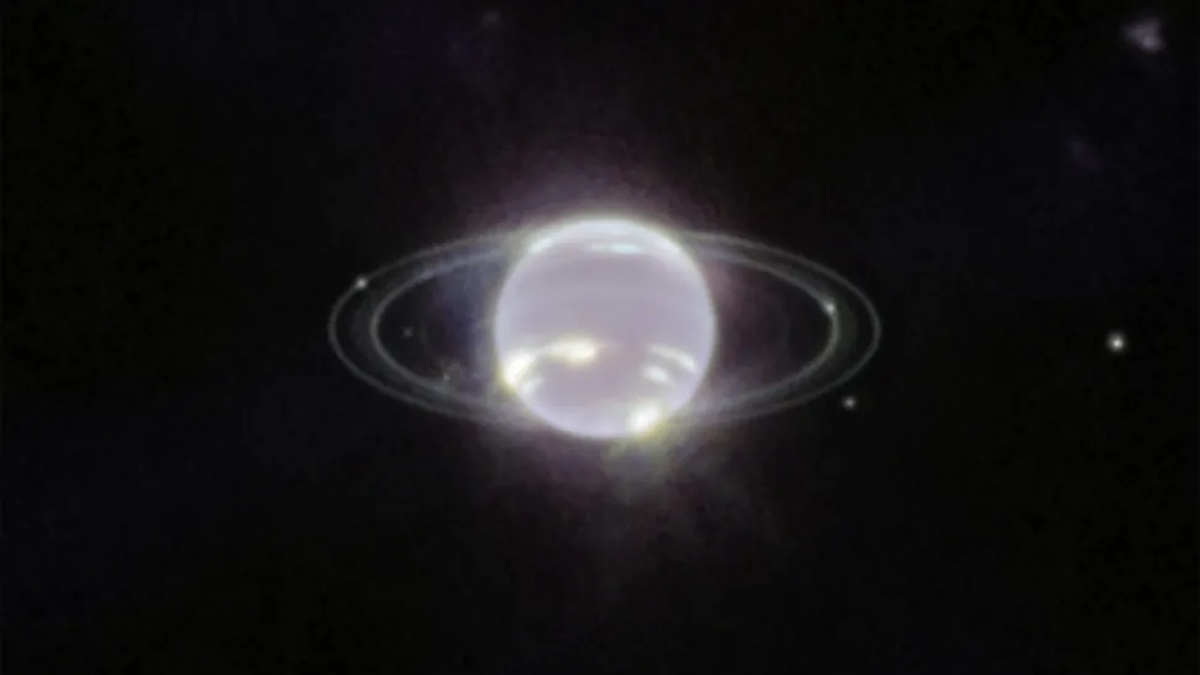

Scientists have discovered new evidence that Nereid, one of Neptune’s most mysterious moons, may be the only survivor of the planet’s original satellite system after a gigantic cosmic catastrophe that occurred billions of years ago. The study, conducted with the aid of the powerful James Webb space telescope, suggests that the moon escaped the destruction caused by the arrival of Triton, Neptune’s largest moon, considered a true “gravitational intruder.”
Furthermore, researchers believe that Triton was gravitationally captured by Neptune coming from the Kuiper Belt, causing enormous instability in the planet’s system. The event would have destroyed several original moons, leaving Nereid as the possible sole survivor of this extremely violent period in the history of the Solar System.
Nereid has intrigued scientists for decades
The moon Nereid has always attracted attention for having an extremely unusual orbit.
Moreover, it exhibits one of the most eccentric movements ever observed among moons of the Solar System.
-
Tourist Discovers Forgotten Joaquín Sorolla Painting Worth Up to 60,000 Euros While Strolling in Seville

-
Brazil’s Fernando de Noronha Boasts World’s Most Beautiful Beach, Accessible Only by Descending 208 Cliffside Steps and With No Food Vendors Allowed

-
Wave Rock: Australia’s Giant Granite Wave Stands 15 Meters Tall, Spans 110 Meters, and Showcases 2.7 Billion Years of Erosion in the Australian Desert
-
How to Unclog Showerhead Holes Blocked by Limescale and Hard Water Without Replacing or Hiring a Technician



Experts claim that the moon’s orbital behavior suggests that something gigantic happened in Neptune’s past.
In this context, the new study has gained enormous international repercussion.

Triton may have destroyed Neptune’s original system
Scientists believe that Triton did not form around Neptune.
Furthermore, evidence indicates that the moon was gravitationally captured after wandering through the outer Solar System.
Experts claim that the arrival of Triton would have caused gravitational chaos, destroying smaller moons and completely altering the structure of the planet.
Therefore, Neptune may have undergone a true cosmic catastrophe.
James Webb helped in the new discovery
The James Webb space telescope was fundamental for the new analyses.
Additionally, researchers studied the chemical composition of Nereid’s surface with unprecedented precision.
Experts claim that the moon has an amount of ice incompatible with objects coming from the Kuiper Belt.
In this scenario, the hypothesis that Nereid is an original moon of Neptune gained strength.
Moon has an extremely strange orbit
Nereid takes practically one Earth year to complete a revolution around Neptune.
Additionally, its orbit varies drastically in distance along the path.
Experts claim that this unusual characteristic may have been caused by the enormous gravitational disturbance caused by Triton.
Therefore, the moon is considered one of the most mysterious in the Solar System.
Neptune’s system may have been completely destroyed
Before the arrival of Triton, Neptune probably had a set of moons very different from the current one.
Additionally, gigantic collisions may have reduced ancient satellites to fragments and rings of debris.
Experts claim that only a few traces of this ancient system have survived to this day.
In this context, Nereid may be a true “space survivor.”
Triton remains one of the greatest mysteries of the Solar System
Triton also intrigues astronomers due to its retrograde orbit.
Additionally, it orbits Neptune in the opposite direction of the planet’s rotation.
Experts claim that this behavior practically confirms that the moon was gravitationally captured.
Therefore, Triton is considered a key piece to understanding Neptune’s violent past.
Scientists want to understand the origin of giant moons
The discovery helps researchers better understand how planetary systems evolve.
Additionally, extreme gravitational events may be more common than previously imagined.
Experts claim that studying Neptune also helps to understand the formation of other giant planets.
In this scenario, Nereid has become an important target for future research.
Neptune remains little explored
Despite its scientific importance, Neptune has received only one space visit from humanity.
Additionally, only the Voyager 2 probe passed by the planet in 1989.
Experts claim that Neptune’s system remains extremely understudied to this day.
Therefore, new space missions are being discussed by scientists.

Moon has a large amount of ice
Analyses showed that Nereid has a surface rich in water ice.
Moreover, this chemical composition differs significantly from many objects in the Kuiper Belt.
Experts claim that this reinforces the hypothesis of an origin close to Neptune.
In this context, the old theory of a “captured moon” has lost strength.
Astronomers believe there are still many mysteries
Neptune’s system remains surrounded by questions without definitive answers.
Additionally, many details about formation, collisions, and orbital evolution are still unknown.
Experts claim that the planet may hide important clues about the first billion years of the Solar System.
Therefore, scientific interest in Neptune has grown again.
Discovery reinforces the importance of James Webb
The James Webb Telescope is revolutionizing space research.
Furthermore, the equipment has already enabled discoveries involving exoplanets, galaxies, and moons of the Solar System.
Experts claim that Webb’s technology offers details that were impossible to obtain previously.
In this scenario, new revelations about Neptune may still emerge.
What scientists hope to discover now
Researchers want to deepen studies on Nereid and Triton in the coming years.
Additionally, future observations may confirm how the destruction of Neptune’s ancient moon system occurred.
Among the main points investigated are:
- Origin of Triton
- Formation of Nereid
- Gravitational collisions
- Orbital evolution of the moons
- Early history of Neptune
All these factors can help reconstruct one of the most violent chapters of the Solar System.
Neptune may hide a much more violent past than previously imagined
The possibility that Nereid is the last survivor of Neptune’s original moons shows how the Solar System may have undergone extremely chaotic events billions of years ago.
Moreover, the discovery reinforces that gas giants like Neptune still hide enormous scientific mysteries.
As researchers continue to investigate the past of the blue planet, Nereid emerges as a rare and valuable piece to understand an ancient cosmic catastrophe that may have completely reshaped Neptune’s system.