






 Portuguese
  Spanish


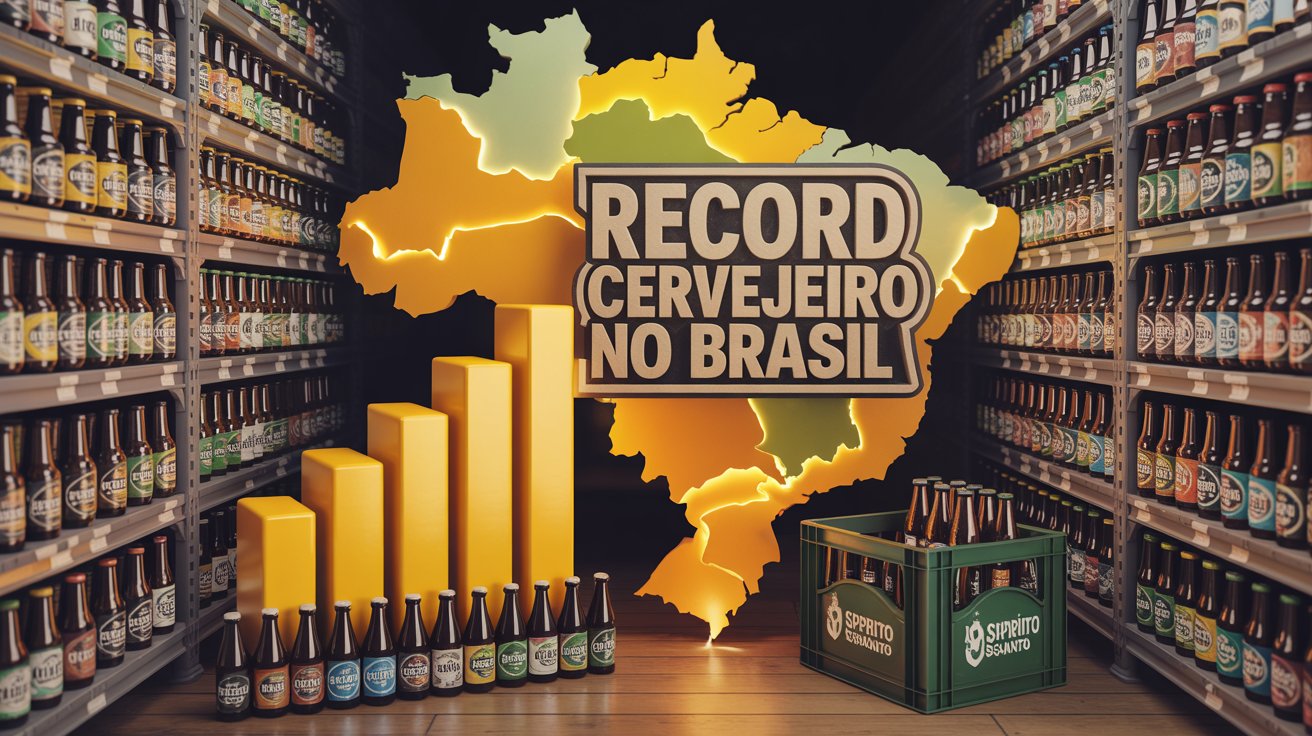
Brazil Closes 2024 With Beer Brands and Labels on the Rise, Record Exports, and Regional Growth, Consolidating Itself as a Power in the Beer Sector. Data Show Consumption Changes and Advances in Non-Alcoholic Beers.
Brazil closed 2024 with 43,176 beer labels registered and 55,015 active brands at the Ministry of Agriculture and Livestock (Mapa).
Additionally, it recorded record exports of 332.5 million liters and US$ 204 million in foreign revenue.
“It is a joy to celebrate the beer sector, one of the great national passions,” said the Minister of Agriculture and Livestock, Carlos Fávaro, at the launch of the Beer Yearbook 2025 (reference year 2024), produced by Mapa in partnership with the National Union of the Beer Industry (Sindicerv).
-
JBS Halts Beef Production for China as Brazil Exceeds 50% of 1.106 Million-Ton Quota; Tariff May Rise from 12% to 67%, Raising Concerns Over Cattle Prices.

-
Brazil’s Social Security Alters Biometric Rules for Pensions and Benefits, Sets 30-Day Deadline, Expands Requirements, and Clarifies Who Is Exempt from Immediate Update

-
Major Brazilian Supermarkets, Including Carrefour and Assaí, May Close Earlier to Prevent Price Increases
-
Coca-Cola Shuts Down 100-Year-Old Factory in the U.S., Impacting 85 Workers and Shaking Local Community with Historic Consequences


According to Mapa, it is a comprehensive snapshot of the chain, from registration of establishments to foreign trade.
Overview of the 2025 Yearbook
The survey confirms the sector’s diversity and highlights significant movement between beer labels in Brazil and beer brands in Brazil.
While beer labels in Brazil declined 5.4% compared to 2023, beer brands in Brazil maintained a high volume, totaling 55,015 product registrations in Mapa.
The document reinforces that label (product) and brand are not equivalent: a single label can appear in the market under more than one commercial brand.
Among the official statements, Mapa highlighted that the yearbook “is an important tool for transparency and support for planning throughout the production chain.”
From the industry’s perspective, Sindicerv assessed that the performance reflects a “solid structure and continuous investments in production and people.”
Product Registration: Where Are the Labels and Brands
São Paulo remains the leader in registrations of beer labels in Brazil, with 12,803 active products, and has the highest average per establishment, at 30 labels.
Espírito Santo was the state with the greatest absolute increase in labels, rising from 1,221 to 1,434 in a year, a gain of 213 registrations.
The national average is 22.2 labels per establishment.
According to the yearbook, consolidation movements, portfolio adjustments, and occasional cancelations of registrations help explain the variation, including significant reductions in units such as São Paulo and Rio Grande do Sul.
Who Stands Out Among the States
In establishments, Brazil reached 1,949 breweries in 2024, with 102 new factories and an increase of 5.5% compared to 2023.
Santa Catarina had the largest absolute increase, with +25 breweries (+11.1%).
São Paulo maintains the largest base in the country, with 427 factories, and the Southeast accounts for 45.6% of the businesses (889 establishments).
Overall, 790 municipalities have at least one brewery, and the best brewery density per capita is in Rio Grande do Sul: 1 brewery for every 32,177 inhabitants.
The Northeast recorded the highest relative growth of establishments, and the municipal dispersion increased to 14.2% of municipalities with at least one active brewery, up from 13.8% in 2023.
Non-Alcoholic Beers: Historical Jump and Consumption Change
The non-alcoholic or de-alcoholized segment (up to 0.5% alcohol content) gained traction and signals a change in consumer habits.
The production of this group jumped 536.9% in 2024, now accounting for 4.9% of all beer produced in the country.
The yearbook also details the classification “low alcohol” (up to 2%) and “conventional” (up to 54%), which helps map new preferences and guide the portfolios of breweries.
Record Exports: Markets and Prices
Brazil exported 332,540,021 liters of beer in 2024, +43.4% compared to the previous year, and earned US$ 204,289,191 (+31.1%), the highest levels in the analyzed series.
Despite the record volume, the average price of exported beer fell from US$ 0.67/L (2023) to US$ 0.61/L (2024).
Paraguay accounted for 66.5% of the volume, and South America concentrated 97.7% of the shipments.
In value, Paraguay also led and increased spending on Brazilian beer, while European countries emerged marginally, with the Netherlands ranking first outside the Americas among the top ten by volume.
In Brazilian imports, Germany remains the main source, with 3,185,550 liters (42.5% of the total), and nine of the fifteen largest suppliers, in value, are European.
Declared Production and Preferred Styles
Brazilian breweries declared 15.34 billion liters produced in 2024.
Of this total, 24.7% were pure malt (without adjuncts such as wheat, rye, oats, or corn).
Among the styles, Light Lager dominated with 8.95 billion liters (58.3% of production), followed by Pilsener (32.4%) and other Lagers (8.5%).
IPA and Malzbier accounted for smaller fractions, at 0.2% and 0.3%, respectively.
Even with the slight decline in labels, the base of beer brands in Brazil remains robust, anchored in lines that resonate with the Lager consumer, and in a non-alcoholic niche that is rapidly consolidating.
What the Government and Industry Say
“The Beer Yearbook 2025 reinforces the strength and diversity of the sector,” stated the Secretariat of Agricultural Defense.
For Sindicerv, “beer is agriculture, employment, income, diversity, culture, and gastronomy,” and the numbers demonstrate resilience and focus on quality, innovation, and international market.
Fastest Growing States: Highlights of 2024
Santa Catarina led the creation of new factories, with +25.
São Paulo maintained its lead in the total number of breweries (427) and in beer labels in Brazil.
Espírito Santo was the state that gained the most labels in the last year (+213).
In the regional overview, the Southeast accounts for 45.6% of establishments, but the Northeast has accelerated in proportional pace.
With this overview, which state is expected to lead the next wave of growth: the consolidated leaders of the South-Southeast or the emerging hubs of the Northeast?




Be the first to react!