






 Portuguese
  Spanish


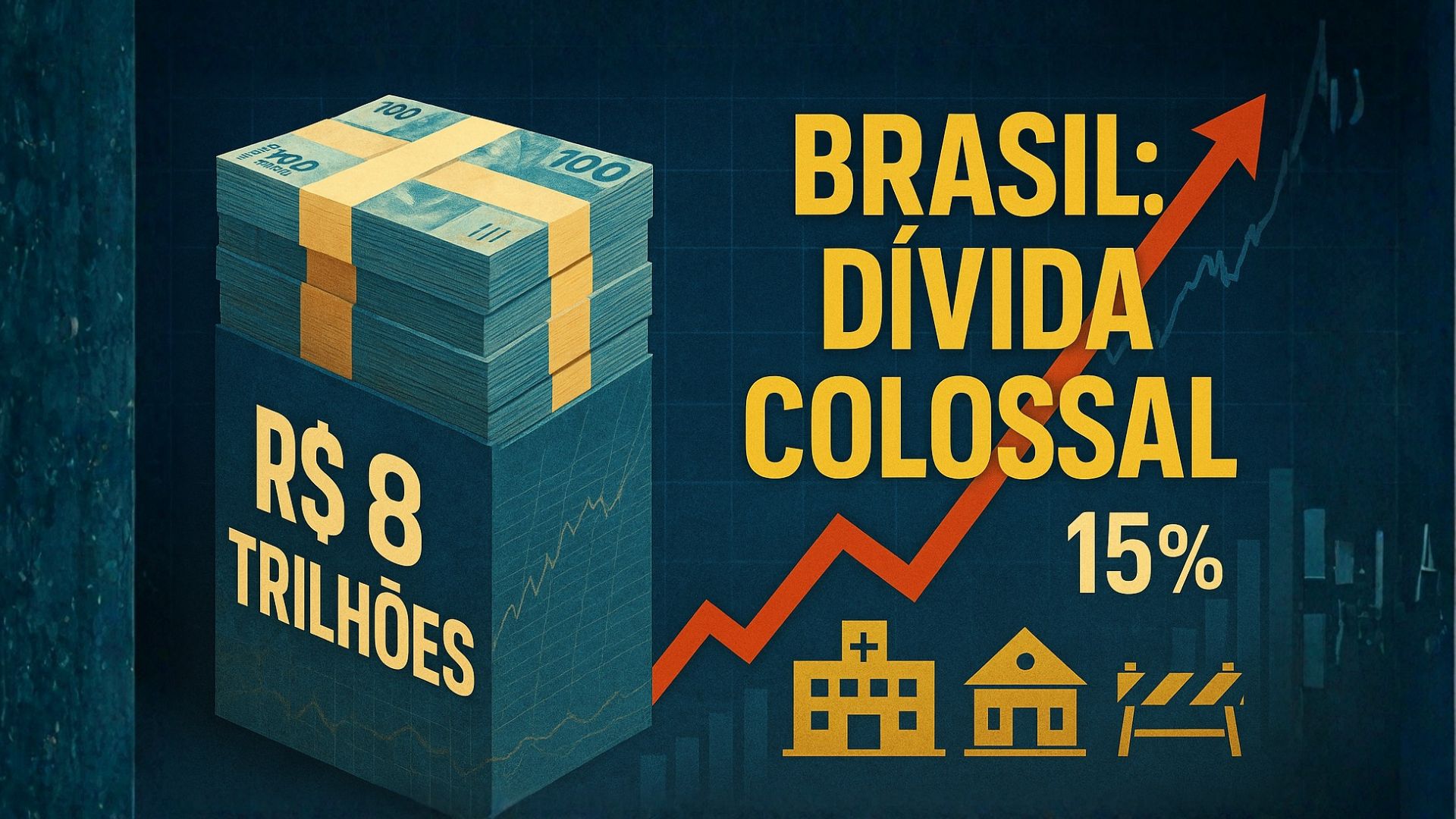


Brazil’s Public Debt Exceeds R$ 8 Trillion and Causes a Chain Reaction That Influences Interest Rates, Credit, Consumption, and Even Investments in Essential Areas Such as Health and Education.
Debt Hits R$ 8.122 Trillion and Pressures the Real Economy
The Federal Public Debt ended September at R$ 8.122 trillion, with a nominal decline of 0.28% compared to August.
The Treasury attributes the variation to net redemptions in the month, partially offset by interest accrual.
The average cost over 12 months rose to 12% per year, and the average maturity increased to 4.16 years.
-
Brazil to Issue “Panda Bonds” in China, Aiming to Raise Up to 5 Billion Yuan at Lower Interest Rates Than Dollar Debt
-
NATO Faces Internal Tensions as U.S. Pushes for Increased Defense Spending, Targeting 5% of GDP by 2035, with Warnings for Countries Near 2% Level

-
Brazil to Introduce B16 Diesel with Increased Soybean Oil Content for Trucks by 2026
-
Brazil’s July Bolsa Família Payments May Include Extra $150 and $50 for Families with Children, Pregnant Women, and Updated CadÚnico Registration


The data is from the Monthly Debt Report published on October 29, 2025.
In the broader aggregate monitored by the Central Bank, the gross government debt reached 78.1% of GDP in September, an increase of 0.6 percentage points compared to August.
This indicator summarizes the fiscal risk perceived by investors and influences the premiums required to finance the public sector.
Why This Affects Your Pocket
When the interest bill grows, there is less room in the Budget for expenses and investments.
In simple terms: more resources go to roll over the debt and less funding is available for health, education, and infrastructure.
The government itself has signaled limits on discretionary spending throughout 2025 to pursue the fiscal targets set in the new regime.
The perception of risk also affects the interest rates that underpin the entire economy.
With high debt and fiscal uncertainty, investors demand a higher return to finance the State, and the interest rate curve rises.
This is passed on to the credit available to families and businesses.
The benchmark interest rate, the Selic, has been at 15% per year since the decision in September, a level mentioned in public statements and aligned with market projections for the end of 2025.
Higher interest rates increase the cost of working capital financing, retail installment sales, and mortgage credit, reducing consumption and investment.
With weaker demand, companies postpone projects, cut positions, and activity slows down.
This is a known cycle: fiscal risk pressures interest rates; interest rates slow the economy; tax revenue suffers; and the debt itself tends to rise if the primary surplus does not materialize.
What Explains the Size of the Debt
The formation of the stock results from accumulated decisions over different governments, combined with recent shocks.
The pandemic increased spending and reduced revenue, a trend seen in various countries.
Subsequently, the economy grew less than needed to reduce the debt-to-GDP ratio, while high interest rates increased the cost of debt service.
In September, the Treasury detailed that although the total stock declined in the month, the average cost over 12 months continued to rise, reflecting the interest rate environment.
In addition to the current scenario, official projections indicate a challenging trajectory.
The Independent Fiscal Institution (IFI) estimates that the gross debt will close 2025 at 77.6% of GDP and reach about 82.4% in 2026, with an upward trend ahead if there is no improvement in primary results and growth.
How Debt Influences Interest Rates
The relationship is direct.
The greater the government’s financing need and the greater the doubt about its ability to stabilize the debt, the higher the premium demanded by investors to hold public bonds.
This premium is reflected in the DIs, in the cost of banking funding, and consequently in loans to consumers and businesses.
In 2025, the market maintained the Selic projected at 15% for the end of the year, citing a slowdown in activity, but still with persistent inflation and fiscal uncertainty.
In the September report, the Treasury noted opposing movements in the curve: rising short-term yields, falling long-term yields, influenced by the external scenario and domestic monetary policy.
Meanwhile, the risk perception measured by the 5-year CDS slightly decreased in the month, which helps, but does not solve the structural challenge.
Impacts in Daily Life: Credit, Consumption, and Employment
High rates weigh on the credit card revolving debt, installments, and financings.
Families postpone purchases, and businesses delay expansion plans.
When sales cool, operations become idle; hirings stop and, in extreme cases, layoffs occur.
The machinery runs slower, which limits revenue and feeds back into the fiscal problem.
This chain helps to understand why the debt picture is not just a topic for Brasília, but a variable with a concrete effect on the cost of living.
What Can Change the Trajectory
To reduce the debt-to-GDP ratio, the technical path combines four fronts: stronger growth, lower interest rates, spending control, and recurring primary surpluses.
In 2025, the approved target for the central government is a zero primary result, but the IFI calculates that additional effort will be needed in the fourth quarter to achieve it.
The Ministry of Planning, in turn, has been implementing cuts in discretionary spending to align accounts with the new sustainable fiscal regime.
Regarding mandatory expenses, debates include benefit revisions, career rules, and improvement in spending quality.
Experts also mention measures to increase efficiency in management and improve public investment, focusing on projects with higher social returns.
These are topics that require legal changes and political negotiation, so they do not have an immediate effect on the stock.
International Comparisons Demand Caution
Although Brazilian debt is below that observed in some advanced economies, the simple comparison by percentage of GDP does not capture differences in credibility, interest rates, currency of issuance, and financial structure.
Countries with greater capacity to finance in their own currency and with a history of fiscal discipline tend to pay lower interest for the same level of debt, which alters the perception of sustainability.
Recent domestic evidence — increasing average cost of the FPD and GGDB above 78% of GDP — reinforces that the adjustment needs to occur here and now, at a pace compatible with local reality.
The Scenario Ahead: Risks and Conditions
The trajectory of the debt will depend on the combination of economic activity, inflation, monetary policy, and compliance with fiscal targets.
If the country can generate recurring primary surpluses, unlock high-productivity investments, and improve spending predictability, the risk premium tends to decline, creating room for lower interest rates and a resumption of growth.
Conversely, frustrations with the fiscal rule or revenues falling short of expectations could keep interest rates high for longer and prolong the phase of expensive credit.
Given this scenario, the central question remains: can Brazil align growth, fiscal discipline, and interest rate reduction so that the debt ceases to drain essential resources from health and education?







