Portuguese
  Spanish





The Brazilian Army Announces A New High Technology Anti-Tank Missile, Developed In Partnership With SIATT, Promising To Significantly Strengthen National Defense. The State-Of-The-Art Equipment Could Represent A Strategic Advance For The Country.
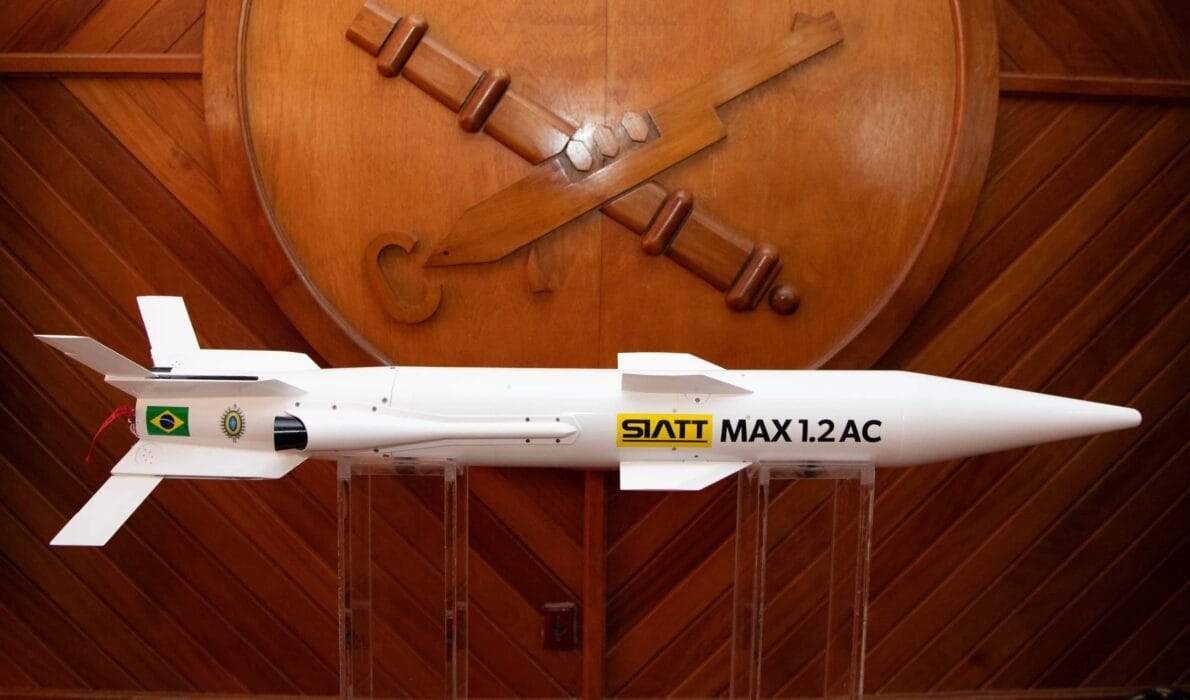
The Department of Science and Technology (DCT) of the Brazilian Army and the company SIATT signed, on September 26, the licensing agreement for the new high technology anti-tank missile MAX 1.2 AC, for production and sale. During the ceremony held at the Army Evaluation Center (CAEx) facilities in Marambaia, Rio de Janeiro, the Brazilian Army also officially announced the new name of the missile, previously known as MSS 1.2 AC, now named “MAX 1.2 AC.”
New Missile Will Have A Range Of 3 Thousand Meters
The new high technology anti-tank missile MAX 1.2 AC is of the beam riding type, with a range exceeding 2,000 meters. The beam riding system allows the equipment to follow a LASER beam pointed by the operator to the target, making it extremely accurate and efficient.


The name “MAX” is a tribute to Sergeant Max Wolf Filho, a Brazilian hero who served bravely in the Brazilian Expeditionary Force (FEB) during World War II, participating in the Italy Campaign.
-
New Brazilian Frigate Equipped with Advanced Missiles and Radars to Safeguard Strategic Maritime Areas

-
New Brazilian Frigate Equipped with Advanced Missiles and Radars to Protect Strategic Maritime Areas, Including the Blue Amazon and Pre-Salt Reserves
-
China Unveils Laser Weapon Capable of Instantly Neutralizing Military Drones, Marking a Significant Advancement in Air Defense Technology
-
U.S. Navy’s Ticonderoga-class Cruiser Becomes a 9,800-Ton Missile Fortress with Advanced Aegis System Capable of Tracking Hundreds of Targets



The choice of name carries a symbolic connection to the courage and determination demonstrated by the sergeant in battle, values that the new high technology anti-tank missile MAX 1.2 AC also represents in its design and application.
In the coming years, the program is expected to receive investments to increase its range, develop strategies for autonomous flight, as well as improve its penetration capability, expanding it to over 1,000 meters, and increasing its effectiveness against reactive armor.
Reactive armor systems use explosives to reduce the impact of anti-tank missiles, making penetration more difficult.
Understand The Importance Of The New High Technology Anti-Tank Missile For The Brazilian Military Sector
According to Ricardo Ramos, Partner-Director of SIATT, these improvements will ensure greater operational capacity in modern combat environments, securing the modernity and superiority of the system in response to the demands of national defense.
This advance reflects the ongoing effort to equip the Armed Forces with advanced high technologies that ensure the sovereignty and security of the country.
The director of SIATT, Rogério Salvador, emphasized the importance of the joint work between the company and the Armed Forces, highlighting the challenges overcome over the years and SIATT’s commitment to developing the defense sector.
According to Salvador, this contract for the new high technology anti-tank missile is the result of years of cooperation and joint effort, always in pursuit of innovation and excellence, which are fundamental values for the work. The company takes pride in contributing to Brazil’s defense capacity and strengthening this partnership with the Armed Forces.
Brazil Moving Toward Self-Sufficiency In Defense And Security
The signing of the licensing agreement between the DCT of the Brazilian Army and SIATT represents an important milestone in the collaboration between the Armed Forces and the national defense industry, strengthening Brazil’s capacity to develop autonomous and modern technologies for the protection of national sovereignty. The MAX 1.2 AC is an anti-tank missile developed to offer precision and effectiveness in the field, being an essential part of the country’s defense system.
The event was held by the Commander of the Army, General of the Army Tomás, and was attended by 8 high command generals, including General of the Army Novaes, Commander of Land Operations, and General of the Army Lancia, Logistics Commander.
The licensing of the new high technology anti-tank missile MAX 1.2 AC marks another step for the country toward self-sufficiency in defense and security, in addition to reinforcing the commitment to honoring the heroes who contribute to Brazil’s history.