New Frigate Cunha Moreira, built in Brazil with German technology, features anti-ship missiles, multifunctional radars, modern naval guns, integrated sensors, helicopter deck, and capability to operate in the protection of the Blue Amazon, the pre-salt, and national maritime communications
The Frigate Cunha Moreira (F202) was launched this Friday (26) in Itajaí, as the third vessel of the Tamandaré Class Frigates Program. The ship is part of the first batch of four units aimed at modernizing the Navy.
The christening ceremony was attended by Lula and the Minister of the Civil House, Miriam Belchior. The vessel was built in Brazil, with local labor and technology from ThyssenKrupp Marine Systems.
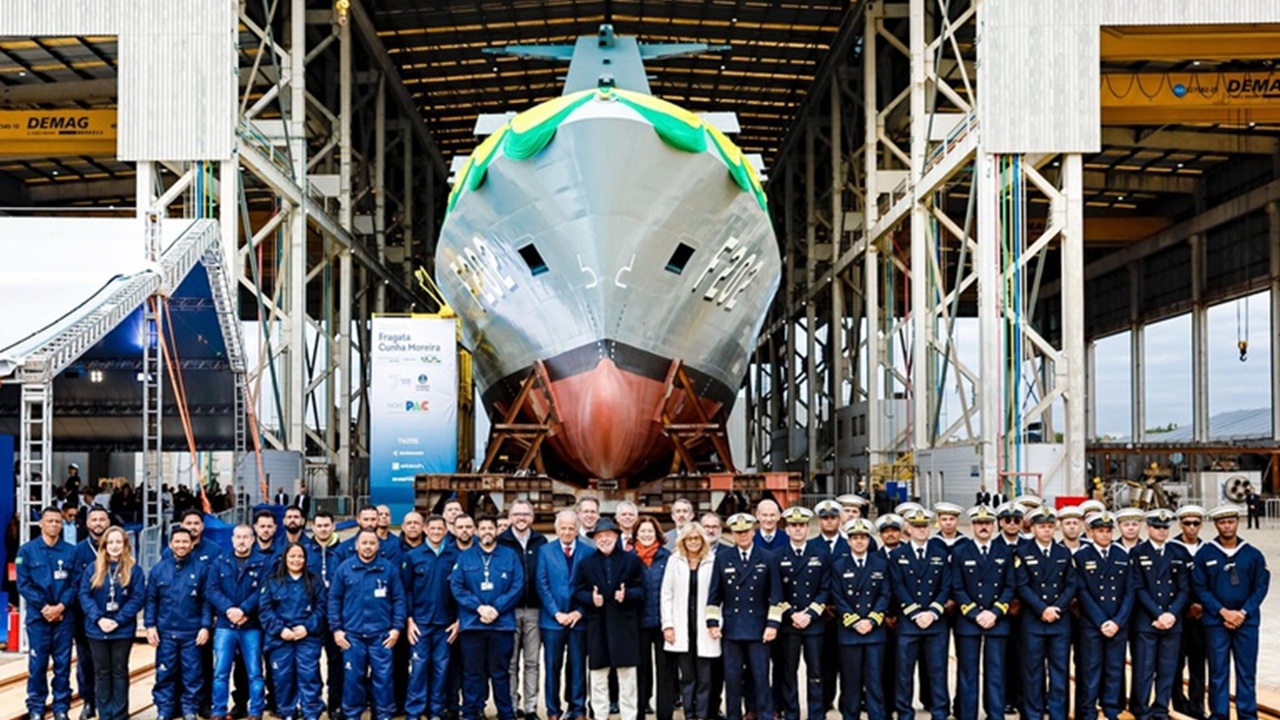
Frigate reinforces protection of the Blue Amazon
The mission of the Frigate Cunha Moreira will be to operate in the monitoring and control of the Brazilian maritime space, in the so-called Blue Amazon, an area of 5.7 million square kilometers along the country’s coast.
-
China Unveils Laser Weapon Capable of Instantly Neutralizing Military Drones, Marking a Significant Advancement in Air Defense Technology

-
U.S. Navy’s Ticonderoga-class Cruiser Becomes a 9,800-Ton Missile Fortress with Advanced Aegis System Capable of Tracking Hundreds of Targets

-
France’s Charles de Gaulle: The Sole Nuclear-Powered Aircraft Carrier Outside the US, Weighing 42,500 Tons and Equipped with Two Atomic Reactors

-
The military spaceplane that almost took the Cold War into orbit: Boeing X-20 Dyna-Soar was designed to re-enter above Mach 20, fly for up to 40 hours, land like a plane, and transform Titan rockets into a gateway to a new era of orbital warfare.


This space includes critical structures, such as the pre-salt oil reserves. The vessel will also contribute to the defense of oceanic islands and the protection of national maritime communications.
The program enhances the Navy’s capacity in search and rescue operations and in fulfilling international commitments. The final delivery of the Cunha Moreira is scheduled for 2028, after the installation of systems, armaments, and other internal stages.
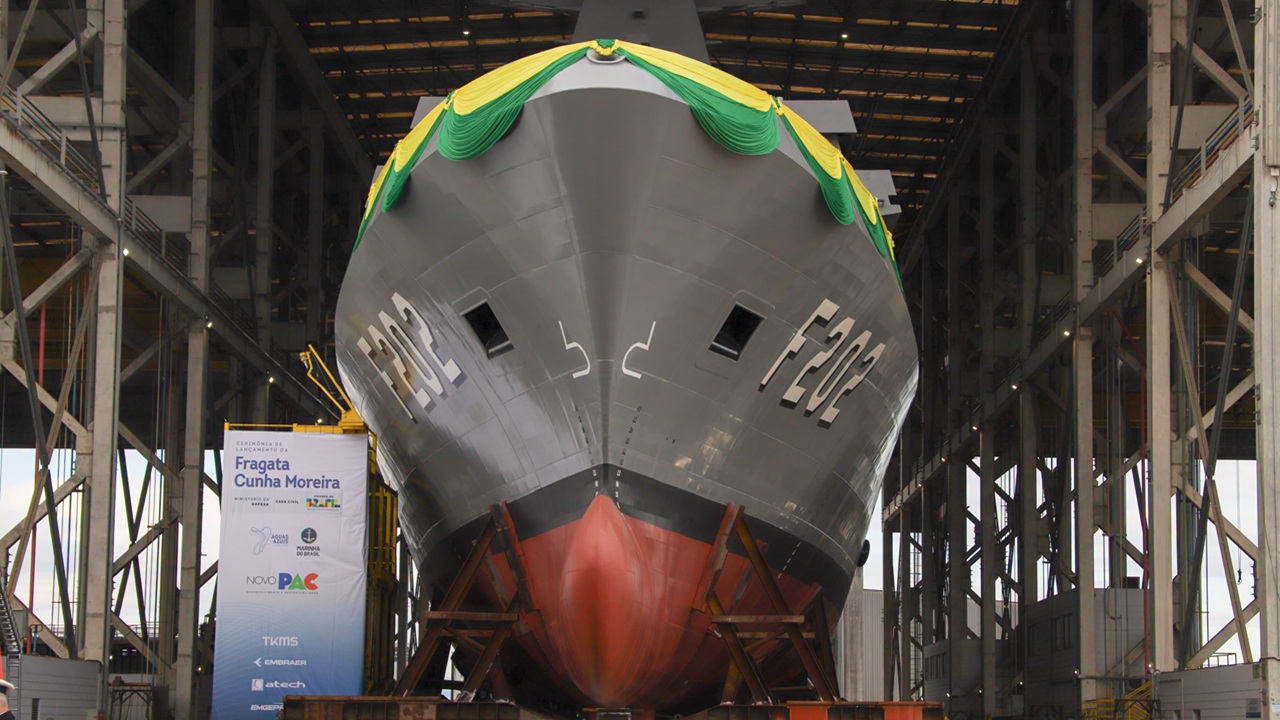
Ship has advanced systems and 107 meters
The Tamandaré Class frigates are military ships with high technological complexity. The vessels have a displacement of 3,500 tons, 107 meters in length, a flight deck, and a hangar for helicopters.
The Cunha Moreira is equipped with multifunctional radars, an anti-ship missile system, state-of-the-art naval guns, integrated sensors, and advanced weapon systems. The set meets strict standards of navigability, stability, operation, performance, and safety.
The launch into the sea indicates that the vessel is ready to sail, but it does not yet represent its final delivery. The frigate will undergo further technical stages.
Construction in Brazil involves German technology
The Cunha Moreira was entirely built in Brazil. The project includes technology from ThyssenKrupp Marine Systems and is part of a strategy to transfer knowledge to the national industry.
The Navy reports that the program contributes to the absorption of strategic knowledge, professional qualification, innovation, and the creation of jobs in the Brazilian naval industry.
The initiative also encourages the nationalization of advanced systems and prepares national companies to operate in the production, maintenance, and modernization of the vessels.
New PAC foresees R$ 10.5 billion
The Tamandaré Class Frigates Program has estimated investments of R$ 13.9 billion between 2019 and 2030. Of this total, R$ 10.5 billion are part of the New PAC.
The initiative is part of the New Industry Brazil and seeks to strengthen the Defense Industrial Base. It is expected to generate around 23,000 jobs: 2,000 direct, 6,000 indirect, and 15,000 induced.
During the ceremony, Miriam Belchior stated that the New PAC also aims to expand the country’s productive and technological capacity. According to the minister, the investments should prepare Brazil to export sophisticated products.
Lula stated that the launch represents a step linked to national sovereignty. The president also declared that Defense is among the government’s priorities, alongside education, health, energy transition, and artificial intelligence.
Four frigates make up the first batch
The first batch includes four ships. The Tamandaré Frigate (F200) has already been launched and incorporated into the Navy. The vessel was launched on August 9, 2024, and its armament display is scheduled for April 24, 2026.
The Jerônimo de Albuquerque Frigate (F201) was launched on August 8, 2025. Sea trials are scheduled for the second half of 2026, with the armament display scheduled for 2027.
Cunha Moreira had its first plate cut on November 28, 2024, keel laying on June 5, 2025, and launching on June 26, 2026. The armament display is scheduled for February 2028.
The fourth vessel, Mariz e Barros (F203), had its first plate cut on January 9, 2026. The launch is scheduled for November 2027 and the armament display for 2029.
Stages mark progress until incorporation
The construction follows symbolic and technical phases. The first plate cut marks the start of manufacturing. The keel laying symbolizes assembly, with the joining of the ship’s first blocks.
Then comes the launch or christening, when the sponsor christens the vessel. Next are the sea trials, with military and civilians on board to verify robustness, safety, and reliability.
The armament display concludes the process as the official incorporation ceremony of the frigate into the Navy. It is expected that all four units of the first batch will be ready by 2029.
Comment on what you think is most important in the Tamandaré Class Frigates Program. The protection of the Blue Amazon, job creation, technology transfer, and also the modernization of the Navy show how defense, the naval industry, and technology are connected in the country and can influence new projects.