Portuguese
  Spanish


Henrique, 4 years old, and Davi, 12, caught attention on social media with fishing records in Goiás, including a 130 kg pirarucu and tambaquis over 20 kg. The routine started as leisure between parents, children, and grandparents, but gained national reach by showing children in contact with sport fishing, modern equipment, and the practice of catch and release
The Goian brothers Henrique Nunes Guimarães, 4 years old, and Davi Nunes Guimarães, 12, started to catch attention on social media with fishing videos in Goiás. Among the most impressive records is the capture of a 130 kg pirarucu, caught by Davi in Itapuranga.
According to G1 Goiás, the family lives in Anápolis and posts the videos on the profile “Quem pega é nois”, which has already surpassed 1 million views. The repercussion grew because the records mix big fish, small child, casting technique, and a family routine far from the urban environment.
The boys’ father, the businessman and engineer Duilio Guimarães Teles, 46 years old, said that fishing entered his children’s lives early. Davi has been fishing with parents and grandparents since he was 3 years old; Henrique, now 4, has appeared in records since he was 1 year and 10 months old.
-
Cape Verde’s World Cup Surprise: Betting on Electric Cars, a 5 MW Solar Plant, and an Ambitious Plan to Transform Energy for 600,000 Residents

-
Man Finds 1,469 Ancient Roman Silver Coins While Metal Detecting in Romania
-
72-Year-Old Retired Professor from Rural Brazil Recites 247 Digits of Pi in One Minute, Setting National Memory Record
-
Scientists Discover Microbial Structures Beneath a 42,000-Year-Old Crater in Korea, Shedding Light on How Asteroid Impacts Could Create Life-Friendly Lakes


The family presents fishing as an accompanied activity, done in a group and linked to catch and release, a common practice in sport fishing.
The 130 kg pirarucu became the strongest record, but the numbers don’t stop there
The largest fish mentioned by the family was the 130 kg pirarucu caught by Davi in Itapuranga. The number draws attention because the pirarucu is one of the largest scaled freshwater fish in the world. Embrapa describes the species, scientifically named Arapaima gigas, as capable of reaching about 200 kg and 3 meters in length.
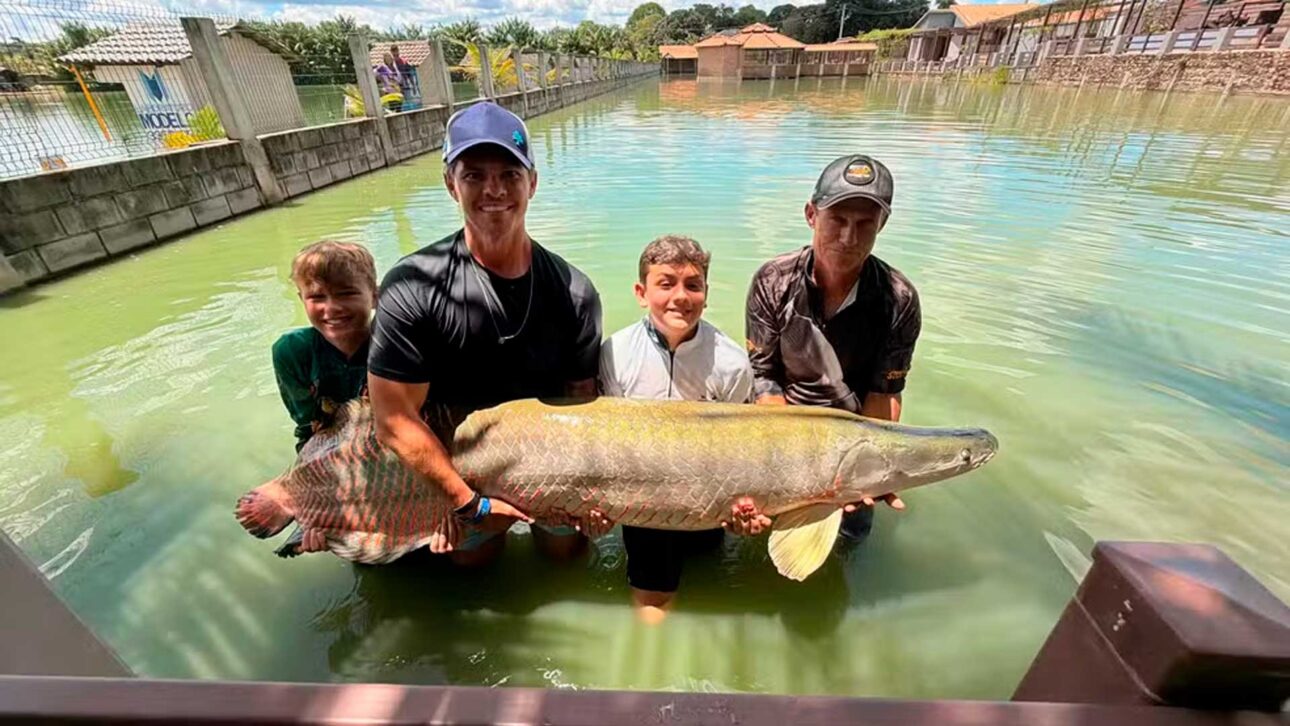
Davi also caught a 28 kg tambaqui in Anápolis, another weight record for a 12-year-old child. Meanwhile, Henrique, at just 4 years old, is noted in the family for catches that include a 24 kg tambaqui in Trindade, as well as fishing trips in the Serra da Mesa region, where the family has a ranch.
The difference between the brothers lies more in their age than in their involvement with the activity. Davi appears as the more experienced one in the videos and also presents new trends in the sport fishing market. Henrique became notable for executing casts with a float and reel, a movement that requires coordination and is often difficult even for adult beginners.
Henrique is 4 years old and became the most curious face in the videos
In the family’s videos, Henrique draws attention even before the fish appears. The image of a small child holding fishing equipment, casting, and participating in the capture of large fish defies what many people expect to see at this age.
The father states that the boy often says he “was born fishing.” The phrase became part of the family narrative, but the records show something more concrete: the child grew up accompanying parents, grandparents, and his brother on fishing trips, always within a routine where adults are nearby.
This family presence changes the interpretation of the scene. The focus is not on turning children’s fishing into a competition or treating large fish as trophies at any cost. The strength of the videos lies in the contrast between Henrique’s age and the skill he demonstrates in front of the camera.
From Instagram to TikTok, fishing became content with big fish, new equipment, and an outdoor routine
The profile “Quem pega é nois” grew because it delivers a combination that works well on social media: short scenes, children as protagonists, anticipation before the catch, and fish that seem larger when they appear next to the boys.
One of Davi’s videos, showing a sonar used in fishing spots, surpassed 300,000 views. The equipment helps show what happens underwater and brings fishing closer to an audience that also enjoys technology, not just rods, lines, and hooks.
On TikTok, the family also gained attention with the capture of a pirarara, which exceeded 245,000 views. This type of video usually captivates the audience with the natural suspense of fishing, when no one knows the size of the fish until it appears.
Exposure, however, requires caution. When children appear in outdoor activities, especially near water and with fishing equipment, adult supervision is no longer a detail. In the case of the Goian brothers, the narrative presented by the family is one of accompanied leisure, with direct participation from parents and grandparents.
Goiás has rules for sport fishing, license, and fish transportation
The brothers’ repercussion also highlights sport fishing in Goiás. According to information published by the Government of Goiás on March 2, 2026, the state maintains specific rules for those who fish, even after the end of the piracema. Among them are the need for a license and the so-called zero quota for fish transportation.
The Semad Normative Instruction No. 17, published in the Official Gazette of Goiás on May 28, 2026, established a four-year ban on the road transportation of fish in all the state’s hydrographic basins in the amateur, sport, guided, and underwater modalities. The regulation also states that minors under 18 are exempt from the fee but are still required to obtain and present the license.
Sport fishing, according to state rules, is linked to the catch and release system in situations provided for by the regulation. During the closed season, sport and guided fishing are only allowed in reservoirs, with the immediate return of the fish to the water body and the use of barbless hooks.
The pirarucu receives extra attention. Ibama reported on March 23, 2026, that the species is now considered an invasive exotic outside its natural occurrence area, the Amazon biome, with fishing authorization for population control in certain hydrographic regions. Even so, the agency itself emphasizes that the activity must follow local legislation and the environmental guidelines of each state.