Portuguese
  Spanish


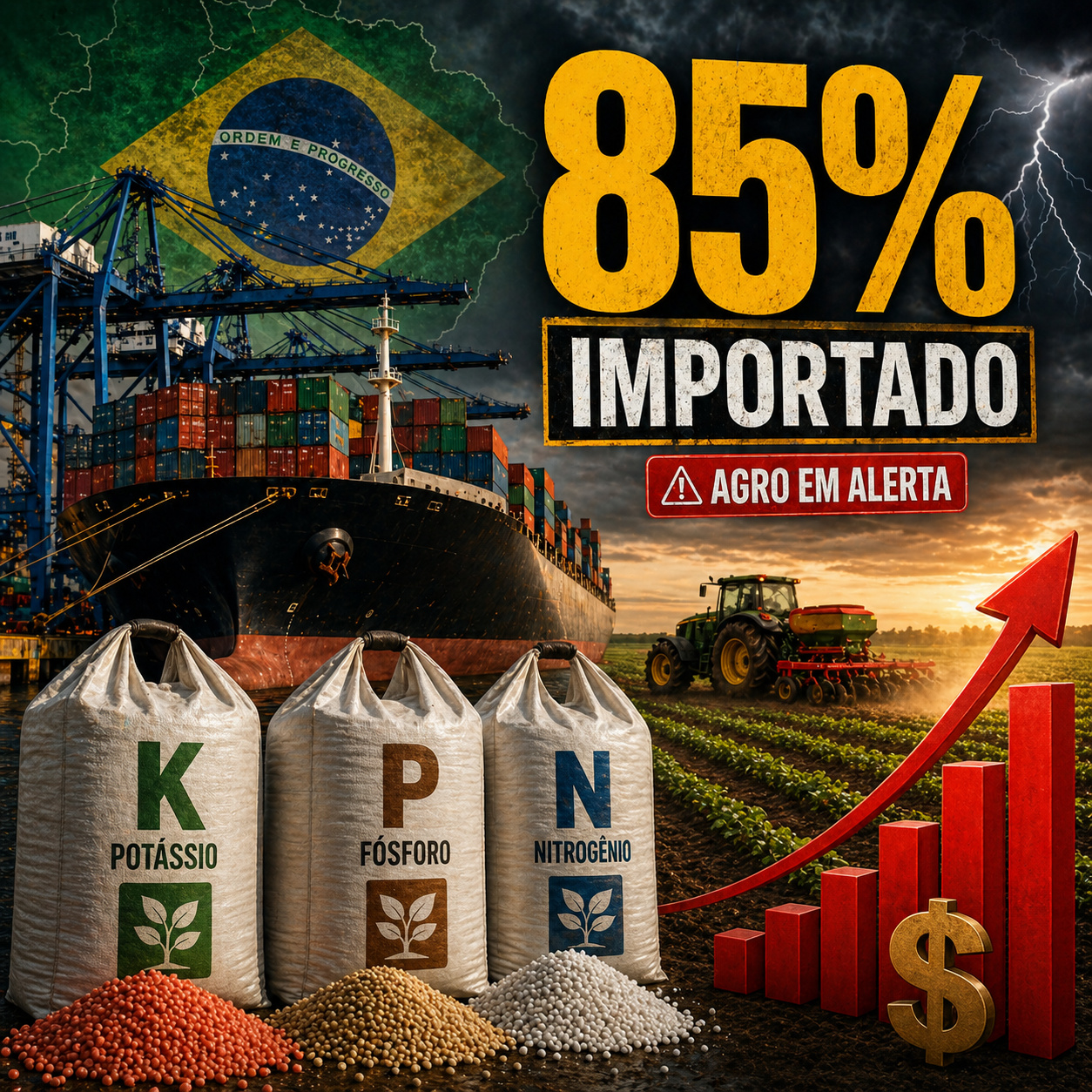

Dependence on imported fertilizers exposes Brazilian agribusiness to global risks and could make the next harvest more expensive before planting.
Brazilian agribusiness, one of the planet’s largest agricultural forces, operates on a foundation that rarely makes headlines but defines the cost and viability of each harvest: fertilizers. According to a publication by the Ministry of Agriculture and Livestock on April 16, 2026, Brazil currently imports about 85% of the fertilizers it uses, while the National Fertilizer Plan indicates that the country accounts for about 8% of global consumption of these inputs and ranks fourth worldwide, behind only China, India, and the United States.
This dependence transforms Brazilian rural production into a system highly exposed to external variables. Soybeans, corn, and sugarcane concentrate more than 73% of fertilizer consumption in the country, meaning that any pressure on international supply, prices, or import logistics directly impacts some of the most important chains in Brazilian agriculture.
Potassium, phosphorus, and nitrogen form the invisible base of agricultural productivity
Modern agricultural production directly depends on three fundamental macronutrients. Nitrogen is essential for plant vegetative growth, phosphorus acts in root development and energy formation, while potassium regulates vital functions such as disease resistance and water use efficiency.
-
Producer receives news and had to cull almost the entire herd, bounced back with the help of compensation, and is now producing 450 liters of milk per day in SC.

-
Quail Eggs Reveal a “Secret Code” on Their Shells Explaining Unique Patterns and Colors

-
Rare Tropical Fruit Canistel, with Egg Yolk Color and Caramel Flavor, Gains Interest from Researchers and Small Producers in Brazil
-
Brazilian Farmers Develop Wheeled Metal Lever to Ease Cassava Harvesting Without Heavy Machinery


Without these elements, crop productivity significantly decreases, even in fertile soils. This means that fertilizer is not an optional input, but rather a structural component of production.
In practice, fertilizer functions as the invisible fuel of modern agriculture, and its absence or increased cost directly impacts yield per hectare.
Global chain concentrates production and increases Brazil’s vulnerability
The international fertilizer market is highly concentrated. Countries like Russia, Belarus, Canada, and China dominate the production and export of strategic inputs, especially potassium.
This concentration creates a scenario where geopolitical events, economic sanctions, or logistical restrictions can quickly affect global supply. When this occurs, the impact reaches Brazil with an almost immediate effect, raising prices and pressuring harvest planning.


Brazilian agribusiness, despite its scale, depends on decisions made outside the country to secure one of its main inputs.
Fertilizer cost directly influences the final price of food
Fertilizer represents a significant portion of agricultural production costs. In crops such as soybeans, corn, and wheat, this input can account for a relevant share of the total cost per hectare.
When international prices rise, the producer faces a critical decision: absorb the cost and reduce margin or pass this increase along the production chain. This movement tends to impact:
- Grain prices
- Animal feed cost
- Protein production
- Food inflation
In other words, fertilizer affects not only the producer but the entire food chain, from the farm to the final consumer.
International logistics becomes a critical factor for Brazilian agribusiness
In addition to concentrated production, international logistics also represents a sensitive point. The transport of fertilizers depends on maritime routes, efficient ports, and a constant flow of ships.
Any interruption in these corridors, whether due to conflict, logistical bottlenecks, or commercial restrictions, can delay deliveries and compromise the agricultural calendar.
In Brazil, these inputs arrive predominantly via ports, which must handle high volumes during specific periods of the year.
The system operates with high temporal precision, and small delays can generate disproportionate effects in the field.
Attempts to reduce dependence still advance in a limited way
In recent years, Brazil has begun to discuss strategies to reduce external dependence on fertilizers. Among the alternatives are the development of national reserves, expansion of domestic production, and more efficient use of inputs.
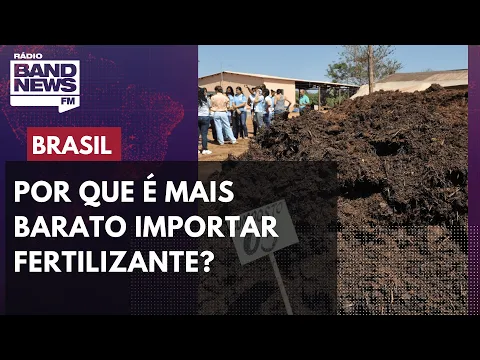
However, these solutions face structural challenges, such as high mineral exploration costs, the need for infrastructure investment, and project maturation time.
Even with ongoing initiatives, external dependence remains the predominant reality in the short and medium term.
Fertilizer market has already shown capacity to generate rapid shocks
Recent events have demonstrated how abruptly the fertilizer market can react. Price fluctuations, export restrictions, and geopolitical tensions have already caused significant increases in input costs in short periods.
These episodes show that the global system is sensitive and can generate rapid impacts in dependent countries. Recent history reinforces that the risk is not theoretical, but has already materialized at different times.

For the Brazilian rural producer, crop planning goes beyond agronomic decisions. It involves international market analysis, import costs, exchange rates, and input availability.
This complexity increases the level of uncertainty and demands greater financial and logistical management capacity. The producer operates not only as a farmer but as a risk manager in a highly interconnected global system.
Structural fragility can influence the competitiveness of Brazilian agribusiness
Brazil is one of the world’s largest agricultural exporters, but this position depends on competitive costs.
If fertilizer becomes more expensive or less available, the country’s competitiveness can be affected, especially in international markets sensitive to price.
Furthermore, producers in other countries with greater self-sufficiency may have an advantage in scenarios of global instability. Dependence on external inputs thus becomes a strategic factor for competitiveness.
Given this scenario, can Brazilian agribusiness reduce its dependence on fertilizers in the short term?
The current structure of Brazilian agribusiness shows a significant dependence on imported fertilizers, combined with a concentrated global market sensitive to external shocks.
With the next harvest always depending on the arrival of these inputs at the right time, the country remains exposed to risks that go beyond the field.
The question that arises is direct: will Brazil be able to reduce this dependence in time to protect its production, or will it continue to operate under one of the biggest vulnerability points of its own agribusiness?