Portuguese
  Spanish


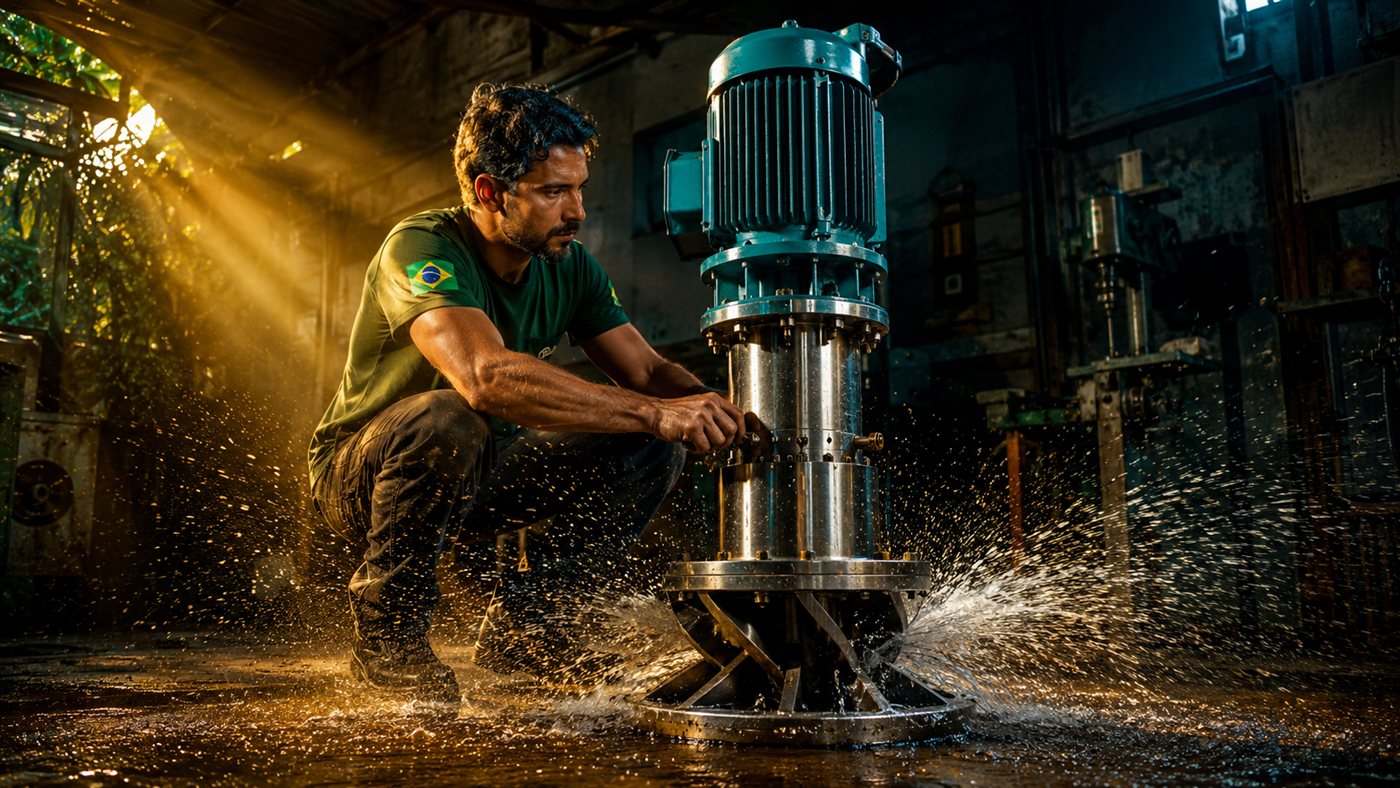

In the video from the Energia Verde channel, with over 46 thousand views, Moisés starts the R$ 14 thousand turbine on the test bench and shows live on the inverter, 1,700 watts entering the utility’s grid
The handmade Pelton turbine became a Brazilian product with live proof. In a video published on May 25, 2026, on the Energia Verde channel on YouTube, the manufacturer Moisés presents his vertical micro hydroelectric plant working on the test bench and connected to an on-grid inverter, injecting energy into the utility’s grid in front of the camera, without cuts.
The equipment is sold ready for R$ 14,000, with a cabinet and rectifier power supply, according to the Energia Verde channel. Generating day and night, non-stop, the machine produces more than 1,000 kWh per month even with little water, which represents savings of over R$ 1,000 monthly based on the national average tariff, and makes the investment pay off in just over a year.
The vertical turbine without pulley and belt
The system’s design explains the durability. As Moisés details in the video, the turbine works with the generator upright and the Pelton wheel directly coupled underneath it, without pulleys or belts, which the manufacturer defines as an efficient and zero-maintenance system.
-
Unknown Molecule Possibly Detected on Pluto and Titan by James Webb Telescope

-
Global Population Estimates May Be More Inaccurate Than Thought: Study Finds Rural Areas Underestimated in 35 Countries, Sparking Debate Over Earth’s 8.2 Billion Inhabitants
-
From Space, a “Great Solar Wall” Spans 400 km of China’s Kubuqi Desert, Transforming the “Sea of Death” with Giant Panels to Combat Sandstorms and Revitalize the Land

-
New Study Finds Brief Stress Episodes Can Alter Blood and Increase Risk of Clot Formation


The robustness is in the engineering details. The Bosch generator of 3.5 to 3.7 kW is kept away from water, with O-ring sealing, precisely to never let moisture reach the equipment, even though it is IP65, according to the Energia Verde channel. The 240-millimeter rotor spins on an aligned shaft, the structure is all steel, the internal rotor is aluminum, and the screws are stainless steel. The result, according to the manufacturer: a machine that runs smoothly for 25 to 30 years.
The golden rule: the power comes from the water
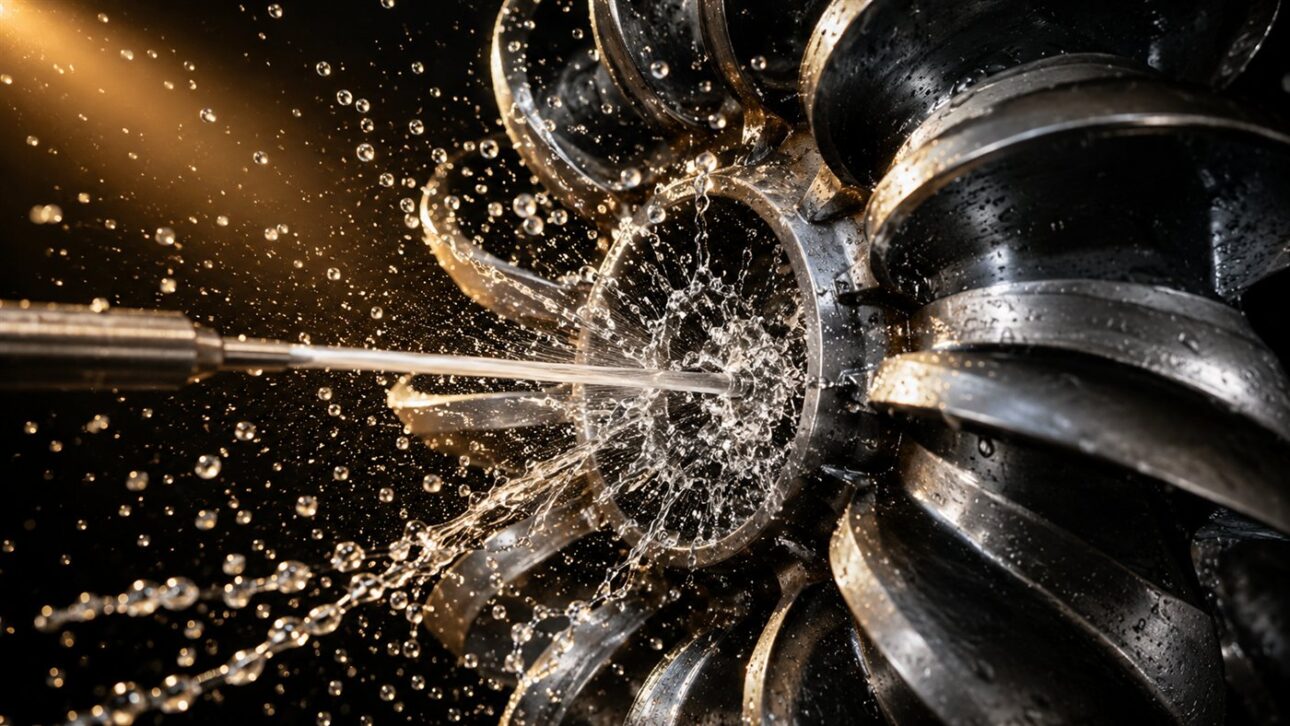
Moisés repeats in the video the rule that many people ignore when dreaming of their own energy: just as the sun provides energy for solar panels, water does for the turbine. A thin three-quarter hose with a 10-meter drop is useless: without flow and without a drop, there is no generation, warns the manufacturer.
The numbers from the test itself illustrate the principle. According to the Green Energy channel, the demonstration system runs with only 4 to 5 liters per second, in a 3-inch hose, and therefore delivers about 1,500 to 1,700 watts, less than half the capacity of the generator. With 10 to 15 liters per second, in a 150-millimeter pipe, the power practically doubles in the same machine. The minimum recommended drop is above 15 to 20 meters.
The handcrafted injector nozzle that is worth hours of lathe work
The most sophisticated piece of the set is not the generator, it’s the adjustable injector nozzle, which Moisés insists on differentiating from a simple valve. A 1045 steel needle runs through the interior of the steel casing and controls the flow, always forming a thin and concentrated jet, like that of a high-pressure washer, something no ball valve can deliver.
The manufacturing is practically workshop watchmaking: turned nylon bushing, aligned flange, two seals, needle and flange angles calculated to work in harmony. As Moisés explains in the video, it’s about 6 hours of lathe work in a region where the hour costs R$ 120, in addition to consumables like a MIG cylinder at R$ 300 and a lathe insert at R$ 80 or R$ 100. The manufacturer produces the injector from 3 to 8 inches and has already made 200-millimeter versions for large flows.
Custom-made Pelton and the jet in the right place
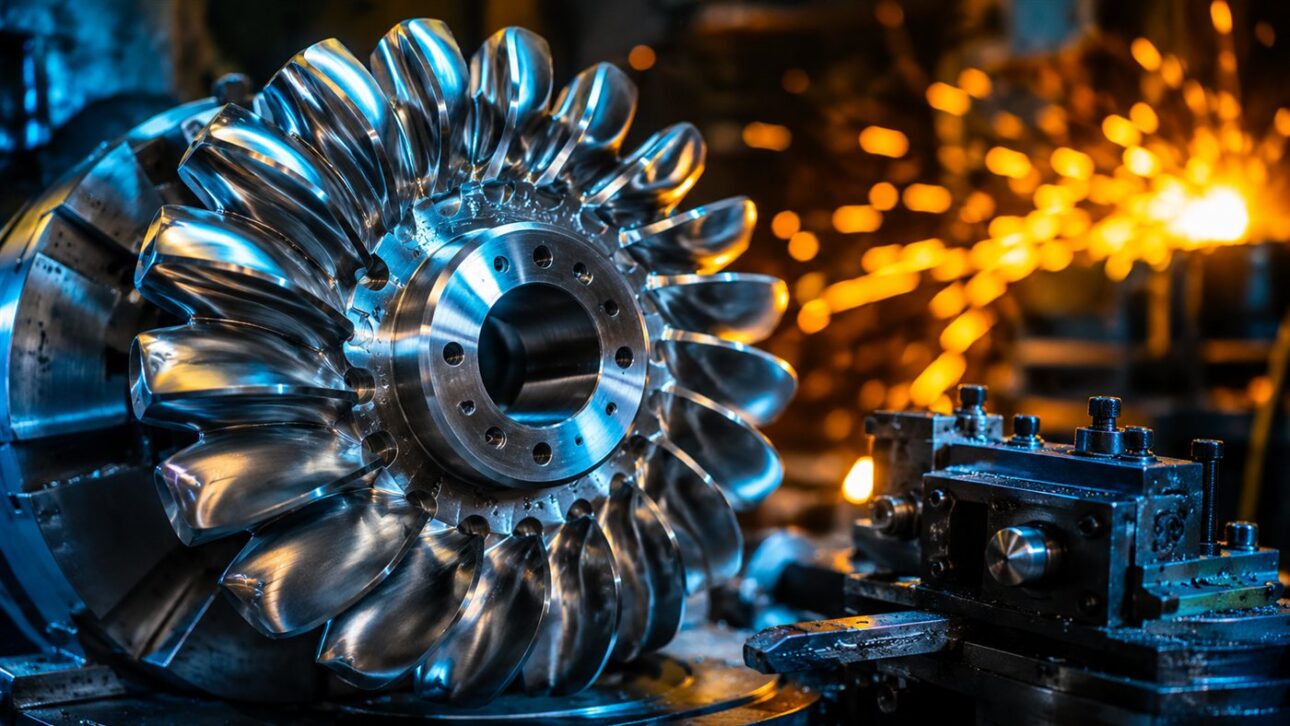
The Pelton turbine wheel also comes out of the workshop custom-made, the size the client needs, with 70-millimeter buckets for jets of up to 20 to 25 millimeters and larger wheels for jets of 40 to 50 millimeters, according to the Green Energy channel. Each wheel is machined, welded, balanced on the lathe, and assembled with stainless steel bolts, nuts, and locknuts, and costs around R$ 1,200 to R$ 1,300.
There’s even a physics lesson in the demonstration. The jet doesn’t hit the buckets head-on, but rather the center of the blade, where the water splits and cleans both halves at the same time, avoiding centrifugal effect and keeping the wheel always free to accelerate, as Moisés shows with the piece in hand.
1,700 watts on the screen: live proof on the inverter
The part that differentiates the video from so many promises on the internet is the proof. Moisés walks from the turbine to the inverter and shows the parameters on the screen, without a cut: 1,600 to 1,700 watts being injected, with the system working at 195 volts of direct current, after the three phases of the generator pass through the rectifier bridge.
The consumer alert comes along: before buying from any supplier, demand to see the system working and injecting power into an inverter, because the market is full of advertisements for turbines of 2, 3, 10, and even 20 kW that never appear operating. In the test, the utility network is 800 or 900 meters away, and the micro power plant’s energy goes directly into it.
More than 1,000 kWh per month: the bill that pays for itself in a year
The math of continuous generation is the strongest commercial argument. According to the Energia Verde channel, a month has 720 hours and the turbine generates day and night, uninterruptedly: 1,500 watts times 720 hours exceed 1,000 kWh monthly, enough energy to comfortably power three houses.
With the average tariff around R$ 1 per kWh in much of Brazil, the savings exceed R$ 1,000 per month with little water and can approach R$ 2,000 monthly where the flow is greater, as the video itself calculates. It is this constant revenue, without relying on the sun or time of day, that makes the Pelton turbine pay for itself in just over a year, a much faster return than solar systems, in the comparison made by the manufacturer itself. The price of R$ 14,000 does not include the inverter, shipping, or installation.
Water wheel for those with little elevation
And what about those who don’t have the 15 or 20 meters of drop? The video answers: water wheel. According to the Energia Verde channel, Moisés maintains water wheels installed in Minas Gerais generating energy with just 3 to 4 meters of height, in a more labor-intensive system, but viable for low elevation.
The workshop also doesn’t sell just the complete set. Those who need only the injector nozzle or just the Pelton wheel send the elevation and flow, and the piece is custom-designed, a handcrafted business model that caters from farmers without electricity to those who want to inject into the grid. As a teaser for the next video, Moisés also shows the restoration of a Francis turbine over 100 years old, with new cast parts in the workshop itself.
Watch the Pelton turbine injecting energy in video
The complete demonstration, from the test bench to the inverter showing 1,700 watts on the screen, is on the Energia Verde channel on YouTube.


After seeing the water from a 3-inch hose pay the electricity bill for three houses, the question arises: how many streams with waterfalls are passing through Brazilian properties without generating a single watt? Tell us in the comments: would you invest R$ 14,000 in a Pelton turbine that pays for itself in a year?