






 Portuguese
  Spanish
  5 min of reading
  0 comments


In Minneapolis, United States, a warehouse was transformed into Avivo Village, a closed village with 100 individual microhouses. Since 2020, the project has served 851 homeless people and moved 343 of them to permanent housing, with security, kitchen, bathrooms, and medical support.
Imagine entering a large warehouse and, instead of machines and boxes, finding a miniature city, with 100 little houses lined up, each with a locking door. This is exactly what Avivo Village is, in Minneapolis, United States, a village of microhouses set up inside a warehouse to accommodate those who slept outdoors. The model is detailed by Good Good Good, which describes it as the country’s first indoor village of tiny houses.
The numbers explain why the idea attracts so much attention. Since it opened in December 2020, the village has served 851 homeless people and helped 343 of them achieve permanent housing, according to data from the official Avivo Village website updated on April 1, 2026. The only criterion for entry is sleeping on the street, outside the traditional shelter system.
One hundred microhouses inside a closed warehouse
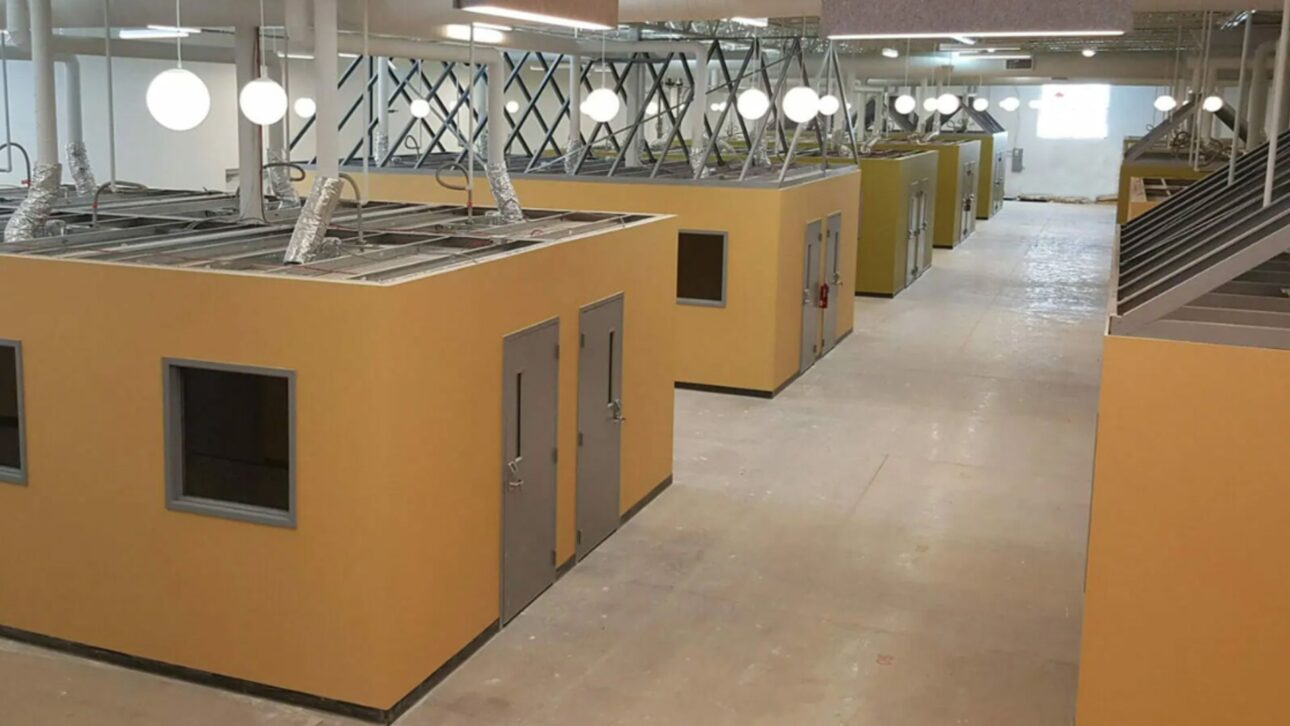
Instead of spreading the little houses over an open area, Avivo Village placed everything under one roof, in a refurbished warehouse in the North Loop neighborhood. There are 100 individual microhouses, each about 2.4 by 2.4 meters, equivalent to the 8 by 8 feet mentioned by Good Good Good.
-
Vancouver Addresses Housing Crisis with 606 Modular Homes Offering Kitchens, Bathrooms, and 24-Hour Support

-
Say Goodbye to Warped Wooden Decks: Composite Flooring Made from Recycled Plastic and Sawdust Offers a Low-Maintenance Outdoor Solution

-
Forget the mansions: the Casa de Mainha, a low-cost renovation in the Agreste of Pernambuco with natural ventilation, won the world’s largest architecture award with over 120,000 votes.

-
Couple trades four-bedroom house in Canada for a retired school bus costing less than $7.5k bought on Facebook, dismantles the vehicle down to the screws, and transforms the yellow scrap into a luxury home on wheels, with a bedroom, bathroom, kitchen, and handmade skylight.

The choice for the covered environment is not aesthetic, it’s survival. Minneapolis faces harsh winters, and keeping the microhouses inside a warehouse protects the residents from the cold that kills those living on the street. As Kelly Matter, president and CEO of Avivo, summarizes, the place offers “stability and security first, a safe place away from the elements,” in a statement to Good Good Good.
Each unit is a safe and private dwelling, with its own door, which changes everything for someone coming from a tent or a sidewalk. Having a key in hand, inside a monitored warehouse, gives back to the person something that the homeless situation had taken away: privacy. It’s the difference between a mattress in a crowded hall and a little corner that’s just yours.
What’s inside each unit and in the village
Inside, the proposal is simple and functional. The microhouse is designed to be a safe room, not a complete house, so collective life happens in the common areas of the warehouse. This design allows for much more structure than a tent could ever have.
The village concentrates essential services in one place. There are shared kitchens and pantries, laundry, individual showers, and bathrooms, all designed for the collective use of the 100 microhouses, according to Avivo Village information. Residents do not need to leave to take a shower, do laundry, or have a meal.
And the care goes beyond the basics. Avivo Village maintains staff and security 24 hours a day, seven days a week, in addition to offering medical assistance, mental health therapy, substance abuse treatment, and social support, according to the official website. It’s a complete package that addresses not only homelessness but the causes that keep a person in a homeless situation.
The numbers: 851 served and 343 in permanent housing
The strength of the project lies in the results. By April 1, 2026, Avivo Village had served 851 people and directed 343 of them to permanent housing, according to the official website. It’s not a shelter that just keeps people out of the rain, it’s an exit door from the street.
The data also reveals the size of the human impact. In the same period, the village reversed 255 overdoses, witnessed the birth of 21 babies, and welcomed 45 war veterans, in addition to allowing the stay of 51 pets, informs Avivo Village. Each of these numbers is a life that the traditional system usually leaves behind.
There is also a portrait of those who need it most. More than half of the residents, 51%, identify as Native American, a group historically affected by the homeless situation in the United States. Bringing these people to permanent housing is confronting an inequality that has been around for a long time.
Without requiring sobriety: the harm reduction model
What makes Avivo Village work is the low barrier to entry. Unlike many shelters, the village adopts a harm reduction approach, meaning it does not require a person to be sober to be welcomed, and it even allows them to bring their pet, according to Good Good Good. The idea is not to create obstacles for those who are already at rock bottom.
This non-judgmental welcome has an immediate effect. “When they finally get here, they kind of take a deep breath, like, ‘Ah, now I’m okay,'” said David Jeffries, program director, to Good Good Good. It’s the relief of someone who, after months or years on the street, finds a door that locks in the United States where the cold is often a sentence.
The village also bets on a sense of community. “Everyone does their part, like any normal community would,” said Heather Day, program manager, to Good Good Good. Instead of treating residents as numbers, the warehouse becomes a real neighborhood, where each person has responsibility and belonging while seeking permanent housing.
Why this model matters, even for Brazil
Avivo Village shows a path that breaks with the traditional shelter. Instead of collective halls without privacy, it offers microhouses with a door, dignity, and services under the same roof, the kind of solution that treats the resident as a person, not as a problem to be hidden. No wonder, the project has become a reference in the United States.
The model is directly relevant to the Brazilian debate. In a country where the homeless population has grown significantly in recent years, the idea of transforming an idle warehouse into a village of microhouses with integrated support is cheap, quick, and replicable. Brazil has plenty of empty warehouses and too many people sleeping on the sidewalks.
The final message is about priority. The experience in the United States proves that taking someone off the street and bringing them to permanent housing does not depend on magic, but on political will and intelligent design. When you decide to care, a simple warehouse becomes the difference between life and death in winter.
Avivo Village is proof that dignity can fit even inside a warehouse. With 100 microhouses, a kitchen, bathrooms, and medical support, the village has already taken 851 people out of the homeless situation in the United States and led 343 of them to permanent housing, without requiring anything other than the desire to get out of the cold. It’s a reminder that solutions to homelessness exist, you just need to want to apply them.
And you, do you think transforming empty warehouses into villages of microhouses could work in your city? Tell us in the comments if Brazil should copy this idea.


Be the first to react!