






 Portuguese
  Spanish
  1 min of reading
  0 comments


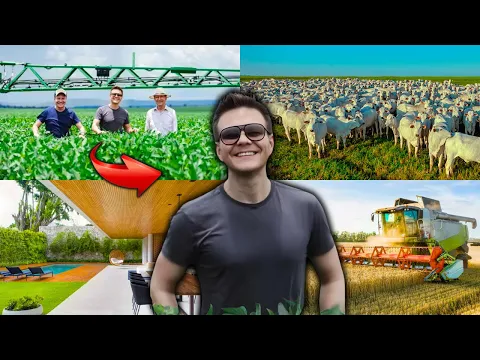
Michel Teló’s rural property in Corumbá brings together agriculture, technology, and family management on a large scale in the Brazilian Midwest, reflecting a strategy of income diversification and connection with the origins in the field, as well as serving as a refuge away from the intense routine of the stages.
Michel Teló maintains a 14,000-hectare farm in Corumbá, Mato Grosso do Sul, that combines
Together with his father, Aldo, and his brother, Teo, the singer manages the property, which has become a solid investment front and also a space for family gatherings, away from the intense routine of shows and professional commitments.
Over the years, the farm gained visibility after the artist publicly detailed the operation, revealing that cattle raising was the starting point before the gradual incorporation of crops and the adoption of integrated practices in land use.
-
The world’s largest natural bridge cave is in China, impressing in Guizhou with almost 180 meters in height, a gigantic opening, and internal space used even for cars, becoming a cool tourist refuge within a monumental karst formation.

-
Goodbye, clothesline: new option for drying clothes utilizes walls, doors, and even room height with multiple drying levels, retractable model, and compact structure that promises to transform small laundries in 2026.

-
A discarded microwave may contain 22-carat gold in internal components; study recovered a 450 mg nugget from electronic boards.
-
Beach in the Northeast reaches a new level with a resort worth R$ 745 million, villas up to R$ 8.3 million, a complex of 2,347 hectares, and 6.5 km of beachfront in a destination still far from the hustle and bustle of Pipa.


In this process, the family began to adopt the integration between agriculture and livestock, allowing for alternating land use between planting and fattening animals, a strategy that increases productivity and reduces periods of idleness throughout the production cycle.
More than diversifying income, the venture highlights the transformation of an old connection with the land into a long-term investment, maintaining the bond with the origins while incorporating professional management aligned with the demands of today’s agribusiness.
Farm in Corumbá and integration of crops and livestock

Located in one of the most relevant regions for agribusiness in the Midwest, the property combines cattle raising and soybean cultivation within a model that seeks productive efficiency without giving up economic diversification.
Throughout the agricultural cycle, the dynamics of the farm allow for alternating activities, as after the soybean harvest, the area is prepared to receive cattle intended for fattening, later returning to planting in a planned system.
In practice, this rotation between crops and livestock has become one of the operational pillars of the property, contributing to better soil utilization and greater financial stability in the face of market and production fluctuations.
Initially focused on livestock, the farm expanded its operations with the introduction of crops, reducing dependence on a single activity and consolidating a more balanced and adaptable production structure.
Even with the owner’s notoriety, management continues to have a strong family character, being directly conducted by family members, which reinforces the continuity of a tradition predating the singer’s national projection.
Technology in agriculture and remote monitoring
With the expansion of activities, the modernization of the farm has taken on a central role, especially given the need to reconcile rural routines with an artistic agenda marked by frequent travel and commitments.
To handle this dynamic, connectivity and remote monitoring solutions were implemented, allowing data on machinery, harvest, and productive performance to be monitored from a distance, including through mobile devices.
This model has transformed technology into an essential management tool, enabling quicker decisions and greater control over processes that depend on variables such as weather, planting time, and operational efficiency.

By adopting this type of monitoring, the farm aligns itself with practices already established in Brazilian agriculture, where the use of data and digital systems has become crucial for productivity gains and cost reduction.
Still, the direct presence of the family remains relevant, as Teló himself often monitors activities on-site whenever possible, reinforcing a management style that combines technology with active participation.
Expansion of crops and climatic challenges
The expansion of agriculture occurred amid an adverse scenario, marked by drought and the effects of El Niño, which impacted various regions of Mato Grosso do Sul during the early stages of the production cycle.
In this context, the singer reported difficulties caused by the drought precisely when the family was advancing in the implementation of crops, highlighting the natural challenges faced by rural producers.
Despite the unfavorable climatic conditions, the cultivated area was expanded from 200 to 400 hectares, indicating the decision to maintain the growth plan even in the face of recorded losses.
This choice reflects a common strategy in properties of this size, where gradual expansion allows for testing the adaptation of the soil, the team, and the techniques used throughout the harvests.
During this period, the experience was interpreted with caution, but without retreat, being associated by the artist with his own trajectory in music, marked by stages of construction and results that do not appear immediately.
At the same time, the situation reinforced a central aspect of agribusiness: although technology and planning reduce risks, climatic factors continue to exert a decisive influence on production.
Farm as a family refuge and rural heritage

Beyond the productive dimension, the property plays a relevant role in the singer’s personal life, serving as a refuge amid the intense routine of travel, recordings, and performances.
In this environment, the rural space assumes a function that goes beyond financial investment, offering privacy, contact with nature, and family coexistence, elements often associated with life in the countryside.
Shared moments on social media show the family’s presence at the location, highlighting activities related to the field and the children’s contact with rural routines.
This aspect reinforces a movement observed among sertanejo artists, who maintain or resume ties with the countryside as a way to preserve cultural references and lifestyle.
In the case of Michel Teló, the farm brings together dimensions ranging from business to family legacy, articulating heritage, production, and coexistence in the same space.
Thus, the operation built in Corumbá highlights a trajectory that began in cattle ranching, incorporated crops, adopted technology, and maintained family management, consolidating the property as one of the main axes of the artist’s life outside the stage.


Be the first to react!