






 Portuguese
  Spanish


Ada Jamile Gomes de Oliveira, a student from Manaus, created MeMO, which uses 12 Hz binaural waves to modulate, in laboratory cells, the expression of genes linked to Alzheimer’s. The research is initial, but it won 4th place at ISEF 2026, the world’s largest science fair.
What if a certain type of sound could, one day, help slow the progression of Alzheimer’s? It was this bold question that led a student from Manaus to the podium of the world’s largest pre-university science fair. Ada Jamile Gomes de Oliveira used binaural waves to alter, in the lab, the activity of genes linked to the disease, and the result earned her an international award in the United States. However, it is research in its initial stage, conducted in cells, not a ready treatment.
The achievement was reported by Jornal da USP in May 2026. The project is called MeMO and won 4th place in the Translational Medical Science category at ISEF 2026, the Regeneron International Science and Engineering Fair, held in Phoenix, Arizona. Behind it is a teenager from the Military School of Manaus, a federal public school of the Army, driven by a painfully personal motivation: Alzheimer’s within her own family.
What is MeMO and how does sound “talk” to genes
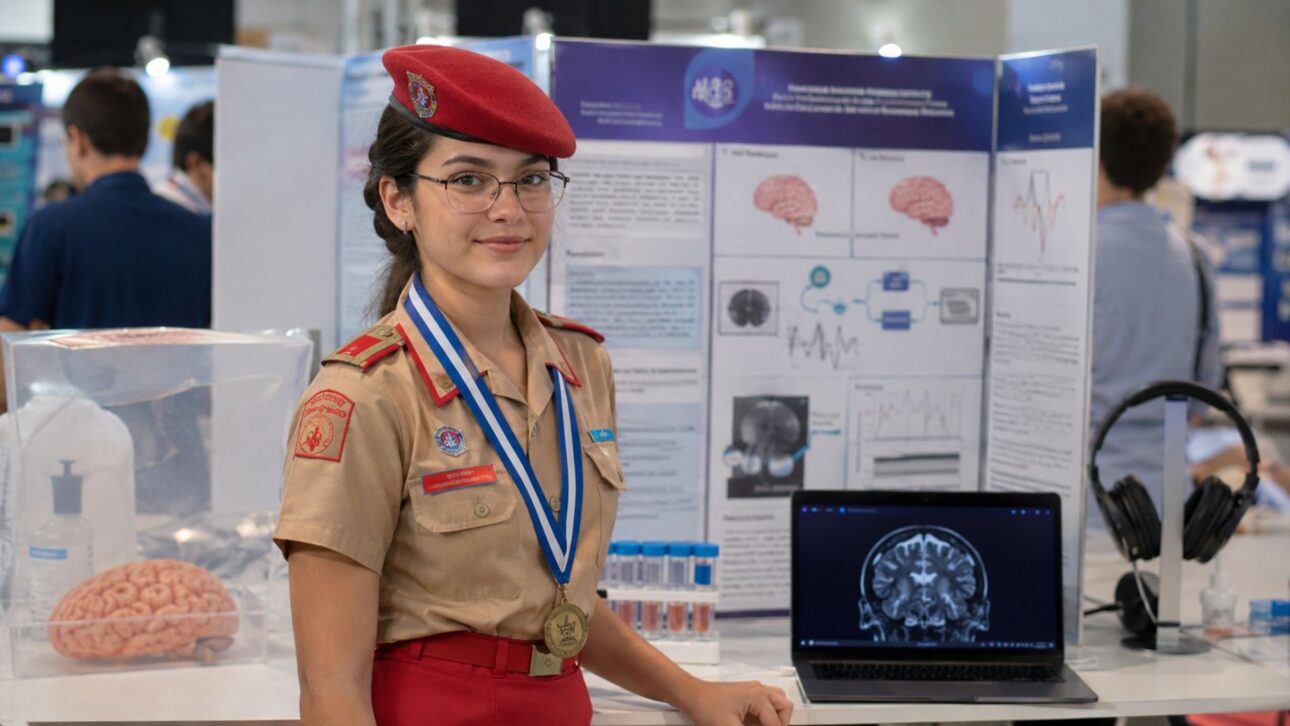
Binaural waves are a brain trick: when each ear receives a sound of slightly different frequency, the brain perceives a third “beat,” the so-called binaural wave. In MeMO, Ada used 12 Hz binaural waves, a range associated with certain patterns of brain activity, to investigate if this sound stimulus could influence processes linked to the disease.
-
Bosch Unveils Revolutionary 2.3 kg Hub Motor for E-Bikes with 45 Nm Torque and 400 Watts Power, Eliminating Resistance Above 25 km/h in Historic Shift for German Manufacturer

-
Brazilian Engineer Develops Marine Bacteria from Ubatuba into a Mini Power Plant Generating 227 mW per Square Meter, Cleans Air by Capturing CO₂ and Releasing Oxygen
-
Trump Signs Orders to Develop Quantum Computer and Bolster U.S. Systems Against Encryption-Breaking Attacks

-
Breakthrough in Clean Energy: Scientists Develop Battery-Free Artificial Photosynthesis Using Only Sunlight to Generate Chemical Energy


The research was not conducted on people, and this detail is essential. The experiment was an in vitro bioassay, meaning it was conducted on lab-cultured cells of the H4 lineage, exposed to a 12 Hz binaural beat for one hour. The scientific question was direct: can sound alter the way certain Alzheimer’s genes express themselves in these cells? MeMO was created to test exactly this, with method and measurement.
The project’s name sums up the ambition. MeMO refers to memory, precisely what Alzheimer’s gradually takes away. Ada’s proposal is to explore a non-invasive and cheap path, where the stimulus would be just sound, without medicine or surgery. It is a promising hypothesis, but it still has a long way to go before becoming anything resembling therapy.
The Alzheimer’s genes that reacted to sound
The results, within the laboratory, caught the evaluators’ attention. Exposed to 12 Hz binaural waves, the cells showed a decrease in the expression of genes associated with neurodegeneration. The highlight was the MAPT gene, linked to the tau protein, whose expression dropped by 48% in the experiment, according to the research details published by the Portal A Crítica.
Other genes also responded, to a lesser extent. The BACE, involved in the formation of plaques related to Alzheimer’s, saw an 11% reduction, and the APP, another disease marker, dropped by 2%. These are three genes involved in the brain’s degeneration processes, and seeing them react to a purely sound stimulus is what makes the finding intriguing for science.
This is where the caution that honesty demands comes in. Reducing the expression of a gene in cells in a laboratory is not the same as treating or curing a person with Alzheimer’s. It is an encouraging sign in a simplified model, not a promise of cure, and the research itself treats this as a starting point. The 48% figure is impressive, but it needs to be read for what it is: an in vitro result, in one hour of exposure.
Who is Ada, the student from Manaus behind the project
Behind the science is a 17-year-old teenager with a story. Ada Jamile Gomes de Oliveira is in her third year of high school at the Military School of Manaus and delved into the topic of Alzheimer’s due to the impact of the disease on people in her own family. The motivation was not abstract; it was the pain of seeing memory fade up close, and this gave purpose to every night of experimentation.
Her school deserves recognition because it breaks a stereotype. The Military School of Manaus is a public, federal institution linked to the Army, showing that cutting-edge science also originates in the public network, in the heart of the Amazon. The student from Manaus proved that talent has no ZIP code, and that there is a lack of opportunity, not capacity, in the interior and the North of the country.
What drives Ada appears in her speech. “Knowing that our dedication, from experiments to long nights of research, has a real impact fills us with pride,” said the student from Manaus to Portal A Crítica. It’s the pride of someone who turned a family tragedy into serious scientific investigation, and not just a vent.
From the Amazon to the world stage: 4th place at ISEF 2026
The recognition came on the biggest stage possible for a young scientist. MeMO achieved 4th place in the Translational Medical Science category at ISEF 2026, with a prize of $600, at the fair held from May 9 to 15 in Phoenix, United States. ISEF 2026 is the largest pre-university science and engineering fair in the world, and competing there is already a huge achievement.
The path there went through Brazil. Ada reached ISEF 2026 after standing out at FEBRACE, the Brazilian Science and Engineering Fair, promoted by the Polytechnic School of USP, which is the main gateway for Brazilian students to the international competition. The Brazilian delegation had a strong performance, bringing home several awards, and the student from Manaus was one of the voices of this group.
Putting a project from the Amazon on the world stage has enormous symbolic weight. It means that a public school teenager, starting from a family pain, competed and won alongside the brightest young people on the planet. The fair put Manaus on the world science map, and showed that deep Brazil also produces cutting-edge innovation.
The promise of an auditory therapy, and why it’s still early
The idea behind MeMO is enticing, and it’s easy to understand the enthusiasm. If binaural waves really influence Alzheimer’s genes, it opens up the possibility of a complementary, cheap, and non-invasive approach, where listening to a certain sound would help take care of the brain. It would be a treatment without needles, without expensive medicine, and accessible to anyone with a headphone, the dream of any health system.
But this is where we need to keep our feet on the ground. The study was conducted on cells, in a single hour of exposure, and is far from proving any effect on humans. The next steps planned include in vivo tests and analysis of brain electrical activity during stimulation, stages that take years and may not confirm what the lab suggested.
That’s why the right word is caution, not miracle. MeMO is a promising finding that deserves continued research, not a cure waiting for approval. Treating Alzheimer’s remains one of the greatest challenges in medicine, and no family should create false hope from an in vitro result, no matter how encouraging it is. The value of the project lies in pointing a way, not in delivering the arrival.
Why this matters to millions of families
Even with all the caution, the relevance of the topic is enormous. Alzheimer’s affects millions of people worldwide, stealing memory and autonomy, and still has no cure, only treatments that alleviate symptoms. Any thread of scientific hope, even distant, mobilizes entire families living with the disease, and it was from one of these families that MeMO was born.
There is also a message about where innovation comes from. It was not a large international laboratory that raised this bold hypothesis with binaural waves, but a student from Manaus, in the public network, with guidance and a lot of persistence. Investing in education and science in Brazil is what brings forth people like Ada, capable of competing at the highest global level.
In the end, the case balances emotion and responsibility. On one hand, the inspiring story of a young woman from Amazonas awarded at ISEF 2026 for creatively tackling Alzheimer’s. On the other, the duty to explain that serious science takes time. It is possible to celebrate the achievement without promising what does not yet exist, and this is exactly how the achievement of the student from Manaus should be read.
Ada Jamile’s journey sums up the best of science done by young people in Brazil. Starting from a family pain, she created MeMO, used binaural waves to modulate genes linked to Alzheimer’s in the laboratory, and took the name of Manaus to the podium of ISEF 2026. It is a promising start, with feet on the ground, and not an announced cure. The future will tell how far this sound can reach.
And you, do you believe that sound stimuli like binaural waves might one day become a real help against Alzheimer’s, or do you think it’s still too early to create expectations? Share here in the comments what you think about this type of Brazilian research.




Be the first to react!