






 Portuguese
  Spanish


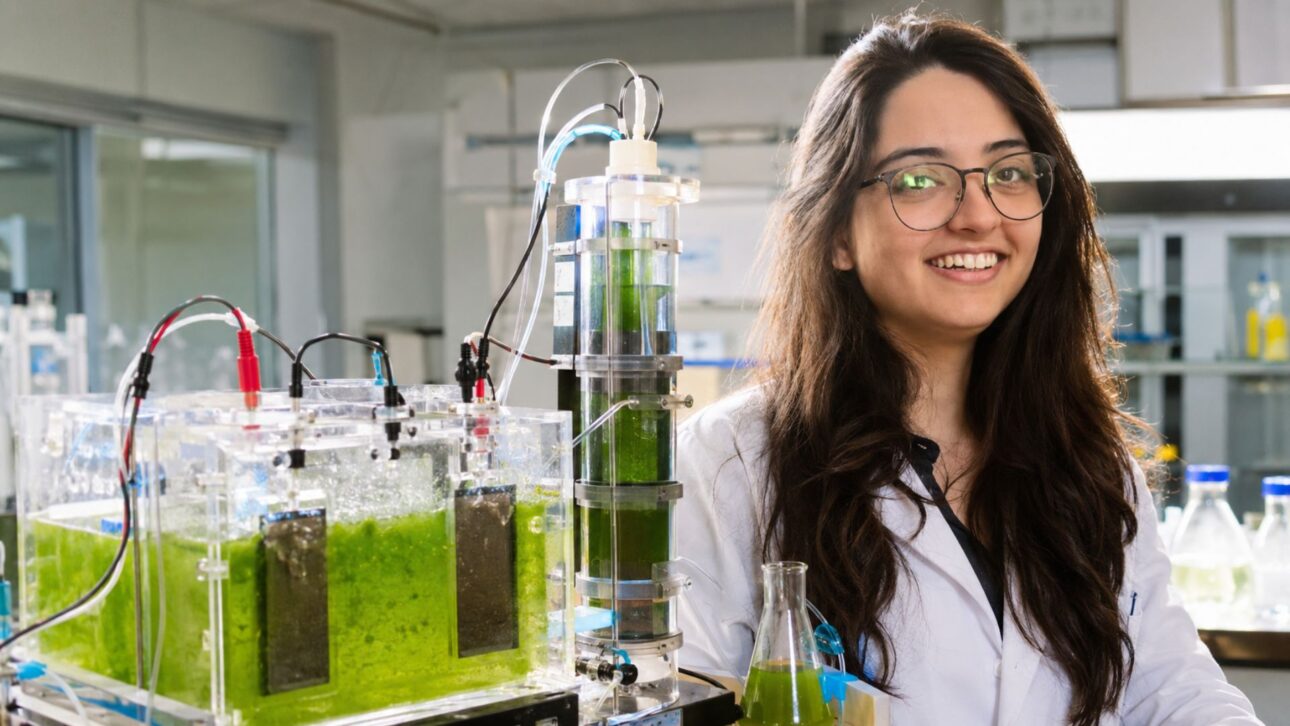
At Unesp, engineer Giulia Castro used a marine cyanobacterium collected in Ubatuba to create a bio-photovoltaic cell that generates energy through photosynthesis: the bacterium releases electrons captured by electrodes. The prototype produces 227 mW per square meter, captures CO2, releases oxygen, and already has a patent at INPI.
Imagine a device that produces electricity and, at the same time, cleans the air you breathe. It’s not fiction: it’s what a marine cyanobacterium, invisible to the naked eye, does inside a prototype created in the interior of São Paulo. While it lives and performs photosynthesis, it generates enough electrical current to power a sensor and still captures carbon dioxide, returning oxygen to the environment. Energy and depollution in the same gesture.
The feat belongs to bioprocess engineer Giulia Castro, under the guidance of Professor Guilherme Peixoto, at the Faculty of Pharmaceutical Sciences at Unesp, in Araraquara. As reported by Metrópoles, the system uses the marine cyanobacterium Synechocystis pevalekii, collected off the coast of Ubatuba, in São Paulo’s coastline. The prototype managed to generate 227 mW per square meter and had the patent filed at INPI, the institute that protects industrial property in Brazil. It’s national science literally lighting up.
How a marine bacterium becomes a source of energy
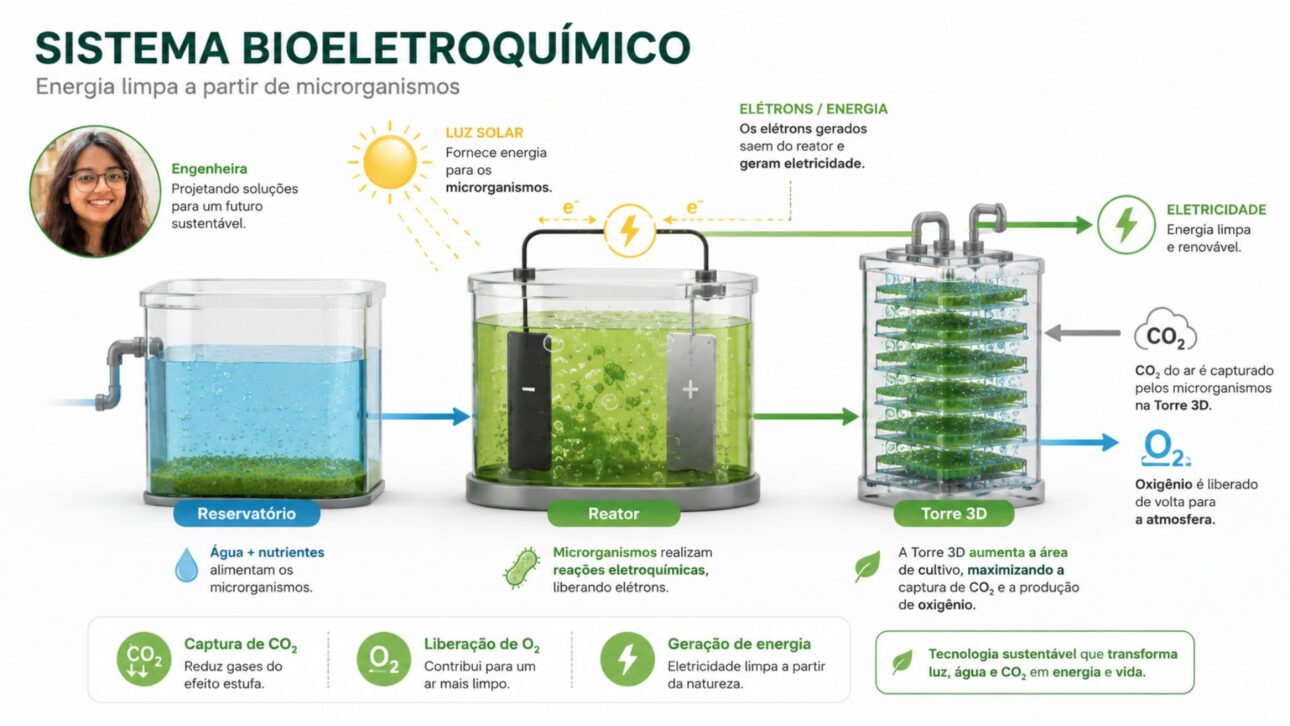
During photosynthesis, the cyanobacterium breaks down water molecules and releases electrons, the particles that form the electrical current. Metal electrodes positioned in the system capture these electrons and create a potential difference, exactly what makes the energy flow. The microscopic plant works, and the device harvests the surplus.
-
Trump Signs Orders to Develop Quantum Computer and Bolster U.S. Systems Against Encryption-Breaking Attacks

-
Breakthrough in Clean Energy: Scientists Develop Battery-Free Artificial Photosynthesis Using Only Sunlight to Generate Chemical Energy
-
Revive Old Photos: Gemini’s Little-Known Feature Uses AI to Restore Damaged Images in Seconds with a Professional Six-Step Recovery Process

-
Young Brazilian Inventor Develops Microplastic Filter, Wins Scholarship to Study in China, and Implements Solution to Improve Water Quality in Southern Brazil


The most interesting part is that the cyanobacteria doesn’t need to die for this. It remains alive, performing photosynthesis as it would in the sea, and the system simply takes advantage of a natural byproduct of this process. It’s truly clean energy because it comes from the same mechanism that sustains life on the planet, without burning, without fossil fuels, and without emissions.
To capture the electrons, the project used simple and inexpensive materials. The electrodes are made of copper, zinc, and conventional metal alloys, nothing rare or expensive. It was precisely this combination of low cost and good results that surprised the researcher herself. “What surprised me the most was how good the results were,” said Giulia Castro, considering the modest material she had on hand.
227 mW per square meter: what the number means
The headline number needs to be understood in the right measure. In tests with LED lighting that simulates the sun’s spectrum, the bio-photovoltaic cell generated 227.47 mW per square meter. Under direct sunlight, with natural variations in climate and temperature, the result was 215.3 mW, a difference of about 5%. It’s enough energy to power sensors, digital watches, or calculators, and not much more than that, for now.
This is where the honesty that all good science requires comes in. According to Olhar Digital, a bio-photovoltaic cell like this generates about a thousand times less energy than a conventional solar panel. In other words, it’s not about replacing solar energy or powering a house today, but rather offering a clean source for devices with very low consumption. The exaggeration would be to promise what the technology does not yet deliver.
It’s in this niche that the real value of the invention lies. Environmental sensors spread in forests or rivers, remote monitoring systems, and devices of the so-called Internet of Things need little energy and are located in places difficult to wire. A bio-photovoltaic cell that feeds on light and a bacterium can be perfect for these cases, functioning far from outlets and without changing batteries.
The twist: generates energy and also cleans the air
If generating clean energy would already be enough, the system has a second trick that is most enchanting. The same cyanobacteria that produce electricity also capture CO2 from the atmosphere and release oxygen, because that’s what photosynthesis does. The device, therefore, not only avoids pollution but actively helps to depollute, removing carbon dioxide from the air while it works.
The scale of this effect takes shape in a simple and powerful calculation. According to the research, a thousand liters of bacterial culture would be capable of removing the CO2 emitted by a standard car driving 10 kilometers a day. Not bad for a column of greenish water full of microorganisms, and it gives a concrete idea of the environmental potential behind the idea.
Researchers see a path that goes beyond energy. For Professor Guilherme Peixoto, the technology opens a door to the environmental market. “This configuration could generate carbon credits and help” countries meet emission reduction targets, highlighted the advisor. Producing electricity while capturing CO2 at the same time is the kind of combination the planet needs, and Giulia sums it up well: according to her, generating energy this way “would ensure the reduction of carbon concentration” in the atmosphere.
The bacteria collected in Ubatuba
Synechocystis pevalekii is a marine cyanobacterium collected on the coast of Ubatuba, in the northern coast of São Paulo, and is now preserved in the microorganism collection of the Oceanographic Institute of USP. It was from the sea of Ubatuba that the organism emerged, which now generates electricity in a laboratory in the interior of São Paulo.
The choice of a marine bacterium is not random. Cyanobacteria are among the oldest and most resilient living beings on the planet, and it was they who, billions of years ago, through photosynthesis, helped fill the atmosphere with oxygen. Using a species from the coast of Ubatuba connects innovation to a Brazilian natural heritage, which gives even more strength to the story. The raw material of the technology is native.
This detail reinforces the national character of the achievement. From the collection in Ubatuba to the patent at INPI, passing through the Unesp laboratory, it is a 100% Brazilian chain of science. It was not imported technology nor foreign bacteria, but rather knowledge and biodiversity from the country itself transformed into innovation with potential global impact.
The three modules of the prototype
Behind the result is a device designed in detail. The bio-photovoltaic cell is divided into three parts that work together: a reservoir that houses the cyanobacteria, a bioelectrochemical reactor where the current is collected, and a tower that captures sunlight. This tower was 3D printed to distribute the lighting evenly, ensuring that the bacteria receive light equally.
The project was not born ready. It took about two years to develop and began as an interdisciplinary challenge proposed by Professor Peixoto, bringing together biology, chemistry, and engineering. Turning a classroom idea into a patented bio-photovoltaic cell is a huge leap, and shows what well-guided university research can achieve.
The simplicity of materials is once again the trump card. With copper, zinc, and common alloys, combined with a bacteria that reproduces itself under light, the cost of assembling the system is low. It is innovation with reduced environmental impact both in operation and manufacturing, the opposite of green technologies that are expensive and polluting to produce.
From sensor to carbon credit: what’s coming next
The future of technology is promising, as long as it is seen as a projection, not as a ready promise. In the short term, the realistic target is to power sensors and small computers, the niche where CO2 capture and energy generation already make sense today. This is where the technology should start moving from the lab to the real world.
The medium and long-term plans are more ambitious. The team projects, with scale advancement, to generate enough energy for a small apartment and, in the future, to operate on a large scale with the potential to generate carbon credits. These scenarios, however, are still goals, not reality, and depend on a lot of research and investment to materialize.
Even so, the starting point is already rare. A cyanobacterium from Ubatuba became a patented bio-photovoltaic cell that combines clean energy and CO2 capture in a single device, made by a Brazilian engineer with cheap material. When such an innovation is born within a public university, the entire country gains an asset, and the race now is to turn the prototype into a product.
In the end, the Unesp case shows science doing what it does best: looking at nature and learning from it. A cyanobacterium collected in Ubatuba, which generates 227 mW per square meter, captures CO2 and returns oxygen, is proof that energy and the environment don’t need to be on opposite sides. It may still be small, but that’s exactly how big changes begin.
And you, did you imagine that a sea bacterium could light up a sensor and help clean the atmosphere at the same time? Share in the comments if you believe technologies like this bio-photovoltaic cell will become part of our daily lives, or if they still seem too far from reality.





Be the first to react!