Portuguese
  Spanish


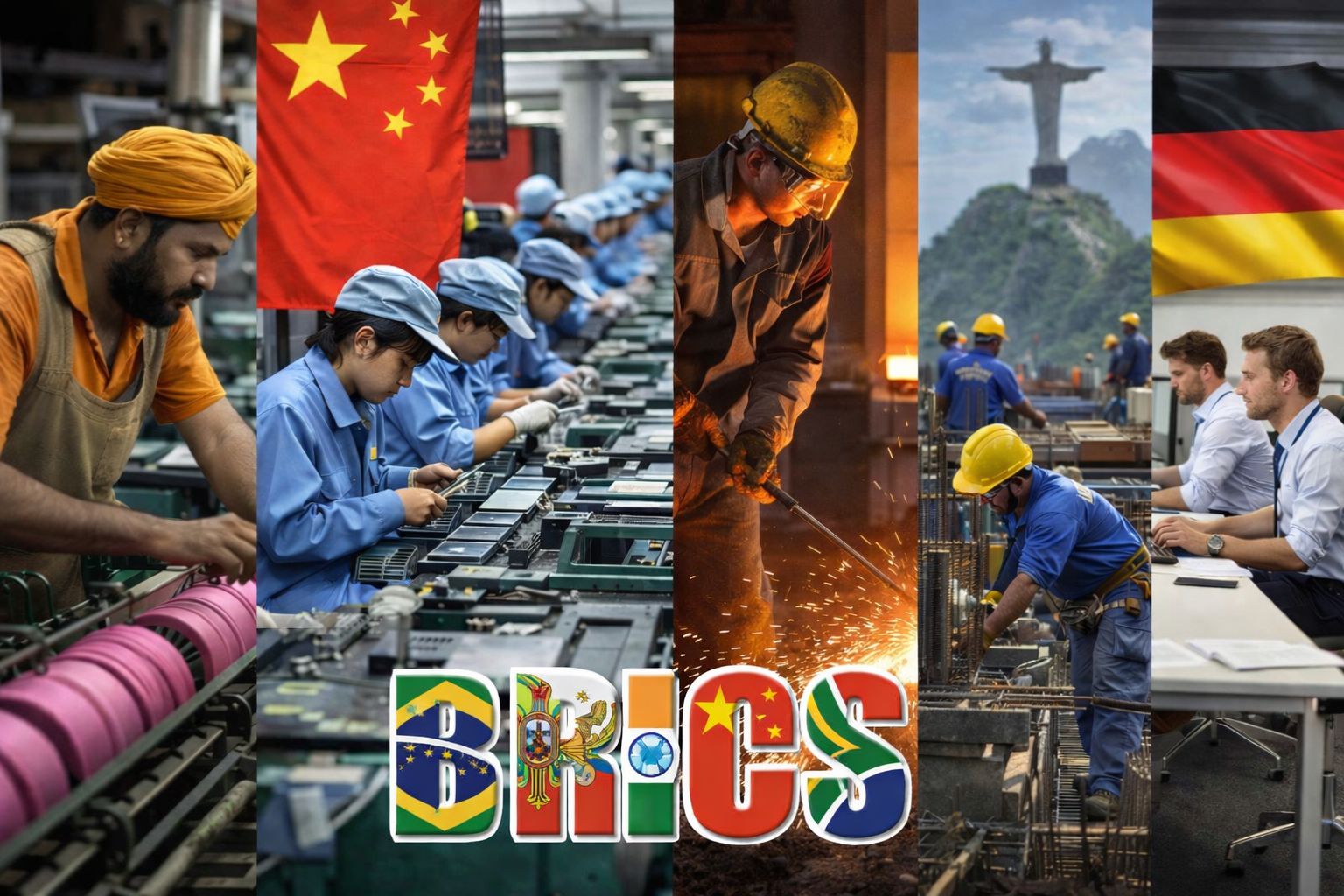

Data from Our World in Data shows that BRICS countries dominate the global ranking of hours worked. India leads with 2,382 annual hours, followed by China (2,327), Russia (2,086), and Brazil (1,993). Germany appears in the last position among the 15 largest economies, with only 1,335 hours, almost a thousand less than India and with a much higher per capita income.
The BRICS countries work more than any other economic group on the planet, and the numbers leave no room for interpretation. Data compiled by Our World in Data for 2023 shows that India leads the global ranking of hours worked with 2,382 annual hours, equivalent to 9.16 hours per working day. China follows closely with 2,327 hours, followed by Russia with 2,086 and Brazil with 1,993 hours, completing four of the five highest positions in the ranking among the 15 largest economies in the world. At the other end, Germany records only 1,335 annual hours, which means that a BRICS Indian worker spends approximately a thousand more hours at work per year than a German.
The contrast between BRICS countries and developed economies raises an uncomfortable question. Brazilian workers logged 1,993 hours in 2023, approximately 33% more time than Germans during the same period, but Germany’s per capita income is several times higher than Brazil’s. The logic that working more generates more wealth does not hold when the data is placed side by side: BRICS countries dedicate more time to work, but productivity per hour is significantly lower, which explains why more hours do not translate into more prosperity for the workers in these countries.
The complete ranking of hours worked that puts BRICS at the top
According to information released by the InfoMoney portal, the 2023 data shows a clear division between emerging and developed economies. At the top of the ranking, the four BRICS members occupy the top positions among the 15 largest economies: India (2,382 hours), China (2,327), Russia (2,086), and Brazil (1,993). South Korea appears in fifth with 1,910 hours, being the only developed economy with a working hours comparable to those of BRICS countries.
-
At 14 years old, she worked in a factory in Hong Kong, studied economics abroad, and then entered the Chinese real estate market, which helped change the landscape of Beijing.

-
While NATO secured more than $10 billion in missiles and space surveillance at a single forum, Brazil still spends 1.1% of its GDP on defense and is stalling its own anti-aircraft system.

-
Corn ethanol attracts R$ 23 billion in 21 new plants and prepares for a nearly 50% jump in Brazilian production by 2027, even with high interest rates.
-
A newly opened terminal in the middle of the Amazon has begun transporting soy and corn through Amapá, eyeing the queue of ships that is congesting the ports in the South.


Below South Korea, the scenario changes completely. The United States records 1,788 hours, Canada 1,731, Italy 1,701, Japan 1,653, Spain 1,637, Mexico 1,628, Australia 1,611, the United Kingdom 1,522, France 1,487, and Germany 1,335, the shortest working hours among the major economies. The division is consistent: while BRICS countries work more than 7 hours per working day, developed nations fall below 6.9 hours. The difference may seem small in a day, but over a year it turns into hundreds of hours that BRICS workers spend at work while Europeans are at home.
How the working day has changed in the last 150 years outside the BRICS
The current difference between BRICS countries and Europe did not exist 150 years ago. In 1870, workers in the countries that industrialized first worked over 3,000 hours a year, equivalent to 60 or 70 hours a week, a pace comparable to what India practices today. At that time, there was no significant distinction between the industrialized world and the rest: everyone worked brutal hours that consumed most of their waking hours.
The revolution occurred in wealthy countries. In Germany, the annual working hours decreased by almost 60% from the late 19th century to the 2010s. In the United Kingdom, the reduction was about 40%. Labor rights, unionization, industrial automation, and increased productivity allowed these countries to produce more in less time, freeing workers for other activities. In BRICS countries, this process occurred more slowly and incompletely, and the result is visible in the numbers from 2023.
Why BRICS Brazilians work 33% more than Germans
Brazil recorded 1,993 hours worked in 2023, a number that has been slowly decreasing over the decades but is still well above European standards. In 1950, at the beginning of the historical series analyzed for Brazil, the population worked 2,364 annual hours, equivalent to about 9 hours a day from Monday to Friday. The reduction of 370 hours over 73 years represents progress, but at a much slower pace than that of the countries that currently lead in quality of life.
The comparison with Germany is particularly revealing. Brazilians work 658 hours more per year than Germans, equivalent to almost three extra months of work, without this being reflected in proportional wages or quality of life. The explanation lies in productivity: the German economy produces more value per hour worked thanks to investments in education, technology, automation, and infrastructure that multiply the output of each hour of work. In Brazil, and in other BRICS countries, low productivity forces workers to compensate with more hours for what the economy cannot deliver efficiently.
What the working hours ranking reveals about the future of BRICS
The data from the ranking suggest that BRICS countries are in a development model that prioritizes the volume of work over efficiency. While Germany reduced its working hours by 60% and multiplied its wealth, BRICS members maintain long hours that physically and emotionally exhaust their workers without generating the same economic return. The question is not just how many hours are worked, but how much each hour produces.
For Brazil, which is actively debating the end of the 6×1 shift and the reduction of the workweek to 40 hours, the data reinforces that working less can mean producing better, as long as the reduction in hours is accompanied by investments in productivity, professional training, and technology. Studies like the 4 Day Week show that Brazilian companies that tested reduced hours experienced an increase in revenue, suggesting that the BRICS country with the fourth longest workweek in the world can benefit by following the path that Europe took decades ago.
The difference between working more and producing more in BRICS countries
The ranking of hours worked destroys a persistent myth. Working more does not necessarily mean producing more or earning more, and the data from BRICS countries is the definitive proof. India works 2,382 hours a year and has a per capita GDP of about $2,400. Germany works 1,335 hours and has a per capita GDP of over $50,000. The difference is not in the dedication of the workers, but in the economic structure that transforms hours into wealth.
For citizens of BRICS countries who work more than practically anyone in the developed world, the message from the data is clear: the path to prosperity does not lie in working even more, but in creating conditions for each hour worked to produce more value. Until this happens, Indians, Chinese, Russians, and Brazilians will remain at the top of a ranking that no one should want to lead.
BRICS countries work more than the rest of the world and earn less. Do you think that working more hours means being more productive? Should the Brazilian workweek be reduced? Leave your opinion in the comments.