Portuguese
  Spanish


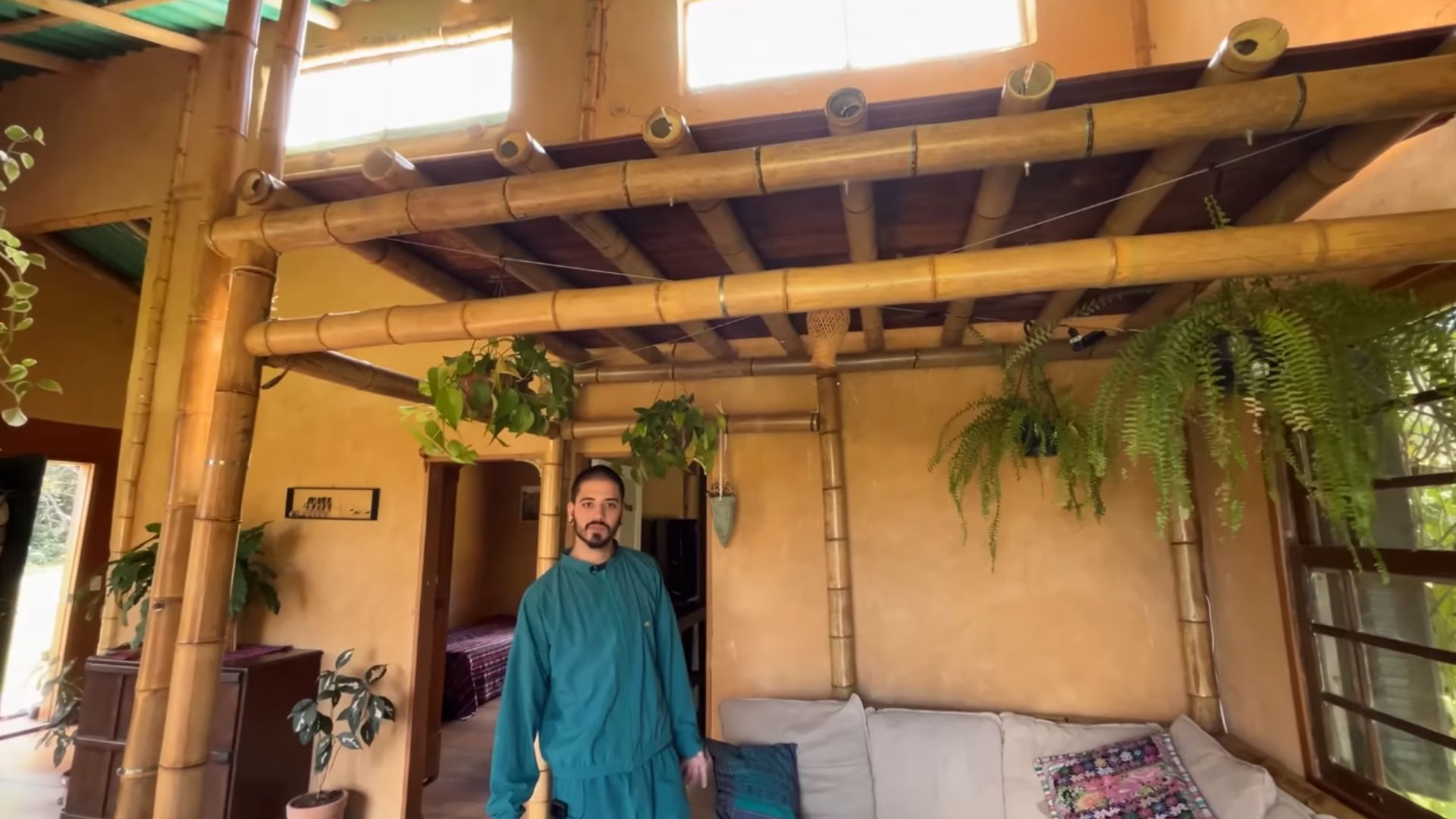

In Monteiro Lobato, Bernardo and Bruno took almost two years to single-handedly build a residence made of bamboo, earth, and recycled materials, amidst nature
Amidst the Serra da Mantiqueira, between rivers and dense vegetation, two brothers decided to transform a virgin plot into a life project. Bernardo and Bruno, self-taught bio-builders, built with their own hands a house made mostly of bamboo and earth — a process that took almost two years and today results in one of the most sought-after spaces in the Monteiro Lobato region, in the interior of São Paulo.
The story started from scratch. When the brothers arrived at the land, there was no electricity, infrastructure, or any previous structure. Faced with this scenario, they decided that the entire construction would follow principles of sustainability, reuse, and low environmental impact. Information about the complete construction process was released by the channel Entre Pra Morar, on YouTube, in a report published on August 23, 2024.
The choice of bamboo and the challenges of erecting a natural structure
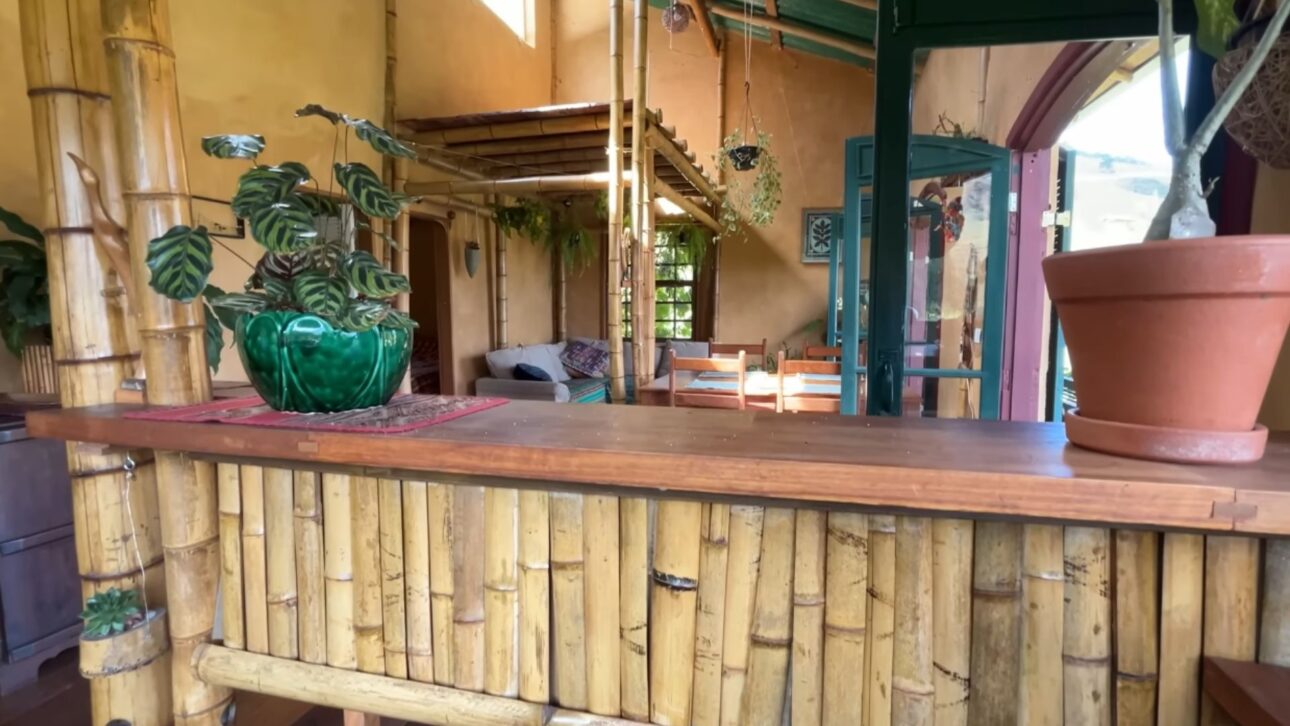
The first major challenge of the project was the selection of the main material: bamboo. According to the brothers, it was not just any variety. They opted for a specific type, known as forest bamboo — different from clump bamboo, more common in makeshift constructions. To start the work, 100 five-meter-long poles were selected one by one, all brought to dry and undergo treatment before assembling the structure.
-
At 22, Andréia left law school to become a truck driver; six years later, she travels across Brazil transporting grains with 130,000 followers.

-
81-Year-Old Brazilian Farmer Preserves Working Sugarcane Mill and Centuries-Old Tools, Showcasing Rural Heritage
-
Over 15 Years After Michael Jackson’s Death, Convicted Doctor Opens Own Clinic in Trinidad and Tobago, Reigniting Debate Over His Career

-
After 100 Job Rejections, 17-Year-Old in Brazil Starts Car Wash Business and Attracts Offers



Just this initial stage, of selecting and preparing the bamboo, took about three months of work. Then came the stages of closing the walls, made with the wattle and daub technique — a traditional method that combines a wooden or bamboo structure with clay. In total, considering delays caused by the pandemic, the entire construction took approximately two years to complete.
However, using bamboo as a structural material requires specific care. According to Bernardo and Bruno, the plant is resistant but delicate: it can crack naturally, which requires reinforcements with clamps — a common practice in most constructions of this type. Moreover, bamboo cannot be exposed to constant cycles of rain and sun without adequate protection, which made it necessary to design a wider roof, capable of preventing direct water incidence on the structure.
To ensure the durability of the material, the brothers also carried out an immersion treatment process. In a pit lined with tarpaulin, the already dry bamboo was submerged in a diluted solution of copper sulfate and boric acid, in a ratio of 1 to 100, for a period of seven to ten days. This process causes the bamboo to replace its natural sap — attractive to insects — with mineral components, making it less vulnerable to pests. According to the bioconstructors, this step is what guarantees the longevity of the structure over the years.
A suspended, sustainable house built with recycled materials
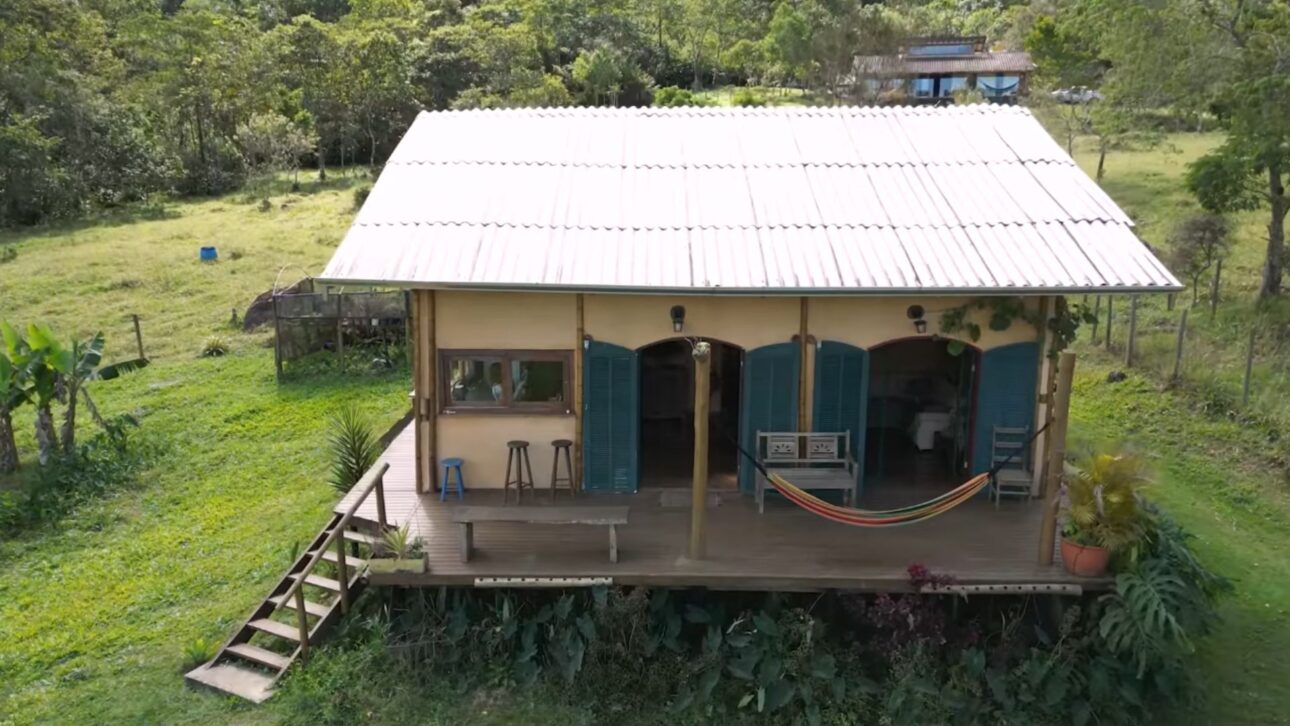
Another important decision of the project was to build the house suspended from the ground. The choice has a technical explanation: the region, located between two rivers, has constantly high humidity. For this reason, the brothers chose to elevate the structure — 35 centimeters at the back and more than a meter at the front — using demolition wood to compose the floor and the foundation, the base that supports the walls.
This choice brought benefits beyond protection against moisture. According to the bioconstructors, keeping the house suspended also helps prevent the entry of animals such as snakes and spiders, common in rural areas like the Serra da Mantiqueira. Still, the benefit goes beyond safety: the elevated structure preserves the total permeability of the soil, contributing to the environmental balance of the surroundings. From a thermal point of view, the result is also positive — in summer, the space remains cooler; in winter, warmer.
The roof, in turn, was made with recycled long-life packaging panels, provided by a specialized company. Light, resistant, and with good thermal and acoustic performance, the material significantly reduced the cost of the construction, as it allows for greater spacing between the wooden beams — up to a meter apart.
In this sense, the search for sustainability was not limited to bamboo and the general structure. Practically all the internal items of the residence originate from reuse: doors and windows were acquired through online donation groups and social media marketplaces; iron pieces came from scrap yards; and even appliances, such as a stove and refrigerator, were obtained through donation. The sewage treatment system also follows an ecological logic, using a banana circle and evapotranspiration basin — natural methods of wastewater treatment. The property’s water supply comes directly from a local spring.


Identity, bamboo reuse, and future plans for the Entre Rios space
After the intense construction period, the brothers began a new phase: giving identity to the house. About a year after moving in, small adjustments began to shape the space in a more personal and functional way. A highlight of this process was the creative reuse of leftover bamboo from the construction, transformed into plant pots, a countertop, a coat rack, and other handcrafted decoration items.
Moreover, the internal aesthetic details also incorporate sustainable solutions. To cover walls partially made with brick — strategically used in areas that receive piping, such as the kitchen and bathroom — the brothers created a natural earth paint, made with glue, water, and sieved earth. The result, according to them, is practically indistinguishable from the rest of the mud plaster, made with hydrated lime, water, earth, and sand.
On the other hand, the house also holds plans for the future. A mezzanine is already under construction, planned from the start of the project to expand the living space. Also planned for the coming days is the construction of a geodesic dome — another structure suspended for the same reason as the main house: the constant presence of humidity in the region.
The property, named Entre Rios space, totals 62,000 square meters. Although the initial goal was to create a residence for the brothers themselves and a space to host friends, volunteers, courses, and cultural events, the site also began operating as short-term accommodation through rental platforms. According to Bernardo and Bruno, the demand for accommodation in the region has grown, especially among visitors from São Paulo seeking rest — which opened the door for the construction of new chalets on the land, expanding the income source and enabling other future projects.
Still, the cultural purpose remains central to the project. The brothers intend to continue promoting events and educational activities in the region, as well as offering free guidance for those wishing to venture into bioconstruction. According to them, this sharing of technical knowledge — which they have dubbed “knowledge democratization” — is an essential part of the mission behind the Entre Rios space.
Stories like that of Bernardo and Bruno reinforce a growing movement in Brazil: people seeking more sustainable housing alternatives, combining traditional techniques, natural materials, and conscious reuse. Therefore, more than just a simple residence, the bamboo and earth house built in the Serra da Mantiqueira consolidates as a symbol of a lifestyle that prioritizes simplicity, connection with nature, and environmental responsibility — proving that it is possible to build a functional, beautiful, and ecologically balanced home with patience, creativity, and few resources.