






 Portuguese
  Spanish
  4 min of reading
  0 comments


Training in Civil Construction Is Essential to Ensure Quality, Safety, and Efficiency in Works, Promoting Professional Development and Advancement of the Sector.
The training in civil construction undoubtedly plays a fundamental role in the evolution of the workforce, the quality of works, and consequently, the growth of the sector.
In Brazil, known for its large constructions and a market that employs millions of workers, we have always depended on the training of professionals as a critical point.
From the first colonial constructions in the 16th century, when the Portuguese built the first forts and churches, to the modern skyscrapers and infrastructure works of the 21st century, the civil construction sector demands technical knowledge, adaptation to new technologies, and commitment to safety.
-
Bolivian Female Construction Workers Form Association to Combat Discrimination and 38% Pay Gap in the Industry

-
Near Amsterdam, residents buy land and discover they must also build streets, manage drainage, handle waste, and grow food on half their plot.
-
Brazil’s WEG to Open New Factory in China by 2027, Expanding Production of Large Rotating Electric Machines and Low to Medium Voltage Motors in Rugao

-
Chinese Shipyard Secures $1 Billion in Orders for Low-Carbon Container Ships Amid Global Fleet Renewal Efforts


According to the Brazilian Institute of Geography and Statistics (IBGE), which has been tracking the evolution of the sector for decades, civil construction represents about 7% of Brazil’s Gross Domestic Product (GDP), with significant growth starting in the 20th century, driven by accelerated urbanization.
In the past, the transmission of knowledge was almost exclusively empirical, passed down from generation to generation by experienced foremen and bricklayers.
This practice prevailed until the mid-20th century, when, according to data from the National Service for Industrial Training (SENAI), the first formal technical courses for civil construction began to emerge, professionalizing the workforce.
Since then, training has evolved to meet new technical and legal requirements. Today, unions, companies, and institutions like SENAI offer courses that cover everything from basic techniques to the use of advanced technologies, promoting a more qualified sector.
Importance of Training for the Quality of Works

Trained professionals interpret architectural and engineering projects better, in addition to applying materials correctly and operating machinery safely.
This reduces errors and waste, increasing productivity in works.
Moreover, trained workers are more likely to advance in their careers, taking on leadership positions and increasing their employability.
Therefore, companies that invest in training deliver superior quality works, face less rework, and gain competitiveness.
Workplace safety is also an essential factor.
Civil construction involves high risks, such as working at heights and using heavy equipment.
According to the Jorge Duprat Figueiredo Foundation for Safety and Labor Medicine (Fundacentro), which has been working since 1966 to prevent accidents, regular training of workers reduces accidents on construction sites by up to 20%.
Complying with the Regulatory Standards (NRs) of the Ministry of Labor, especially NR-18, which deals with safety in civil construction, directly depends on the training of professionals.
Challenges and Opportunities of Training in Brazil

Despite the advances, Brazil still faces significant challenges.
Access to courses is unequal, especially outside the major urban centers.
Many workers, according to SENAI, still do not recognize the value of formal qualification, which limits their growth.
However, opportunities have been growing.
In 2023, SENAI recorded a 15% increase in enrollment in courses focused on civil construction, partly due to the expansion of online modalities.
Moreover, major construction companies have invested in internal training programs to prepare their employees.
New technologies, such as Building Information Modeling (BIM), drones, management software, and modular construction, are transforming the way of building.
According to a recent report from the Brazilian Chamber of the Construction Industry (CBIC), published in 2024, the use of BIM increased productivity by 25% in the works that adopted it.
Therefore, professionals need to stay increasingly updated to keep up with this transformation.
Training in Civil Construction as a Strategy for Economic and Social Growth
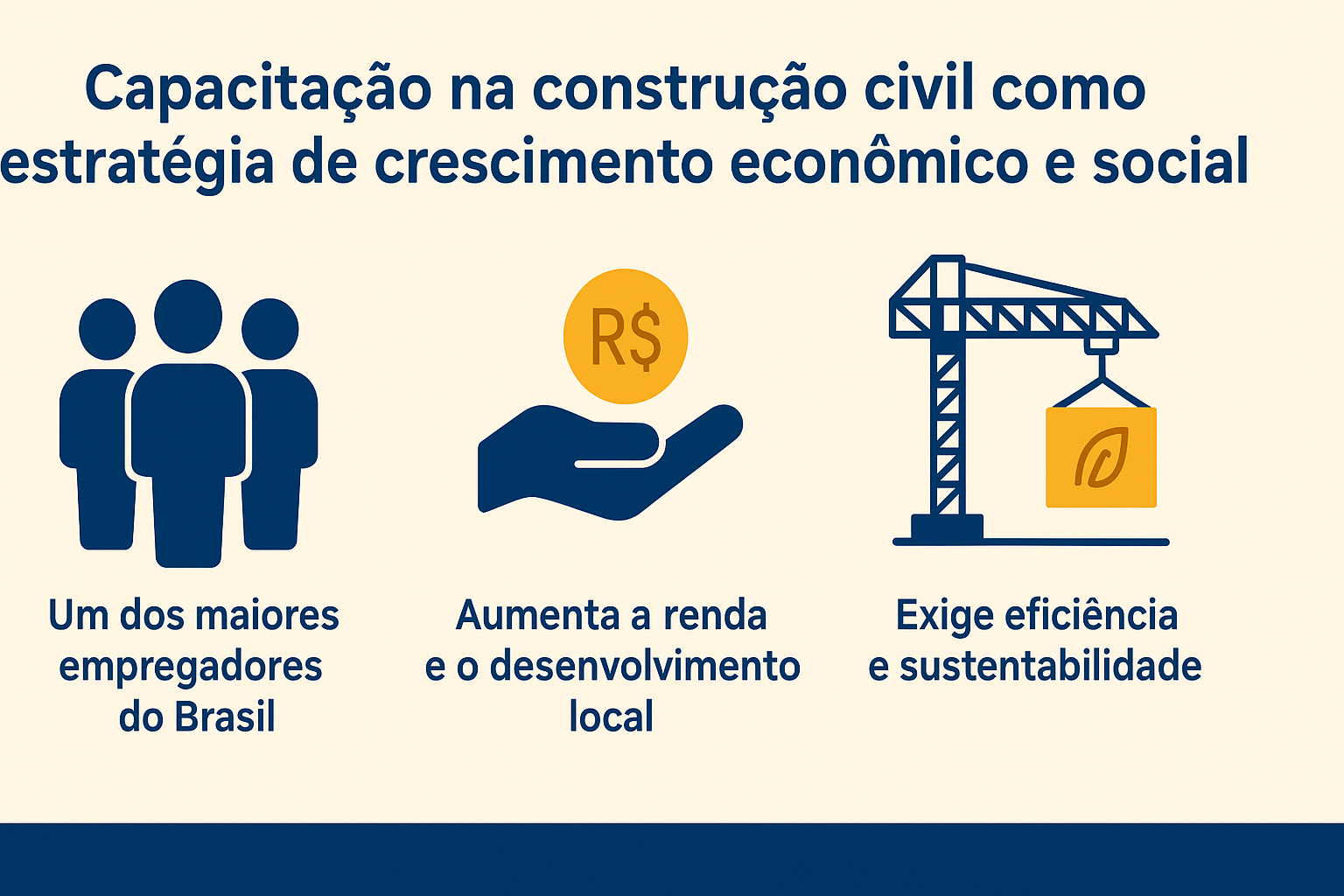
Investing in the training of the workforce in civil construction is not just a technical issue.
It also generates economic and social impact.
The sector is one of the largest employers in Brazil, opening opportunities for different profiles.
When workers receive qualified training, they get better job placements, increase their income, and stimulate local development.
The growth of cities and the need for sustainable infrastructure reinforce the importance of qualified professionals.
Thus, contemporary works require not only efficiency but also attention to sustainability, technology, and accessibility.
This demand reinforces the need for continuous training.
Promoting a culture of lifelong learning is essential for the future of the sector.
More than just one-off courses, companies and institutions should encourage constant improvement.
The Future of Construction Passes Through Training
In summary, training in civil construction has ceased to be a differential and become a fundamental necessity.
The sector drives the Brazilian economy, transforms landscapes, and impacts the lives of millions of people.
Training good professionals is a commitment to quality, safety, and the future of construction.
Valuing training means investing in workers, in the company, and in society as a whole.
By following this path, we move towards a civil construction more human, efficient, and prepared for the challenges of the present and the future.



Be the first to react!