Portuguese
  Spanish


Axion Aircraft Uses Eight Jet Microturbines, Reaches 350 km/h And Promises To Revolutionize Personal, Emergency, And Cargo Transportation
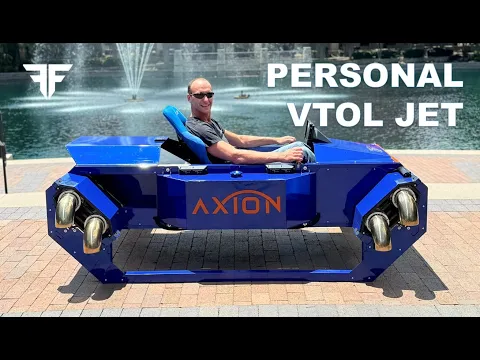
The American startup FusionFlight, based in Texas, presented a project that could change personal aerial mobility. It is the Axion, a vertical takeoff and landing (VTOL) aircraft that draws attention for dispensing with electric motors and relying on eight jet microturbines.
The vehicle is capable of carrying one person and promises to be useful in emergency situations and cargo transportation.
Equipped With Eight Jet Engines
The Axion is an evolution of the JetQuad AB6, a jet drone developed by the same company. The new model uses eight microturbines with thrust vectoring nozzles.
-
Storm Chasers Get Too Close to Oklahoma Tornado, Record 128.8 mph Winds, and Attempt Drone Launch to Measure Pressure and Speed in Dangerous Operation

-
Iranian Scientists Develop Artificial Brain in Lab Using Living Human Neurons Capable of Learning and Forming Neural Networks

-
UK Selects Abandoned Nuclear Island for Rolls-Royce Reactors to Test Mini-Plant Viability Over 60 Years

-
12-Year-Old Indian Girl Invents FreshPaper, a Spice-Inspired Sheet That Extends Fruit Freshness by Four Times, Now Patented in the U.S.




These engines run on diesel, kerosene, or Jet-A, collectively generating 1,097 Nm of thrust. With this system, the aircraft can take off vertically, reach speeds above 350 km/h, and maneuver with agility even in tight spaces.
To fuel the engines, the Axion has two tanks with a total capacity of 113 liters. The flight autonomy is up to 15 minutes.
The control can be done in two ways: manually, with two electronically assisted joysticks, or in autonomous mode.
In automatic mode, the pilot simply selects the destination in a software, and the aircraft manages the takeoff, route, and landing by itself.
Flexible And With Multiple Applications
Versatility is one of the main highlights of the Axion. The aircraft can function as personal transportation, air ambulance, or cargo drone.
In equipment transport mode, it can carry up to 80 kg of payload. It can operate in rescues, transporting life support kits in hard-to-reach areas.
The engines are distributed in pairs. In case of a failure in one of them, the others continue to operate, allowing for a safe landing.
Furthermore, the Axion is designed to operate in adverse weather conditions and in locations where helicopters cannot land.
The flattened shape helps reduce air resistance and allows for more internal configuration options, according to the desired use.

Production On Demand And Testing At The End Of The Year
FusionFlight announced that the Axion will be produced on demand. The starting price is estimated at € 250,000 per unit.
Despite the high price, the company believes that the product can attract interest in the technology, logistics, and rescue sectors.
The vehicle combines speed, payload capacity, and adaptability to different missions.
The first flight tests are scheduled for the end of the year. If successful, production could begin shortly after.
With information from Neo Zone.