






 Portuguese
  Spanish
 4 min of reading
  0 comments


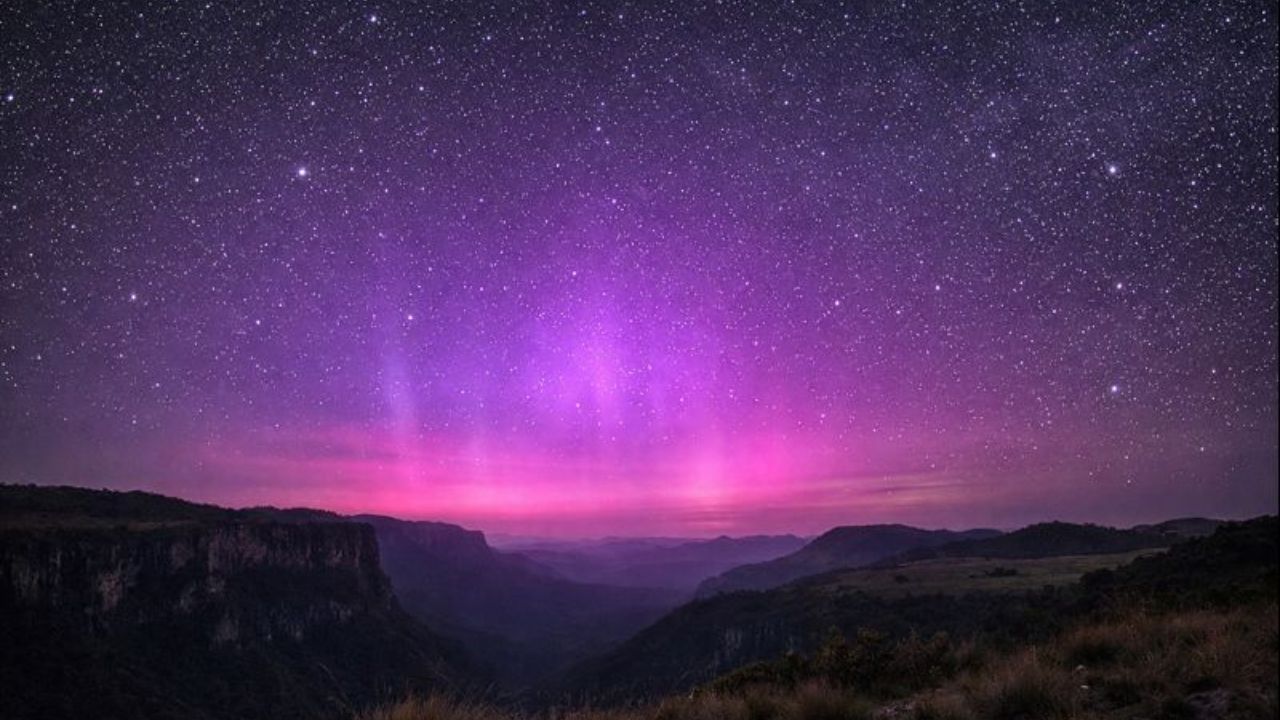
Purple Sky in Cambará do Sul, in Rio Grande do Sul, Intrigues Astronomy and Raises Hypothesis of Aurora Borealis After Solar Storm.
A purple glare illuminated the sky of Cambará do Sul, in Rio Grande do Sul, on Tuesday night (01/20/2025), stirring doubts and fascination among astronomy experts. The phenomenon, recorded for about five minutes, occurred after an intense solar storm, was photographed in long exposure, and raised the possibility — yet unconfirmed — of an aurora borealis (or australis) at unusual latitudes in southern Brazil.
See more: Most Intense Solar Storm in 20 Years Emits Radiation and Caused Unusual Aurora Borealis
Purple Sky Surprises Locals and Experts
The episode drew attention due to its rarity. Around 9 PM, photographer Egon Filter captured the purple color in the sky of Cambará do Sul, in the Serra Gaúcha.
-
Survivor of 1966 SS Daniel J. Morrell Shipwreck in Lake Huron Recounts 38-Hour Ordeal in Extreme Cold

-
The Greatest Hoax in World Cup History? The Film That Denied Brazil’s 1958 Victory and Exposed How Fake Evidence Can Seem Convincing on TV
-
Fake South Korean Online Stores Offer Shopping Thrill Without Spending Money or Receiving Products
-
The War of Jenkins’ Ear: How a Severed Ear Sparked One of the 18th Century’s Most Unusual Conflicts


The image, taken using long exposure techniques, showed a concentrated glow that stood out from the rest of the celestial vault.
/i.s3.glbimg.com/v1/AUTH_59edd422c0c84a879bd37670ae4f538a/internal_photos/bs/2026/M/B/z2goOoQN2OHLpzVNLtfQ/whatsapp-image-2026-01-23-at-12.27.47-1-.jpeg)
According to Egon, the impact was immediate. “I have photographed various visual and astronomical phenomena around the world. This looks very much like an aurora australis, which sent chills of excitement through me at the moment of the click,” he reports.
The professional has been in photography for 41 years, lives in the mountainous region, studies astronomy, and specializes in astrophotography.
See more: Greenland Faces Climate Crisis in the Arctic and Economic Slowdown
Solar Storm Reignites Debate About Aurora Borealis in the South
The hypothesis of an aurora gained traction due to the spatial context. One day before the recording, an intense solar storm hit the Earth.
In extreme conditions, this type of event can expand the area of occurrence of auroras, normally restricted to latitudes above 60 degrees.
Egon emphasizes this point by explaining that Rio Grande do Sul is situated between parallels 29 and 33 degrees.
“I know that rare exceptions can occur in the case of solar storms, and a very powerful one happened a day before, which is why I believe we saw an aurora,” he states.
Experts Call for Caution in Classifying the Phenomenon
Despite the enthusiasm, the scientific community remains cautious. Professor Carlos Fernando Jung, a doctor in production engineering and founder of the Heller & Jung Observatory, assesses that it is still too early to define what occurred.
For Jung, auroras occur when solar wind particles interact with the Earth’s magnetic field, a phenomenon concentrated near the magnetic poles.
“Under normal conditions, this type of manifestation cannot be seen in southern Brazil, where there has never been a record of an aurora,” he explains. Still, he admits that the storm on 01/19 could allow for something atypical, although “they would not be classic auroras like those in Norway or Antarctica.”
Airglow: An Alternative Explanation Considered
Another possibility raised is the so-called airglow. This is an optical effect caused by the collision of atoms in the upper atmosphere following events like magnetic storms and solar winds.
According to Jung, this phenomenon tends to have a more diffuse and less intense glow.
“An airglow has lower intensity and the color is more dispersed in the sky. It can’t be stated for sure, but the fact is that it is an important and scientifically relevant phenomenon for us from Rio Grande do Sul,” says the professor.
INPE Points Out Gaps and Proposes New Investigations
The debate gained new contours with the analysis of geophysicist José Valentin Bageston, director of the National Institute for Space Research in Santa Maria. For him, none of the hypotheses fully explain the record.
“If it were an airglow, the purple light would cover the entire sky, not just limit itself to a part of the photograph,” he observes. Bageston also dismisses the classic aurora, as particle sensors at the observatory in São Martinho da Serra did not detect compatible activity.
“In the last 25 years, we have never recorded an aurora here,” he comments.
Red Arc of Aurora Enters the Scientific Radar
Among the more specific hypotheses is the SAR (Stable Auroral Red Arc), known as the Red Arc of Aurora. The phenomenon is rare and distinct from traditional auroras.
However, Bageston notes that the image from Cambará do Sul does not clearly show the continuous red line typical of this event.
“More data needs to be collected, studied more deeply, and attempts made to observe again,” he states. Thus, new measurements and records will be essential to advance in understanding the case.
Phenomenon Gains International Attention
Even without a definitive explanation, the purple sky of Cambará do Sul has already crossed borders. Researchers from the Space Weather website, a global reference in astronomical records, highlighted the episode.
They also diverge on classification but express surprise that something resembling an aurora borealis was observed in southern Brazil.
Meanwhile, the episode reinforces interest in astronomy in Rio Grande do Sul and shows how solar storm events can produce rare visual manifestations, capable of transforming an ordinary night into a scientific enigma.


-

-

-

-

11 people reacted to this.