






 Portuguese
  Spanish


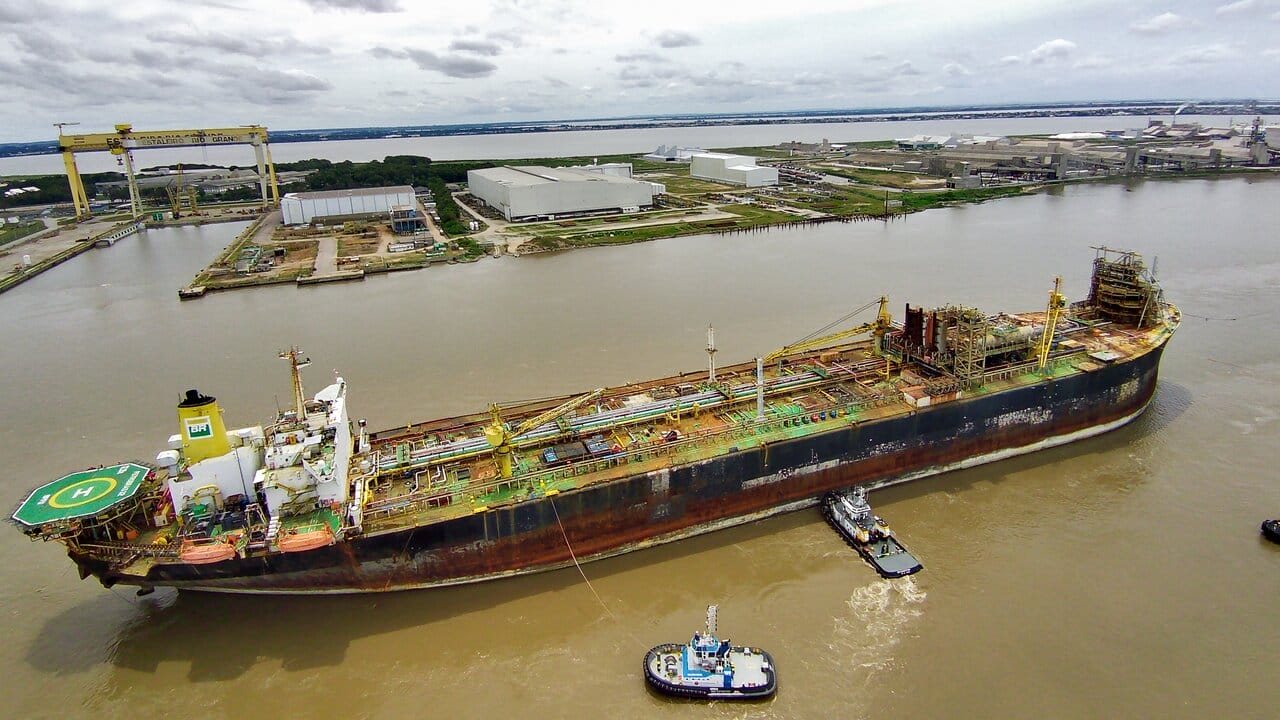

The P-32 Platform of Petrobras Arrived at the Rio Grande Shipyard to Begin an Innovative Sustainable Recycling Process on Brazilian Soil. Acquired by Gerdau at Auction, the Platform Will Be Dismantled by Ecovix, with the Metal Scrap Being Used in Steel Production. The Sustainable Decommissioning Aims to Contribute to the Production of Steel with a Low Carbon Footprint.
After more than a week of journey from the Campos Basin (RJ), the P-32 platform of Petrobras reached its destination at the Rio Grande Shipyard (RS) last Thursday (12/14). This milestone marks the beginning of the first recycling process of a unit of this size on Brazilian soil. With an expected duration of approximately 1 year, the dismantling will follow Petrobras’ new sustainable recycling model, which encompasses all phases of the work, from the reception to the responsible disposal of waste.
Gerdau and Ecovix Lead Sustainable Recycling: Transforming Metal Scrap from the P-32 into Low Carbon Steel
The Director of Engineering, Technology and Innovation at Petrobras, Carlos Travassos, emphasizes that this pioneering model reinforces the company’s international commitment to sustainability and a just energy transition.
Moreover, he underscores that the process represents the creation of new opportunities for the national economic chain, generating value for society as a whole.
-
Eni Acquires 25% Stake in Chilean Lithium Project, Plans to Invest Up to $225 Million in Eco-Friendly Extraction Method

-
French Brand Transforms 6 Million Brazilian PET Bottles into Sustainable Sneakers for Global Fashion Market
-
Abandoned Factory in Rio’s North Zone Becomes Urban Hazard with Standing Water and Debris

-
The U.S. Navy Conducts Submarine Tests in Idaho Lake to Detect Underwater Noises Hidden by the Ocean


The P-32 platform was acquired at auction by Gerdau, who hired Ecovix to lead the dismantling.
The dismantling of the structures will occur at the shipyard’s facilities, and Gerdau will use the resulting metal scrap as raw material for steel production at its Charqueadas (RS) unit.
Other materials will be sent for safe and proper disposal, culminating in nearly 100% recycling of the unit.
Toward Sustainable Decommissioning: Petrobras, Gerdau and Ecovix Plan the Future of the Brazilian Naval Industry
Carlos Vieira, Director of Raw Materials and Forests at Gerdau, highlights the initiative as pioneering in the Brazilian steel industry, helping the company to remain a reference in the production of low carbon steel.
He emphasizes that dismantling platforms like the P-32 is a crucial source of metal scrap, removing a significant volume of these materials from Brazilian seas and transforming them into new steel products, given that steel is fully recyclable.
The execution plan will be strictly monitored by Petrobras to ensure compliance with safety practices, environmental standards, occupational health, and social responsibility, sustainably and in an auditable manner, throughout the entire recycling process.
It is estimated that the dismantling of the P-32 will take about a year.
The arrival of the P-32 in Rio Grande coincides with the conclusion of the auction for the sale of the P-33 platform by Petrobras, the second to be allocated under the company’s new model.
The P-33 is scheduled to arrive at the shipyard around mid-2024, and its dismantling will follow a similar schedule to that of the P-32, taking about a year for completion.
The Beginning of a New Era in Naval Recycling
“We are advancing in a very responsible manner, bringing our expertise to various sectors of the naval area and contributing to job and income generation for the entire southern region of Rio Grande do Sul”, emphasizes Robson Passos, CEO of the Ecovix Group.
He points out that Brazil has crucial competitive advantages to become a world reference in sustainable decommissioning, focusing on generating value and respecting people and the environment.
Carlos Travassos reaffirms Petrobras’ commitment to developing and qualifying the national market by adopting initiatives to increase demand predictability in the market, with comprehensive disclosure of sustainability requirements and the number of units to be recycled over the next ten years.
This milestone in the Brazilian naval industry reflects the joint effort of Petrobras, Gerdau, and Ecovix to promote a sustainable and innovative approach to dismantling platforms, driving not only the sector but also contributing to the construction of a greener and more responsible economy.







