Portuguese
  Spanish


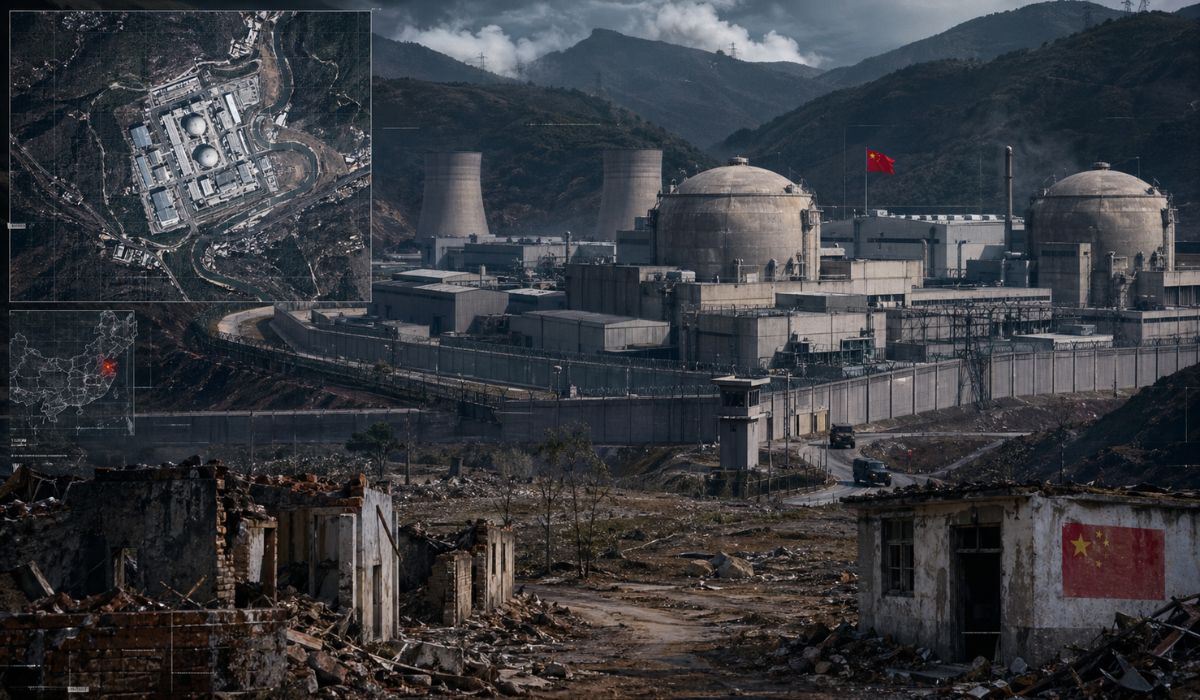

Images analyzed by experts rekindle alerts about changes in a sensitive region of China, where villages have disappeared and new reinforced structures have become part of a complex associated with the country’s nuclear program.
Satellite images analyzed by CNN show that rural areas of Sichuan province, in southwestern China, have been demolished and replaced by new constructions associated with the country’s nuclear program, according to a report published on April 4, 2026.
The investigation states that residents questioned local authorities in 2022 about land confiscation and were told that the case involved “state secret.”
The investigation focuses on a region near Zitong county, where facilities linked to the Chinese nuclear program have existed for decades.
-
Berries, Strawberries, and Blueberries Could Transform Agriculture in Northeastern Brazil, New Tests Reveal

-
Danish Resident Discovers Six Viking Gold Bracelets Weighing 762.5 Grams, Third Largest Gold Treasure in Denmark

-
Over 200 Cities in Southern Brazil on Storm Alert as Cyclone Near Uruguay Brings Heavy Rain, Hail, and Winds Up to 100 km/h

-
Archaeologists Discover 2,300-Year-Old Beer in Sealed Bronze Vessel from Ancient Chinese Tomb



According to CNN, recent images indicate the construction of reinforced buildings, renovated roads, security fences, and support structures in areas that previously had villages and homes.
Villages demolished in Sichuan
Among the cases described by CNN is that of Sichuan residents who, in 2022, sought explanations about the loss of their land and their forced eviction from their homes.
More than three years later, satellite images show that the village was razed and replaced by new buildings which, according to the broadcaster, are part of a nuclear weapons production area.
The mentioned region is around Zitong, a location already monitored by United States intelligence agencies since the Cold War.
The difference pointed out by experts interviewed by CNN lies in the scale of recent works, which involve not only new buildings but also renovations to roads, logistics areas, and connection points between facilities.
China’s Ministry of Foreign Affairs stated: “We are not aware of the situation mentioned.”
China’s Ministry of Defense, according to the broadcaster, did not respond to requests for comment on the findings.
Reinforced dome on the Tongjiang River
One of the structures identified in the images is located on the banks of the Tongjiang River.
According to the investigation, it is a large reinforced dome, erected in less than five years and still apparently in the equipment installation phase.
CNN states that the building has an area equivalent to 13 tennis courts.
The structure is described as encased in concrete and steel, with radiation monitors, armored doors, air treatment equipment, and a network of pipes connected to another building with a tall ventilation chimney.
Experts consulted by the broadcaster said that these characteristics are compatible with environments designed to keep radioactive materials, such as uranium and plutonium, under containment.
Around the facility, CNN identified three layers of security fences and a tunnel entering a mountainside.
Jeffrey Lewis, a global security researcher at Middlebury College and one of the experts who analyzed the material, told the broadcaster that the construction is part of a reconfiguration of the Zitong complex and may indicate an increase in production capacity at the end of the process.
Roads link nuclear bases in Zitong
The dome does not appear in isolation in the images.
Also according to the report, renovated roads connect the so-called Site 906 to at least three other nuclear weapons bases located in valleys near Zitong county.
Chinese government documents analyzed by CNN identify the dome project as XTJ0001.
Another facility mentioned is Site 931, which reportedly expanded over the village of Baitu, leading to the removal of residents.
The neighboring village of Dashan was also demolished to make way for the base’s development, according to the investigation.

Additionally, a road-rail transfer point connected to the network has undergone renovations since 2021.
According to analysts consulted, this set of works suggests an infrastructure modernization, and not just the punctual construction of a building.
The assessment takes into account the integration between bases, transport routes, security structures, and areas capable of supporting long-term operations.
China’s nuclear arsenal remains smaller than those of the US and Russia
China still maintains a nuclear arsenal smaller than those of the United States and Russia.
The Federation of American Scientists estimated in 2025 that Beijing possessed about 600 nuclear warheads, while the American arsenal was estimated at approximately 3,700 warheads.
SIPRI also calculated that China had at least 600 warheads in January 2025.
Despite the numerical difference, research centers and US authorities have been pointing to accelerated growth in the Chinese nuclear program.
The Pentagon stated that Beijing is conducting a broad modernization of its nuclear forces and projected that the country could exceed 1,000 warheads by 2030.
Experts cited by CNN assess that the analysis of Chinese nuclear power should not only consider the number of warheads.
According to them, the reorganization of facilities, the expansion of production structures, and the renewal of logistical networks also influence the ability to maintain, protect, and eventually expand an arsenal.
China maintains defense of its no-first-use policy
The Chinese government states that its nuclear policy is defensive in nature.
In official statements, Beijing says it follows the doctrine of “no first use” of nuclear weapons and maintains that it keeps its forces at the minimum level necessary for national security.
The Chinese Ministry of Defense also rejected recent accusations made by United States authorities regarding alleged prohibited nuclear tests.
In a response cited by CNN, spokesperson Jiang Bin stated that such declarations “distort the facts and defame China.”
This official position contrasts with assessments from Washington and Western research centers, which point to a lack of transparency regarding the pace and scope of Chinese expansion.
For arms control analysts, the absence of verifiable information makes it difficult to compare Beijing’s declared policy with the evolution observed through satellite imagery.


End of New START affects nuclear control
The works in Sichuan occur at a time of weakening international arms control agreements.
The New START, the last major treaty limiting strategic nuclear weapons between the United States and Russia, expired on February 5, 2026, without a legally binding replacement.
With the end of the treaty, Washington and Moscow are no longer subject to formal bilateral limits on deployed strategic weapons.
The agreement also provided for verification and transparency mechanisms, although inspections had already been suspended in previous years.
The inclusion of China in a potential new pact is considered difficult by arms control experts.
Beijing argues that its arsenal remains much smaller than the American and Russian stockpiles, while the United States argues that any future agreement needs to consider Chinese expansion.
Uncertainty about capabilities weighs on military decisions
The advancement of facilities in Sichuan adds new doubts to a scenario of low transparency among nuclear powers.
For experts, the main concern is less about a specific structure and more about the set of changes observed in the Zitong network.
When governments do not have access to complete data on a rival’s capabilities, military decisions may come to be based on estimates.
Jeffrey Lewis told CNN that officials in the United States may advocate for expanding their own nuclear capacity not to exactly match what China is doing, but to respond to what they believe Beijing is doing.
This type of perception is one of the factors that international security experts associate with the risk of a new arms race.