






 Portuguese
  Spanish


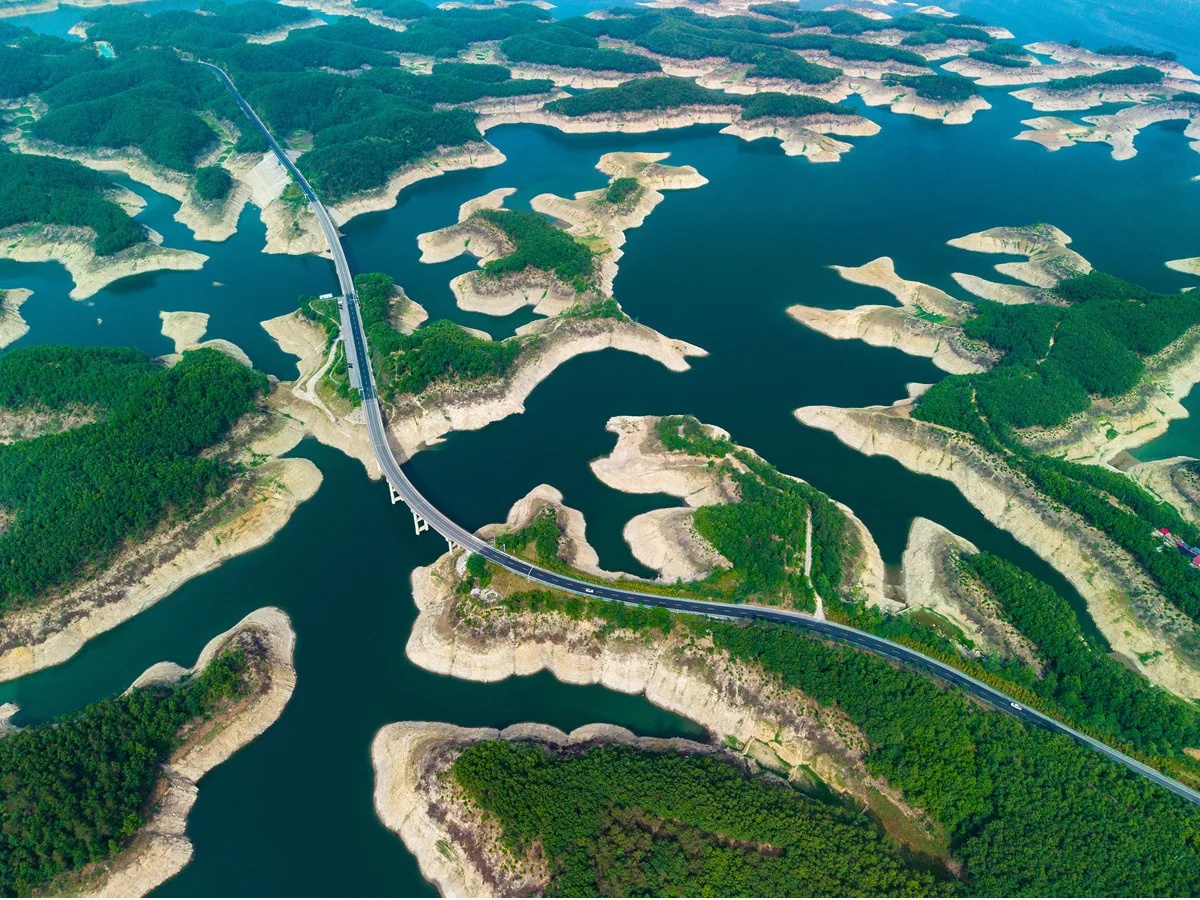

Megaproject in China with 664 km and 612 km of tunnels brings water to dry regions of Yunnan and redefines hydraulic engineering.
In 2021, the Chinese government once again highlighted one of the largest hydraulic works under construction in the country: the Central Yunnan Water Diversion Project, a **664.24-kilometer** system designed to transfer water from the main courses of the Jinsha River, in the upper Yangtze, to areas historically affected by scarcity in the center of Yunnan province, in southwest China. According to the SASAC, in a publication on January 20, 2021, the project was conceived to bring water to dry regions of Yunnan; the provincial Department of Water Resources, based on a People’s Daily report published on November 22, 2023, describes the work as the largest and most expensive water resource allocation project under construction in China.
The technical scale explains the strategic importance of the work. The system crosses mountains, valleys, fault zones, and four major river basins, with approximately 664 kilometers of adduction line, of which 612 kilometers are tunnels, a proportion exceeding 90% of the route. The state agency Xinhua reported on October 28, 2025, that the project captures water from the Jinsha and crosses Lijiang, Dali, Chuxiong, Kunming, and Yuxi until it reaches Honghe, while the Yunnan Department of Water Resources points out that the initiative seeks to alleviate a chronic water bottleneck for cities, industry, agriculture, and plateau lakes in one of the province’s most important economic regions.
664 km system connects basins and creates a new water geography in China
The Central Yunnan project was designed to solve a structural problem: the unequal distribution of water within China itself.
-
U.S. Farmer Tackles $4 Million Water Issue by Installing Hundreds of Miles of Drainage Pipes to Protect Farm Profits

-
Two-Person Team Builds Entire House from Scratch in Just 3 Days Using Low-Cost Materials, Documenting Every Step on Video
-
New Anti-Humidity Paint Reduces Mold and Fungus by Controlling Condensation, Enhancing Indoor Protection and Paint Durability Without Major Renovations

-
Polystyrene Panel Technique Goes Viral for Tackling Household Mold and Persistent Dampness






While some regions have water abundance, others face scarcity that limits urban, industrial, and agricultural growth. **The solution found was to build a system that connects different river basins, allowing water to be transferred from areas with greater availability to drier regions.**
The system captures water from the Jinsha River and transports it through canals, tunnels, and underground structures to areas in central Yunnan. **This redistribution completely alters the regional water balance**, creating a new basis for economic development.
Over 600 km of tunnels transform the project into one of the world’s largest underground works
The most impressive fact about the project lies in its underground composition. Of the total 664 km, about **612 km are excavated tunnels**, according to technical project information. This means that most of the structure is hidden underground, crossing entire mountain ranges.
Large-scale excavation was necessary because Yunnan has an extremely complex terrain, with mountains, deep valleys, and geologically unstable areas.
**Building on the surface would be unfeasible in many sections**, making the tunnel the only possible solution.
Flow rate of 135 m³/s places system among the largest artificial water corridors on the planet
The transport capacity also stands out. The system was designed to conduct up to **135 cubic meters of water per second**, a volume comparable to the flow of large rivers in certain regions.
This flow rate allows for supplying entire cities, sustaining industries, and ensuring large-scale agricultural irrigation.

**It is not a complementary system, but a central infrastructure for regional supply.**
Project crosses multiple river basins and connects strategic river systems
Another relevant technical aspect is the crossing of different basins. The system crosses areas linked to major Asian rivers, including the Jinsha (part of the Yangtze system), Mekong, Red River, and Nanpan.
This interconnection requires detailed hydraulic planning to ensure balance between water intake, transport, and distribution.
The project not only moves water but integrates natural systems that previously functioned independently.
Engineering faces extreme challenges of geology, altitude, and stability
The construction of such a large-scale system in Yunnan involves significant technical challenges. The region features unstable rocks, geological faults, sharp altitude differences, and a risk of infiltrations and landslides.
To deal with these conditions, TBM excavation machines were used, capable of drilling hard rock and installing linings simultaneously.
This type of technology is essential to ensure the safety and continuity of the work in extreme environments.
Infrastructure planned to sustain urban and industrial growth in Yunnan
The project’s objective goes beyond basic supply. Yunnan is a strategic province for China’s economic growth but faces limitations related to water availability.
With the new system, the government seeks to ensure resources for:
- urban expansion,
- industrial development,
- long-term water security.
Water ceases to be a limiting factor and becomes a growth factor.
Agriculture also set to benefit from more stable irrigation
In addition to cities, the agricultural sector is one of the main beneficiaries. Regions that depended on irregular rainfall will be able to rely on continuous irrigation, increasing productivity and reducing risks.
This is especially important in areas where climate variability directly affects food production. The Central Yunnan Water Diversion Project is not an isolated case.

It is part of a global trend where water is becoming one of the most strategic resources of the 21st century. Countries are investing in infrastructure to ensure access, distribution, and water security.
The ability to move water on a large scale is becoming as important as energy or transport.
Invisible work redefines the impact of mega-projects on the territory
Unlike giant dams or open canals, much of the project’s impact is hidden. The tunnels operate underground, reducing visual and environmental interference compared to surface works.
This represents a shift in the profile of mega-constructions. The impact is no longer visible in the landscape but is felt in the economy and supply.
The Central Yunnan project is another example of China’s strategy for controlling and redistributing natural resources. By ensuring water for critical regions, the country reduces vulnerabilities and creates conditions for economic expansion. This approach could become a reference for other countries with similar challenges.
Now the direct question remains: if countries are already excavating hundreds of kilometers under mountains to transport water as if it were a logistical resource, to what extent could water control become one of the planet’s main strategic disputes in the coming decades?


