Portuguese
  Spanish


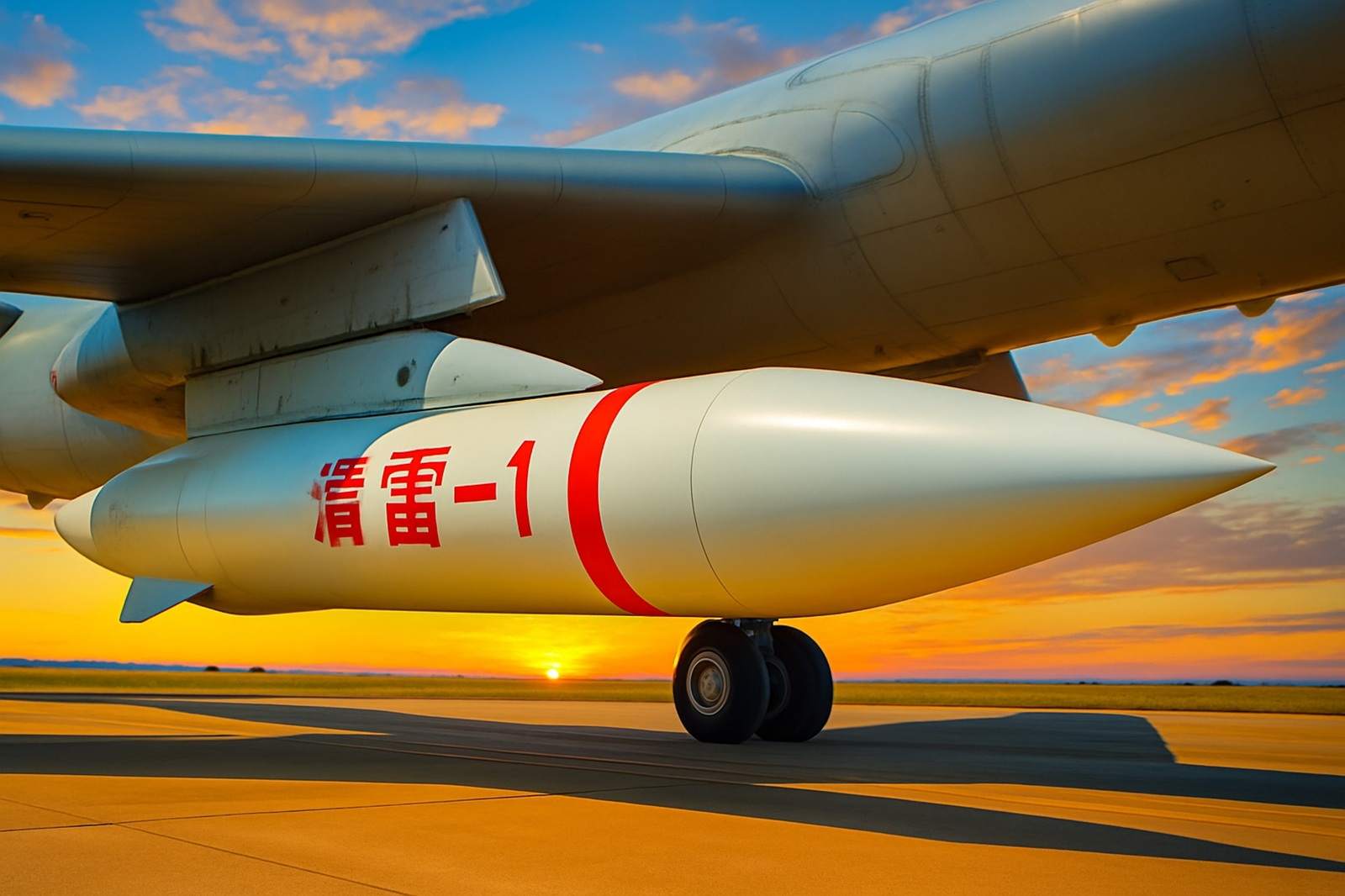


China Presents JL-1 Missile With Range of 8,000 Km, Air Launch, and Nuclear Capability, Highlighting a Combination of Speed, Flexibility, and Deterrence That No Other Country Has Today
The presentation of the Chinese Jinglei-1 missile has placed the country in a prominent position within the global debate on long-range armaments. The claim that the JL-1 would be the only nuclear hypersonic long-range missile in the world resonated because it reinforces the expansion of China’s strategic capability and highlights a possible shift in the military power balance.
According to a Chinese military publication, the weapon would have a range of 8,000 km and would represent a potential threat to Alaska and, in an expanded scenario, to the United States as a whole.
Capabilities Presented by the JL-1
The JL-1 is an air-launched ballistic missile with nuclear capability, designed to be carried by H-6N strategic bombers. The platform is described as a key component of the People’s Liberation Army’s nuclear triad because it completes the integration of land-based, sea-based, and air-based nuclear arms.
-
AI Deciphers 1.4 Meters of Text from a 2,000-Year-Old Scroll Carbonized by Mount Vesuvius Without Unrolling It

-
Ferrari, BMW, Tesla, and Chinese Automakers Shift from Copper to Aluminum Wiring to Reduce Weight and Costs in Electric Vehicles
-
Brazilian Researcher Unveils Innovative Intraocular Lens for Cataract Treatment with High-Precision Optics, Enhancing Vision at Multiple Distances and Reducing Unwanted Visual Effects

-
World’s Largest Particle Accelerator Begins Four-Year Hiatus for Magnet Overhaul, Aiming to Hunt Dark Matter by 2030




A recent analysis highlighted that no other country possesses a similar nuclear hypersonic long-range missile, which would give China an advantage over the United States and Russia.
The publication states that the estimated range of 8,000 km significantly expands the country’s strategic reach, enabling the system to hit targets at great distances.
The missile would also be capable of targeting bombers, enhancing its role within the defense and attack apparatus. In September, the JL-1 was presented during the Victory Day parade, alongside assault rifles and stealth fighters, reinforcing the message of military modernization.
Discussion on Hypersonic Deterrence
A recent assessment points out that an H-6N bomber taking off from the extreme east of Russia could put a large part of the continental United States within the JL-1’s range.
The report emphasizes how geography and potential joint exercises would enlarge the possible impact area.
The magazine Ordnance Industry Science Technology compared the new system with equivalent armaments from other countries. The United States uses the AGM-86B, a subsonic cruise missile with a range of 2,400 km and a guidance system considered outdated.
Its planned replacement, the AGM-181A, is expected in the 2030s but will remain subsonic. Meanwhile, the project for the AGM-183A, an air-launched nuclear hypersonic option, was halted after several setbacks, according to the South China Morning Post.
In the case of Russia, the country has the Kh-102 and Kh-BD missiles, both cruise missiles with wide range and nuclear capability, but limited by subsonic speed.
The only operational air-launched hypersonic weapon is the Kinzhal, which can carry a nuclear warhead but has a significantly shorter range than the JL-1. The analysis concludes that none of these available technologies combine speed and range at a level comparable to the Chinese missile.
Operational Limitations and Dependence on the H-6N
Despite the advantages presented, the JL-1 has limitations. The missile, at 15 meters long, cannot be carried internally by any current Chinese aircraft, including the future stealth bomber still in development. This necessitates the exclusive use of the H-6N, whose extended range requires a reduced payload.
The report highlights that, being subsonic and lacking stealth features, the H-6N lags behind modern aircraft like the B-2 and B-21.
The dependence on this platform creates a strategic vulnerability because it limits the weapon’s operational potential in scenarios requiring discretion or superior speed.
The H-20, the new Chinese bomber, is still under development with no official milestones announced. Any delay would prolong this period of operational limitation.
In this context, the emphasis placed on the JL-1 would serve as a temporary solution while the future bomber has yet to reach maturity.
Expansion of China’s Nuclear Triad
The JL-1 is described as the first air-launched ballistic missile with nuclear capability publicly acknowledged by China. This places the country in a select group of nations that have utilized this type of armament since the United States and the Soviet Union developed similar versions during the Cold War.
The integration of the missile into the People’s Liberation Army Air Force reinforces its role within the nuclear triad. Air launch allows H-6N bombers to release the missile at high altitude and follow unpredictable trajectories, which increases the difficulty of tracking and interception. Defence Security Asia states that this flexibility differentiates the system from land-based and naval missiles.
Analysts point out that the JL-1 derives from the medium-range DF-21 missile, adapted for air operation to bypass defenses like Aegis Ashore, THAAD, and the Guam missile defense shield.
Western intelligence has been monitoring the weapon’s development for years under the NATO codename CH-AS-X-13. The first tests were observed at Neixiang Air Base, with gradual integration into the H-6N.
In 2020, leaked images already suggested that the system was nearing the operational phase. Its public presentation in 2025 followed China’s tradition of showcasing strategic armaments during significant national celebrations, highlighting its importance for the military modernization program.