Portuguese
  Spanish


Declaration from JD.com founder exposes how delivery automation advances in China and reignites discussions on employment, professional requalification, and use of robots in large-scale urban services.
The founder and chairman of JD.com, Richard Qiangdong Liu, stated that the approximately 700,000 delivery workers of the Chinese company could be replaced by robots “sooner or later.”
The statement was made at the Asia-Pacific Economic Cooperation CEO Forum, APEC, held in Beijing, according to the Financial Times, and brought back to public debate the effects of automation on platform workers.
JD.com is one of the largest e-commerce companies in China and maintains its own logistics operation.
-
Trump warns Europe with 100% tariff threat on digital tax, potentially impacting wine and trade agreements

-
As Homeownership Becomes Unattainable in Brazil, Japanese Municipalities Offer Abandoned Houses for as Low as $3,000 to Revitalize Aging, Emptying Cities

-
Job Market in 2026 Welcomes High School Graduates: Logistics, Retail, and Construction Hire Without College Degrees; Quick Courses in Forklifting, Building Electricity, and Welding Boost Salary Prospects

-
Brazil’s ANP Reforms Natural Gas Market, Opens LNG Terminals and Pipelines to More Companies, Raising Hopes for Lower Future Bills


In his speech, Liu linked the advancement of delivery robots to the possibility of reducing, in the future, the need for human workers in the final stage of transport to the consumer, known as the last mile.
The phrase attributed to the executive was: “In the future, when robots are delivering packages, sooner or later there will be a day when delivery workers will basically no longer be needed.”
He also said that he does not want to see the company’s “700,000 brothers” without food or work, advocating for requalification programs for these professionals.
JD.com plans to requalify delivery workers
According to the Financial Times, JD.com signed contracts with about 120 schools to train delivery workers in new roles.
Among the possibilities mentioned by Liu are repair and maintenance activities of the robots used in logistics.
The company has been developing autonomous vehicles for years.
In a statement published in 2023, JD Logistics reported researching last-mile autonomous delivery vehicles since 2016 and said it had more than 600 autonomous units in operation in 30 Chinese cities at that time.
These devices were used in environments such as residential complexes, shopping centers, and office buildings.
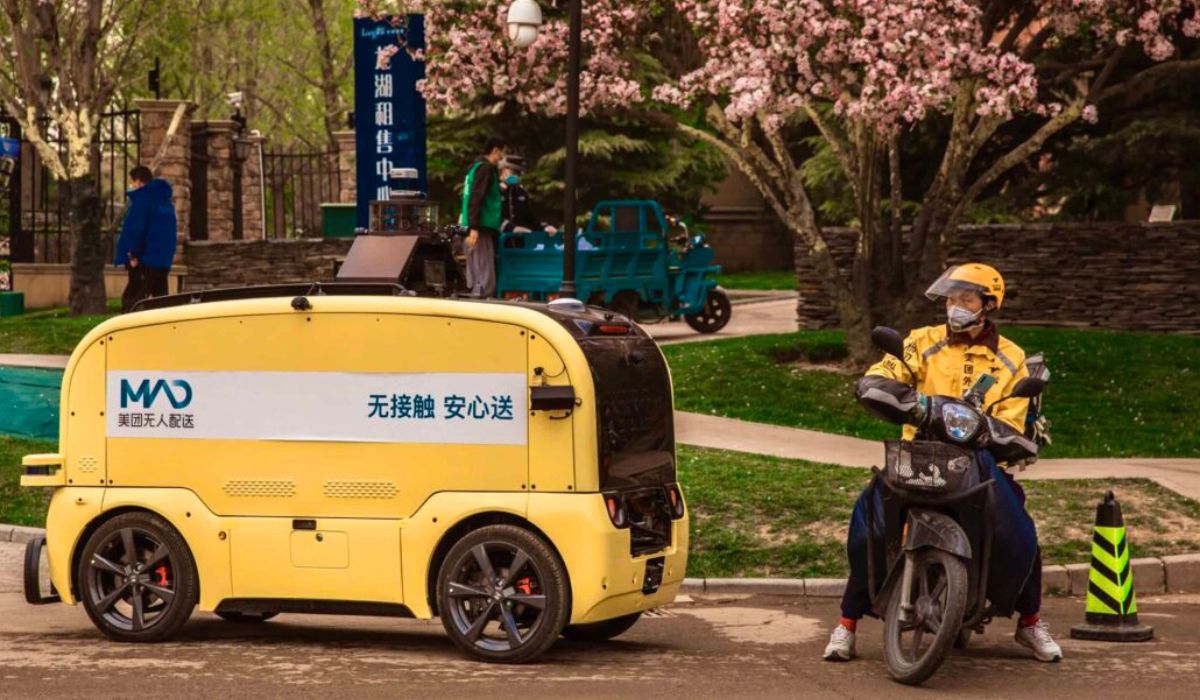
Autonomous delivery vehicles advance in China
The expansion is not limited to JD.com.
A report by The Wire China, published in October 2025, pointed out that China was advancing in the adoption of autonomous delivery vehicles.
The text cited Neolix, one of the companies in the sector, and recorded about 30,000 global orders for its autonomous vehicles.
These vehicles, known by the acronym ADV in English, usually operate on defined routes and at low speeds.
Since they transport goods, not passengers, they follow a different logic than that used by robotaxis, although they also depend on local regulations, urban infrastructure, and safety systems to operate.
The advancement of automation appears in different areas beyond deliveries.
In Japan, Japan Airlines began an experiment with humanoid robots at Haneda Airport in Tokyo to support ground activities, such as baggage handling, in partnership with GMO AI & Robotics.
The initiative was presented as a test to deal with labor shortages and reduce the physical effort of employees.
In the automotive industry, BMW reported on June 25, 2026 that it advanced in tests with humanoid robots from Figure AI at the Spartanburg plant in South Carolina, United States.
According to the automaker, Figure 02 worked on tasks related to the production of the BMW X3, while Figure 03 began to be evaluated in a new logistics application at the unit.
Robots have also been used in security and inspection actions.
Reuters verified in June 2026 that Boston Dynamics’ robotic dogs Spot were present at locations related to the World Cup, but were not used for facial recognition, contrary to misleading claims on social media.
Flexible work grows with digital platforms
Liu’s statement comes at a time of growth in flexible work in China.
The Financial Times cited data from the China New Employment Forms Research Center indicating that the number of temporary or platform workers is expected to reach 320 million in 2026, up from 200 million five years earlier.
This group includes delivery workers, app drivers, and temporary factory workers.
Other Chinese sources also point to growth in this type of occupation.
The Global Times reported that China had 280 million flexible workers in 2025, with a forecast of 320 million in 2026, equivalent to more than 40% of urban employment.
The classification of “flexible work,” however, is treated differently by governments, companies, and researchers.
In an analysis on the topic, Human Rights Watch stated that platform workers in China need more effective protection, especially regarding income, social security, and the right to organize.
The Chinese government has also started to address the issue as part of the national employment policy.
In June 2026, Reuters reported that the State Council released a five-year plan to maintain labor market stability, with mention of adapting to the advancement of artificial intelligence and new forms of collaboration between humans and machines.
Automation changes roles in e-commerce
In this scenario, the statement from the founder of JD.com shows how logistics and e-commerce companies have started to associate automation, productivity, and reorganization of roles.
The replacement of repetitive tasks by machines is already presented by companies in the sector as a way to reduce physical effort and increase operational efficiency.
For workers, unions, governments, and platforms, the discussion focuses on how this transition will be made.