Portuguese
  Spanish


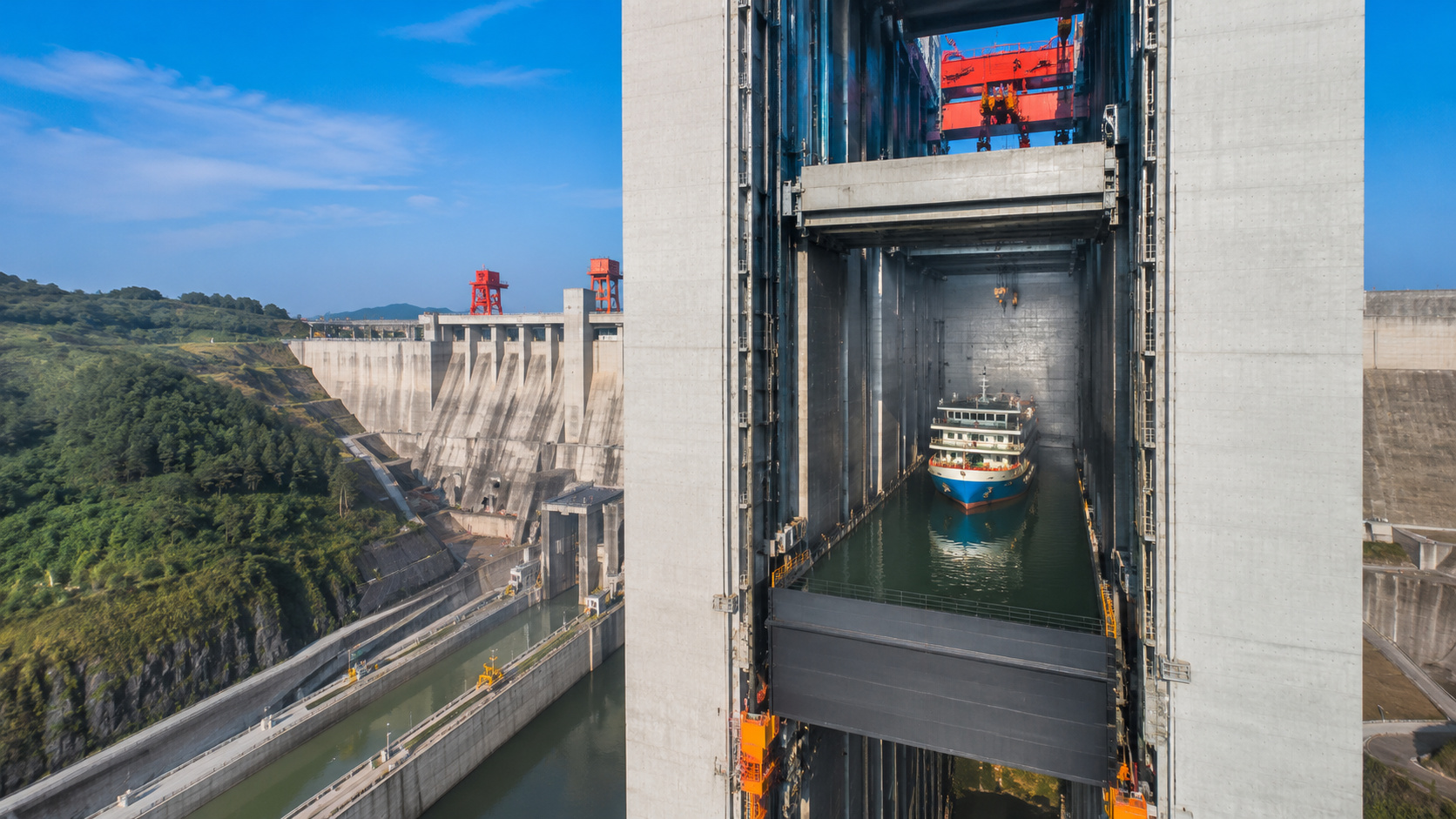

The ship lift at the Three Gorges Dam carries vessels of up to 3,000 tons over 113 meters inside a water-filled tank, reducing the journey to 40 minutes and maintaining the five locks for larger ships.
A ship can enter floating in a huge water-filled box, have the doors closed, and exit 113 meters higher without touching the ground. This is the logic of the ship lift installed at the Three Gorges Dam in China.
The structure accommodates vessels of up to 3,000 tons and was designed to complete the passage in about 40 minutes. Instead of passing through multiple compartments, the boat remains inside a water chamber that moves up or down the entire required height.
On December 5, 2023, the information was released by China Three Gorges Corporation, a Chinese company created to build the Three Gorges Project. The structure functions as a permanent passage for passenger, cargo, and special service vessels.
-
Wooden Ship Lost Under Antarctic Ice for 107 Years Found Nearly Intact at 3,008 Meters Depth, Filmed by Robots Without Human Contact

-
Japanese Ship Transforms into Floating Lab, Drills 7,740 Meters Below Sea to Study Earthquake Zones
-
Ships Use Bubble Technology Under Hulls to Reduce Water Resistance and Lower Emissions
-
Tanker Ship Installs Onboard Factory, Captures 78% of CO2 Emissions in Test and Stores Gas in Large Tanks
Ship lift raises the tank, water, and vessel together
The secret of this construction lies in the chamber where the boat enters. It looks like a giant box but functions as a closed tank that keeps the vessel floating throughout the journey.


Once the ship enters, the doors close and the assembly begins to move. The tank rises or descends carrying the water and the boat simultaneously, without requiring the vessel to be removed from the river.
This difference is important because the ship does not need to ascend on its own. It simply continues to float while the entire structure changes height, like an elevator adapted for a vessel.
Three Gorges Dam needs passages to not interrupt navigation
A dam creates a height difference between one side and the other of the river. Without a special route, ships would be unable to continue their journey because they could not overcome this change in level.
The locks solve this problem in stages. The boat enters a closed area, the water rises or falls to reach another level, and then the gates are opened for the next part of the crossing.
At the Three Gorges Dam, larger ships continue using five locks. They function as a sequence of passages that gradually adjust the water level until the boat reaches the other side.
3,000-ton limit explains why not every ship uses the elevator
The ship elevator was not created to accommodate any vessel. The system accepts boats of up to 3,000 tons, which allows shortening the passage for part of the traffic crossing the dam.
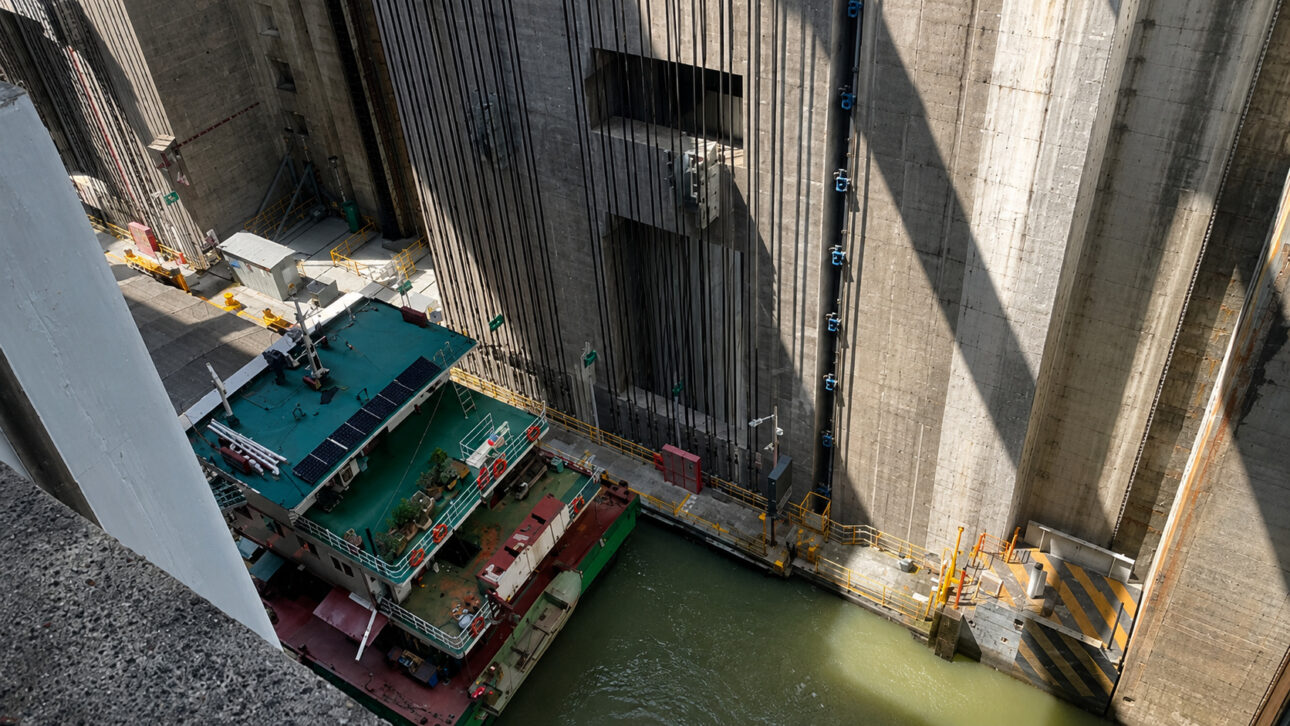
China Three Gorges Corporation, the Chinese company created to build the Three Gorges Project, detailed that the planned crossing by the elevator takes approximately 40 minutes, while the journey through the locks requires about 150 minutes.
The difference shows why the equipment is useful for smaller vessels. Even so, it does not replace the locks because larger boats still need to follow the path formed by the five stages of passage.
Four support points help the tank carry thousands of tons
Carrying a ship inside a water-filled chamber requires much more than a strong engine. The tank needs to remain steady while rising or descending carrying the entire vessel.
Huang Xing, an executive at Wuchang Shipbuilding Industry Group Co, the elevator manufacturer, explained that the chamber is supported at four points by mechanisms arranged symmetrically.
These mechanisms use gears and rack bars, parts with teeth that fit together to control the movement. The function is to reduce the sway of the water inside the tank and prevent the chamber from losing stability.
The structure also has systems that absorb impacts and reduce vibrations. This helps to keep the journey more stable for the tank, the water, and the transported ship.
Ship elevator and locks work together at the same dam
The ship lift offers a shorter route for vessels that meet the weight limit. The locks take on the task of carrying larger boats that do not fit inside the vertical chamber.
This division avoids treating one solution as a complete substitute for the other. The lift speeds up part of the crossing, while the locks remain necessary to maintain the passage of larger ships.
In practice, the Three Gorges Dam combines two ways to overcome the same obstacle: a chamber that rises all at once and a sequence of locks that gradually changes the water level.
Work shows why large waterways require different solutions
The ship lift draws attention because it transforms a difficult task into a simple image to understand: a boat enters a tank and exits much higher, still floating.
But the structure also sends an important message to other waterways. The choice between lift and locks depends on the weight of the boats, the height that needs to be overcome, and the volume of vessels passing through the river.
Therefore, a ship lift does not automatically eliminate all locks in a region. It can reduce the time for some boats, but it needs to operate alongside other routes when there are larger vessels.
The case of the Three Gorges Dam shows that a vessel can ascend 113 meters without leaving the water, within a structure that carries up to 3,000 tons at once.
For the boats that fit in the system, the crossing of about 40 minutes avoids the sequence of five locks. For larger ships, the path through the chambers remains indispensable.
Do you think a lift limited to 3,000 tons can reduce bottlenecks in a busy waterway, or do the five locks remain the most useful solution? Leave your opinion in the comments.