






 Portuguese
  Spanish
  3 min of reading
  0 comments


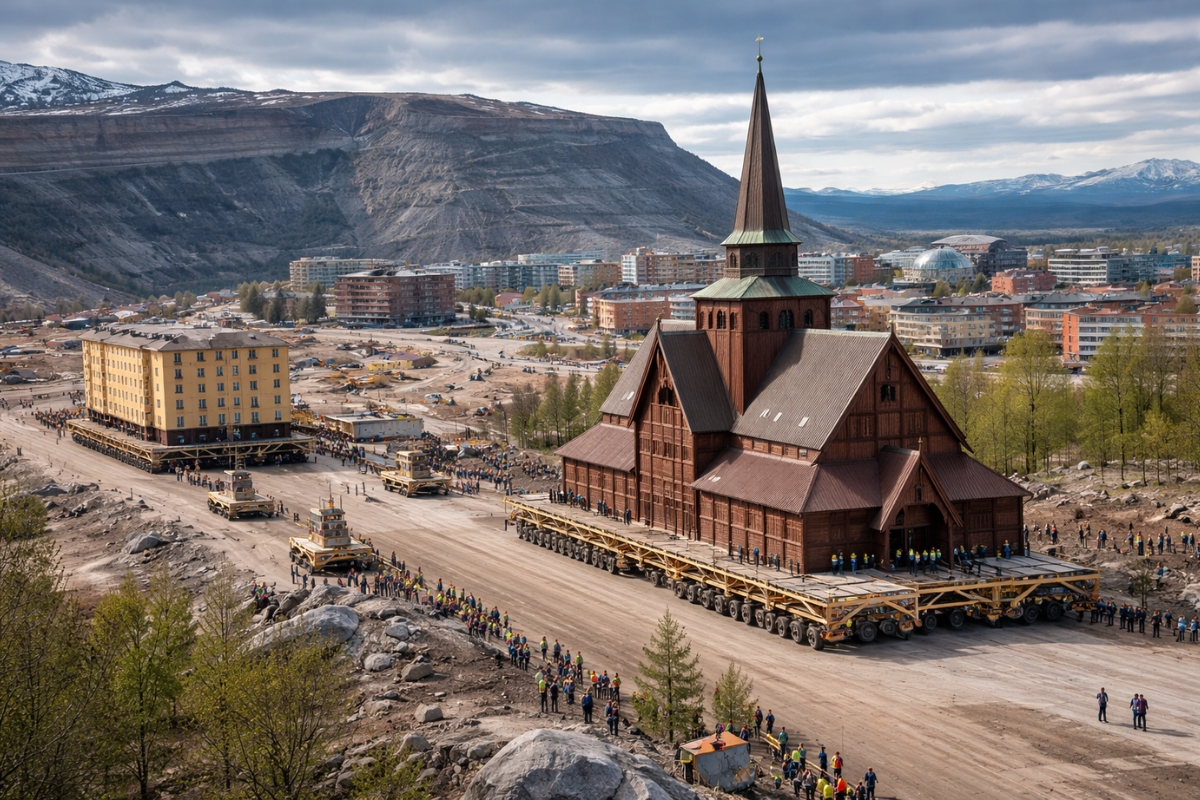
The Change Involves 3 Kilometers, Preserves Historical Landmarks, and Reorganizes the Life of the Population as Mining Advances Underground
The city of Kiruna, in the far north of Sweden, is undergoing a rare transformation in the modern urban world. Part of its center is being moved to another area after the advancement of an underground mine caused land instability.
The process is not limited to new constructions. It involves residents, utilities, commerce, and historical symbols, all affected by a plan that redefines where the city physically exists.
What Happened and Why It Attracted Attention
Kiruna grew around iron mining in the Kiirunavaara region, considered one of the largest in the world. With the advancement of extraction at depth, the land above began to show progressive deformations.
-
Finnish company creates recycled plastic and biomass blocks that fit together without cement, are 10 times lighter than common blocks, and have already been used to build schools in earthquake-affected areas.

-
A US startup wants to build a 10 km space cannon to launch multi-ton payloads into orbit at Mach 23, replacing part of the rockets with a colossal structure that looks like a science fiction weapon.

-
Extreme droughts and floods have doubled on the planet since 1901, according to a study of 1,300 river basins that reveals increasing pressure on agriculture, rivers, soils, ecosystems, and water supply.

-
Turkey begins aligning 5,000 giant concrete blocks of 21 tons in the Black Sea to erect a wall against giant waves, after the sea invaded the port of Faroz, destroyed nets, and sank 5 fishing boats.


In 2004, the need to relocate entire urban areas was defined to avoid structural risks. The decision placed Kiruna at the center of one of Europe’s most unusual urban projects.
The proposal began to treat the change as a continuous process, allowing the city to continue functioning while parts of it are rebuilt in another location.
Why the Ground Is Giving Way and What Is the Origin of the Problem

The mine operates underground and extends to great depths. As the ore is removed, the ground above undergoes physical changes that can result in cracks and instability.
These changes make some areas unsuitable for urban occupancy, requiring the gradual displacement of entire neighborhoods. The phenomenon is constantly monitored and influences city planning.
There are indications that new areas may be affected in the future, expanding the area that needs to be reorganized.
How the Change of the Urban Center Works and Where Kiruna Is Going

The new urban center was planned for an area about 3 kilometers east of the original core. This area began to receive administrative buildings, commerce, and essential services.
The new centrality began to take shape with the inauguration of the city hall Kristallen in 2018, and with the official opening of the new center in September 2022.
The urban reorganization was designed to occur over several years, allowing for gradual adaptation of residents, businesses, and public infrastructure.
Historic Buildings Also Enter the Operation and One Symbol Has Already Moved

The change involves not just new constructions. Structures deemed important for local identity are being preserved through physical transfers.
One of the most emblematic cases was the relocation of the Kiruna Church, carried out on August 19 and 20, 2025. The church was transported to a new location near the new urban center.
This type of operation requires technical planning, ground preparation, and specific logistics to ensure the integrity of the structures during the relocation.
What Can Happen From Now On for Residents, Properties, and Services
The urban transformation continues in stages and is impacting housing, circulation, and public services. As new areas enter risk zones, planning needs to be updated.
The process also requires ongoing solutions for resettlement and adaptation of infrastructure, without interrupting the economic and social routine of the city.
For those living in Kiruna, the change represents an attempt to keep the city functional while it literally changes location.





-

-

-

-

-

78 people reacted to this.