






 Portuguese
  Spanish




Former Physics Professor, Harvard Scientist Michael Guillen Uses the Expansion of the Universe, the Limit of the Cosmic Horizon, and the Idea of Forever Undetectable Regions to Claim That Heaven Would Be Beyond the Observable Universe, Where Time Stops, There Is No Past, Present, or Future, and Absolute Atemporal Existence Would Exist
The Harvard scientist Dr. Michael Guillen, a former physics professor, argues that it is possible to discuss the location of Heaven based on concepts from modern cosmology, placing “Paradise” in a region associated with the Cosmic Horizon, a practical limit of the observable universe from Earth.
The proposal, which combines science, Big Bang, and the Bible, intrigues believers and causes discomfort in part of the scientific community because it shifts a theological concept to a physical framework and uses ideas such as an expanding universe, unreachable regions, and “time stopping” to defend a literal reading of an inaccessible “up there”.
Who Is the Harvard Scientist and Why Has His Talk Gained Traction

The Harvard scientist mentioned is presented as Dr. Michael Guillen, who holds doctoral degrees in physics, mathematics, and astronomy, and has a background as a former physics professor at Harvard. The combination of academic credentials and high-impact language helps explain why the thesis circulates strongly outside the technical debate.
-
Brazil Launches Ambitious Project to Recycle Toothpaste Tubes and Toothbrushes, Aiming to Revolutionize Waste Management

-
The Mystery of Roanoke: Entire Colony Vanished Without a Trace, Leaving Only “Croatoan” as a Clue and Becoming a Historical Legend

-
Namibia Plans to Build Homes for the Homeless Using Mushrooms and Invasive Plants to Tackle Housing Crisis

-
Brazilian Innovator Converts Old Car into Electric Vehicle Using Laptop Batteries and Forklift Motor, Achieves Nearly 90 km/h in Urban Settings




The point that draws attention is not only claiming that Heaven “is real” but saying that “he knows exactly where it is,” proposing a cosmological address. The controversy arises precisely from this promise of precision, because it requires cosmology to be treated as a map for a religious concept.
The Physical Basis Used by the Harvard Scientist: Expanding Universe and Hubble

The Harvard scientist starts from a widely recognized idea: the universe is expanding, and the farther away an object is, the faster it moves away from us. This reading is associated with the observations of American astronomer Edwin Hubble, often used as a cornerstone for discussing cosmic expansion.
In practice, this expansion does not mean that objects “move” through space like cars on a road, but that the distances between large structures increase over time. The argument of the Harvard scientist uses this dynamic to assert that there is a physical threshold where observation itself breaks down, not due to a lack of telescopes but because of a limit imposed by expansion.
The Extreme Example of Distance and Speed and the Role of Light

To illustrate his reasoning, the Harvard scientist provides a numerical example: “theoretically, a galaxy” 273 billion trillion miles from Earth would move at 186,000 miles per second, which he identifies as the speed of light. The choice of the number does not appear as a direct measure of a specific galaxy but as a tool to show a limit.
The logic is that if something moves away fast enough, the light emitted from that region may never reach Earth. This transforms the observable sky into a frontier, defined not only by instruments but by the combination of the finite speed of light and the accelerated expansion of the cosmos.
What Is the Cosmic Horizon in the Argument of the Harvard Scientist
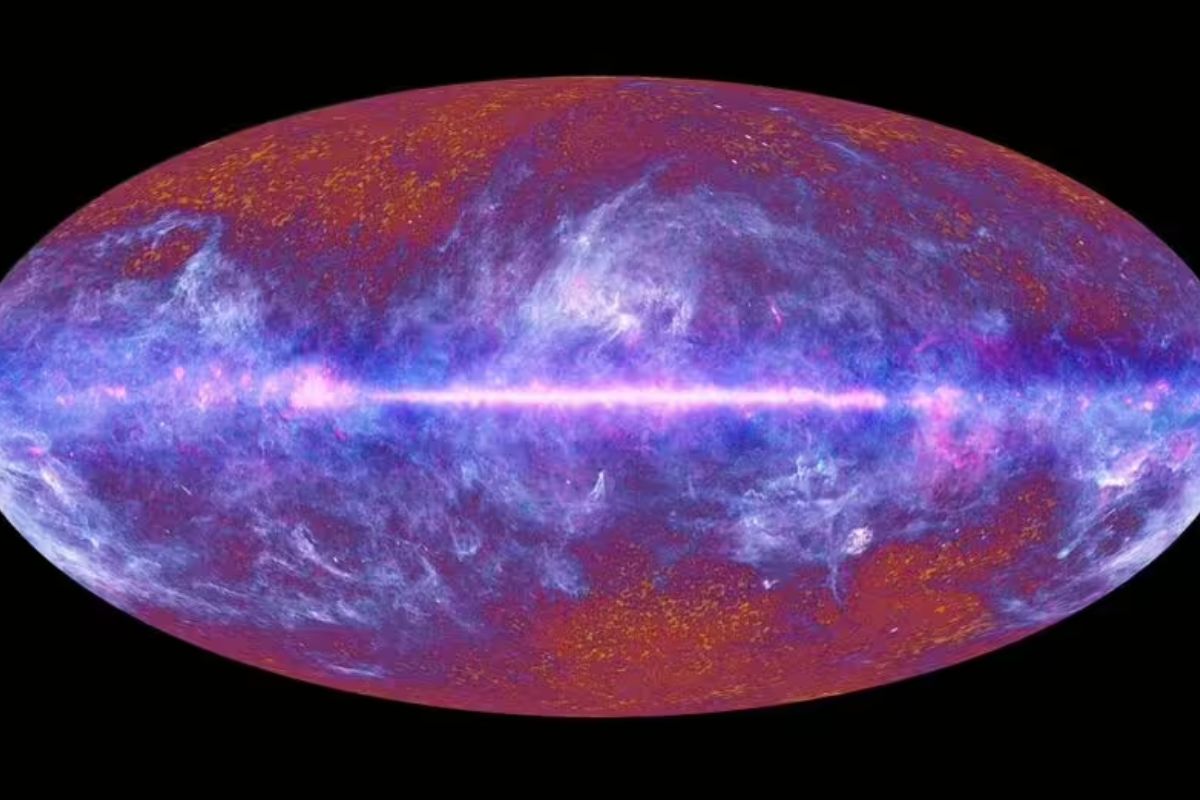
The Harvard scientist describes the Cosmic Horizon as the position of extremely remote objects whose rate of recession is extraordinarily fast. Beyond this threshold, there would still be galaxies, but their light would not have arrived on Earth, and certain areas would be moving away so quickly that they would remain forever undetectable.
This notion creates an observational “wall.” Even if the universe continues beyond what we can see, the information does not arrive. The result is an absolute limit to what astronomers can study, regardless of how sophisticated future telescopes may be, because the problem is not one of resolution but of causal access.
“Time That Stops” and the Idea of Atemporality Beyond the Observable
The most explosive point of the Harvard scientist’s thesis lies in the link between the Cosmic Horizon and time. He asserts that astronomical observations and Einstein’s theories of special and general relativity indicate that time “stops” at the Cosmic Horizon, and at this special distance, there would be no past, present, or future, only “atemporality.”
In the narrative, this atemporality becomes a direct bridge to Heaven. The reasoning is that if there is a region outside conventional spacetime, then it would fit religious descriptions of a realm of existence different from the material world. This is the passage where cosmology becomes theology, and it is precisely here that the division intensifies.
The Connection to the Bible and the Hierarchy of “Heavens” Presented
The Harvard scientist anchors the theological aspect in a reading of levels of Heaven: the lowest level would be the Earth’s atmosphere, the intermediate one would be outer space, and the highest level would be the one “where God resides,” associated with what he places beyond the limits of the observable universe.
In this framing, the “Heaven” remains “up there” from any point on the planet, yet completely inaccessible to mortals. He also asserts that this region would harbor “immaterial and atemporal beings,” representing the souls of those who have passed away. The central idea is total inaccessibility, not due to practical distance, but due to being outside the common regime of time and matter.
The Cited Counterpoint: Horizon as the Limit of the Observable, Not as a Special Place
The disagreement attributed to the majority of “conventional” astronomers is clear: for them, the cosmic horizon would simply be the limit of the observable universe. There would be nothing “special” necessarily on the other side, except for the fact that we cannot see directly due to the finite age of the universe and the finite speed of light.
In this framing, beyond the horizon, the universe may continue, but it remains outside our current capacity for observation. The conflict with the Harvard scientist is not about the existence of an observational limit but about interpreting that limit as a location with metaphysical properties and using that as the location of Heaven.
Big Bang, Cosmic Microwave Background Radiation, and What Can Still Be Observed
The discussion brings in another piece mentioned: the oldest detectable light, associated with the faint remnants of the Big Bang, known as Cosmic Microwave Background Radiation. This radiation is presented as a “residual glow” of the Big Bang, with a huge redshift due to the universe’s expansion over billions of years.
The Big Bang Theory is described as the emergence of the universe about 13.8 billion years ago from an extremely hot and compressed state, with continuous expansion ever since. In the initial moments, light did not travel freely, being deflected by electrically charged particles; as temperature fell and atoms formed, light was able to traverse space and ended up “stretched” by expansion until it became microwaves. The thesis of the Harvard scientist feeds on this backdrop, because it places the horizon as a direct consequence of an evolving universe.
Dark Energy, Acceleration of Expansion, and the Future of Unreachable Regions
Another element mentioned is that the universe’s expansion is accelerating due to dark energy, pushing remote galaxies away at an ever-increasing speed. In the distant future, many currently observable galaxies would become invisible because their light would cease to reach Earth, leaving the local group isolated in a dark sky.
The Harvard scientist interprets this scenario symbolically, suggesting that it could be seen as Heaven “expanding” to accommodate a “growing population.” For critics, this passage reinforces the central problem: transforming a cosmological diagnosis into a religious metaphor with the appearance of a physical conclusion. The dispute is about interpretation, not about the existence of expansion.
Why the Theory Divides Astronomers and Intrigues Believers
The theory intrigues believers because it delivers a concrete, “locatable” image and combines technical terms with spiritual language: horizon, limit, time that stops, atemporality, “up there”, inaccessible. For part of the audience, this offers reconciliation between faith and science, placing religion within a comprehensible cosmic scenario.
For some astronomers, the division appears because the Harvard scientist treats an observational limit as if it were a region with defined properties for metaphysical purposes, and because the leap from “we cannot observe” to “there is Heaven” is not presented as a poetic hypothesis, but as a location. When the statement promises an address, the demand turns into proof.
What Remains Open Within the Reasoning Itself
Even accepting the vocabulary used, the narrative relies on questions that are not answered within the set of assertions themselves. If beyond the horizon certain regions are forever undetectable, how can one sustain specific characteristics of that “matter” beyond conventional spacetime without observation? If the horizon is a limit of the observable, what exactly does it mean to say that “time stops” there, and how does this phrase connect, in the argument, to the experience of “atemporality” described?
The thesis of the Harvard scientist relies on a chain of reasoning: expansion implies limits, limits imply inaccessibility, inaccessibility suggests “beyond our observable universe”, and this is interpreted as the location of Heaven. The debate does not end in cosmology; it begins in the passage of meaning.
Do you think that the blend of the Cosmic Horizon and the Bible made by a Harvard scientist brings faith and science closer together, or merely creates a theory too seductive for a topic that requires direct evidence?




Perfeitamente possível, haja vista, outras teorias que, “do nada, criam algo”! Isso é, que é, “fanatismo científico ateu”. Deus existe e, tudo o que existe, comprova sua existência, “sem fanatismo religioso”
The flaw is that if someone were placed at what is described as the horizon, the horizon would move. This person would have a completely different idea of the horizon. This person might believe, based on the Harvard scientist concept, that Earth was Heaven from where he then stood.
No tal de “céu” é que ficam os “fiéis” arrependidos e perdoados…;para lá não vou!