





 Portuguese
  English
  Spanish
  3 min of reading


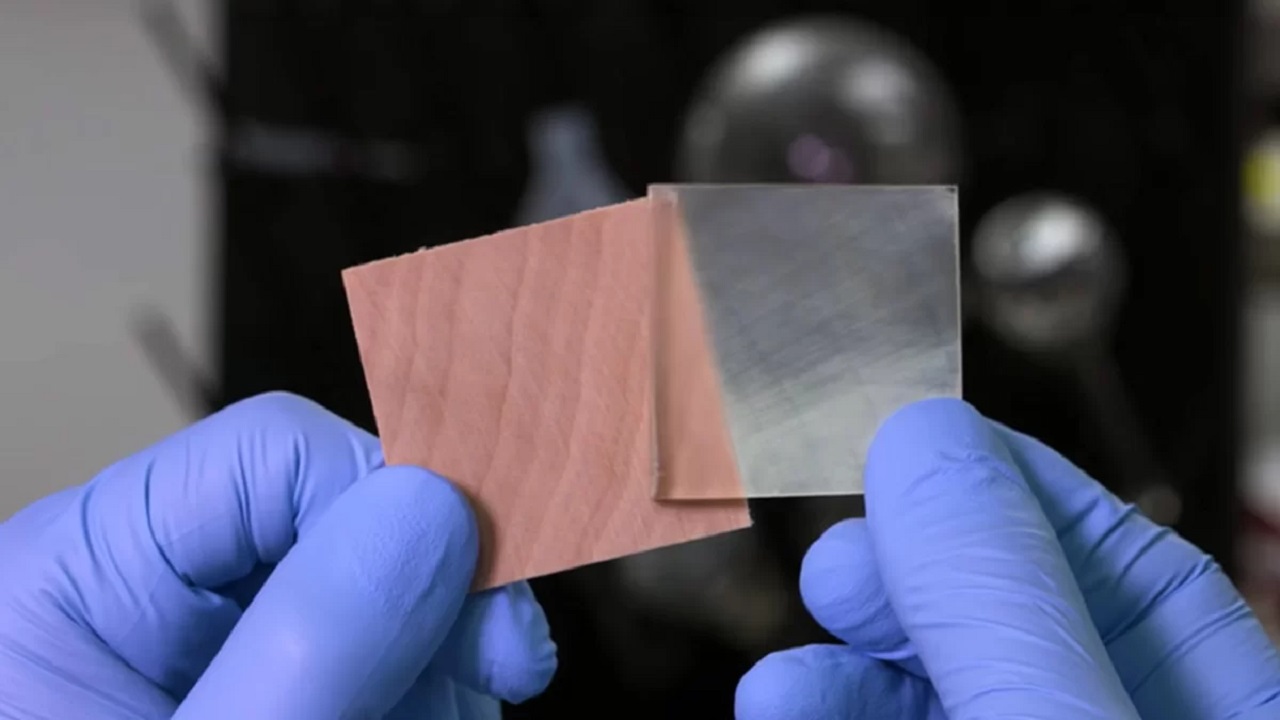
Indian Scientists Developed A New Technology That Can Replace Plastic And Glass In Several Segments. Transparent Wood, Besides Being More Resistant, Is Much More Sustainable.
Scientists from the Indian Institute of Technology Delhi, in India, developed a new technology that can replace plastic and glass in the civil engineering and automotive sectors. Transparent wood can be used in the production of car windshields, electrical equipment, and packaging.
New Product Aligns With Sustainability
According to the scientists, this innovative material reduces ecological impacts on the environment due to its renewable and biodegradable properties, in addition to being more economical and much more resistant than plastic and glass, significantly reducing the energy cost for its production.
According to Prodyut Dhar, a professor of chemical engineering and the lead author of the study, transparent wood as a sustainable material can effectively replace plastic and pollutant-based glasses harmful to the environment.
-
Scientists analyze 21 ancient craters and hypothesize that Earth once had rings 466 million years ago, formed by debris from a fragmented asteroid.

-
China builds the world’s largest astronomy base on the Tibetan plateau: telescopes up to 14.5 meters in Saishiteng are expected to surpass Mauna Kea by the mid-2030s and put Beijing in the race for the deepest discoveries of the modern universe.

-
Nvidia built the infrastructure of artificial intelligence and became the largest company in the world, but Jensen Huang now needs to defend his throne against Huawei, Google’s TPUs, chip startups, and customers who want to escape dependence on more expensive GPUs.
-
NASA captures Typhoon Jangmi with a giant eye spinning in space, winds of 130 km/h, and huge clouds advancing over Japan in images that impress with the storm’s strength.




Among the products that can be replaced are polypropylene, acrylic, polyvinyl chloride (PVC), and polyethylene. First presented in 1992 by German scientist Siegfried Fink, transparent wood is obtained by removing the lignin content found in natural wood and replacing it with plastic materials.
Lignin is an organic biopolymer widely used in the production of non-toxic and biodegradable plant tissues. By using sodium chlorite, scientists managed to remove the lignin from the wood and fill it with epoxy infiltrations. For the scientists, this process has a much lower environmental impact compared to current methods that use methacrylate polymers for plastic production.
Advantages of Transparent Wood
According to Dhar, plastics are used as substitutes for glass, a material that is generally very fragile. However, transparent wood is an even better alternative from an ecological standpoint, with a much longer lifespan and without causing harm to the environment.
During laboratory tests, transparent wood proved to be as strong as natural wood, but more durable and lighter. Moreover, its physical, optical, and mechanical properties indicate that this material can be used as a highly versatile biological base substrate.
For the scientists, ultimately, transparent wood may even be less eco-friendly than pure glass. However, it exhibits significantly less aggressive sustainable characteristics than the manufacturing process for polyethylene and other petroleum-based plastics.
Professor Anish M. Chathoth from the College of Forestry at the Kerala Agricultural University, India, noted that transparent wood can be used in construction, energy storage, packaging, flexible electronics, but given the significant environmental impact concerns, the product also has a great environmental advantage.
Sectors Use Wood Technologies To Focus On Sustainability
The civil construction sector can already prepare to develop buildings that are much more energy-efficient and, also, more environmentally sustainable. Scientists are utilizing a material that is much more energy-efficient and also more environmentally sustainable.
Researchers are using a thermally insulating material created from wood, free of petroleum. The new thermal insulation, developed in Sweden, has surprised everyone with its performance, being as good as common thermal insulation materials.
The product uses integrated wood and aerogel. However, despite appearing new, wood cellulose aerogel is something old, as scientists have been promoting research and developing new gels and other compounds for some time, conducting various tests with different applications, including the previously mentioned transparent wood.






Be the first to react!