





 Portuguese
  English
  Spanish
  2 min of reading
  0 comments


Evidence published by researchers from Monash University indicates that 21 craters from the Ordovician impact peak appear concentrated within 30° of the equator, despite much of the preservable crust being outside this range, reinforcing the hypothesis of an ancient debris ring around the Earth
The hypothesis that Earth once had rings, more discreet than Saturn’s, gained traction after a study linked Ordovician craters to an unusual equatorial band and debris from an ancient asteroid fragmented near the planet.
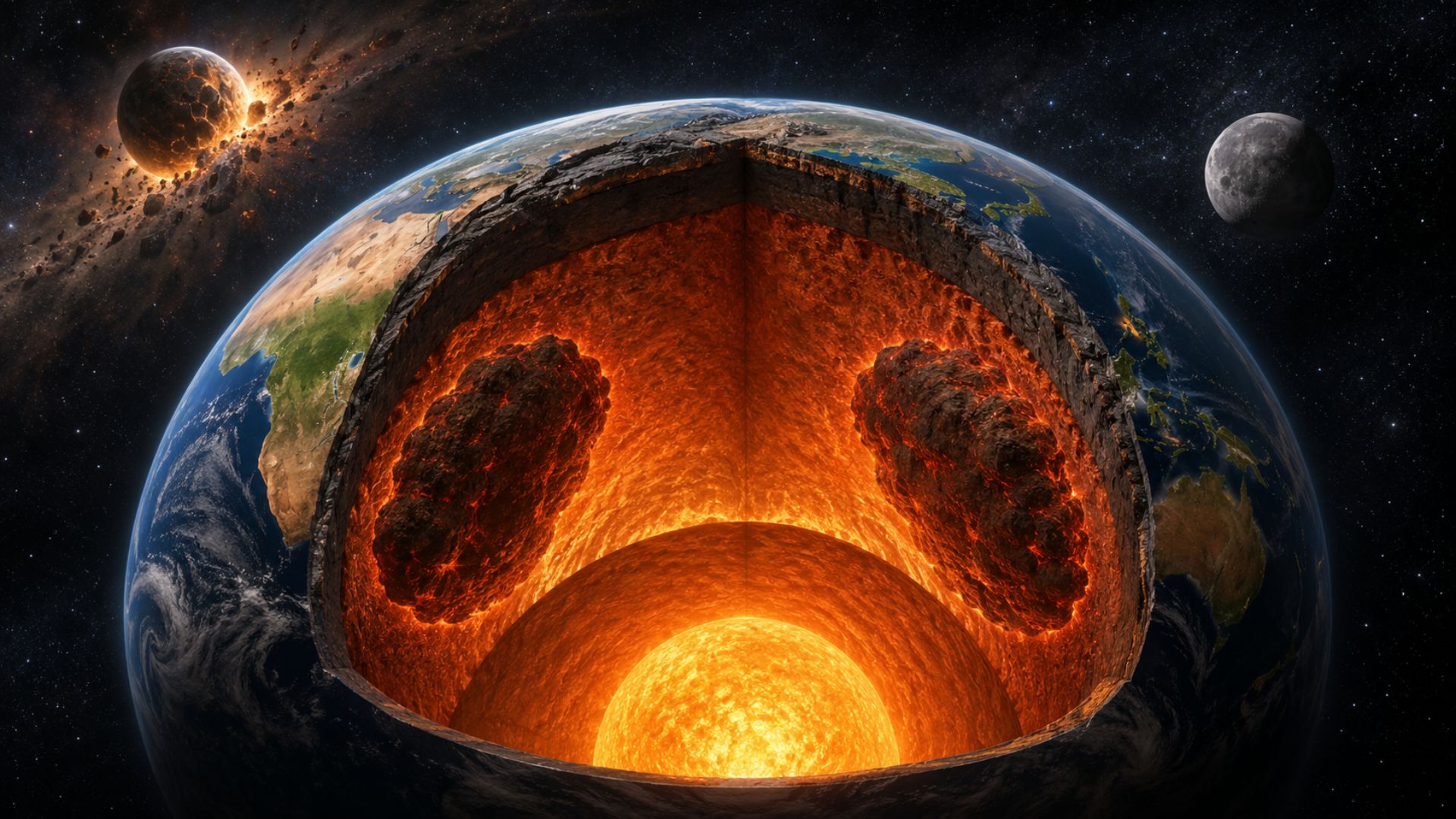
The Earth may have exhibited rings about 466 million years ago, during the Ordovician, after a large fragment linked to L chondrites broke apart near the planet and spread debris around the equator.
Earth, Saturn, and the rings of the Solar System
Saturn remains the most well-known planet for its bright rings. Jupiter, Uranus, and Neptune also have similar structures, although less visible. The possibility that Earth had rings broadens this comparison within the Solar System.
-
China builds the world’s largest astronomy base on the Tibetan plateau: telescopes up to 14.5 meters in Saishiteng are expected to surpass Mauna Kea by the mid-2030s and put Beijing in the race for the deepest discoveries of the modern universe.

-
Nvidia built the infrastructure of artificial intelligence and became the largest company in the world, but Jensen Huang now needs to defend his throne against Huawei, Google’s TPUs, chip startups, and customers who want to escape dependence on more expensive GPUs.
-
NASA captures Typhoon Jangmi with a giant eye spinning in space, winds of 130 km/h, and huge clouds advancing over Japan in images that impress with the storm’s strength.
-
Hidden beneath the dense vegetation of Mexico, a Maya settlement reveals 80 structures, a colorful mural, a monumental plaza, and structures up to 14 meters tall that may be just the beginning of an even larger ancient city.




The hypothesis was presented in November 2024 by Andrew G. Tomkins, Erin L. Martin, and Peter A. Cawood, from Monash University, Australia, in a scientific report on the Ordovician.
Craters concentrated near the equator
The study analyzed the paleolatitudes of 21 impact craters formed during an anomalous interval of approximately 40 million years, known as the Ordovician impact peak.
All the craters appear in an equatorial band of up to 30°. This pattern is striking because about 70% of the exposed crust, with the potential to preserve craters, was outside this region.
For the authors, the distribution may be linked to the fragmentation of a large piece of the parent body of L chondrites during an approach to Earth. The debris would have formed a ring, with material later falling onto the planet.
Rings more tenuous than Saturn’s
The evidence suggests that these possible Earth rings were more tenuous than Saturn’s. Even so, they could have influenced the planet by casting debris and, in a speculative hypothesis, shading part of the surface.
The report also raises the possibility that this shading may have contributed to the cooling associated with the global glacial period Hirnantian.
The study “Evidence suggesting that Earth had a ring in the Ordovician”, published in November 2024 on sciencedirect.com, was authored by Andrew G. Tomkins, Erin L. Martin, and Peter A. Cawood, from Monash University, Australia.







Be the first to react!