Portuguese
  Spanish


Pioneering Ecological Project Tries to Save a Nearly Extinct Species with the Help of Microscopic Larvae Released into a New Artificial Reef
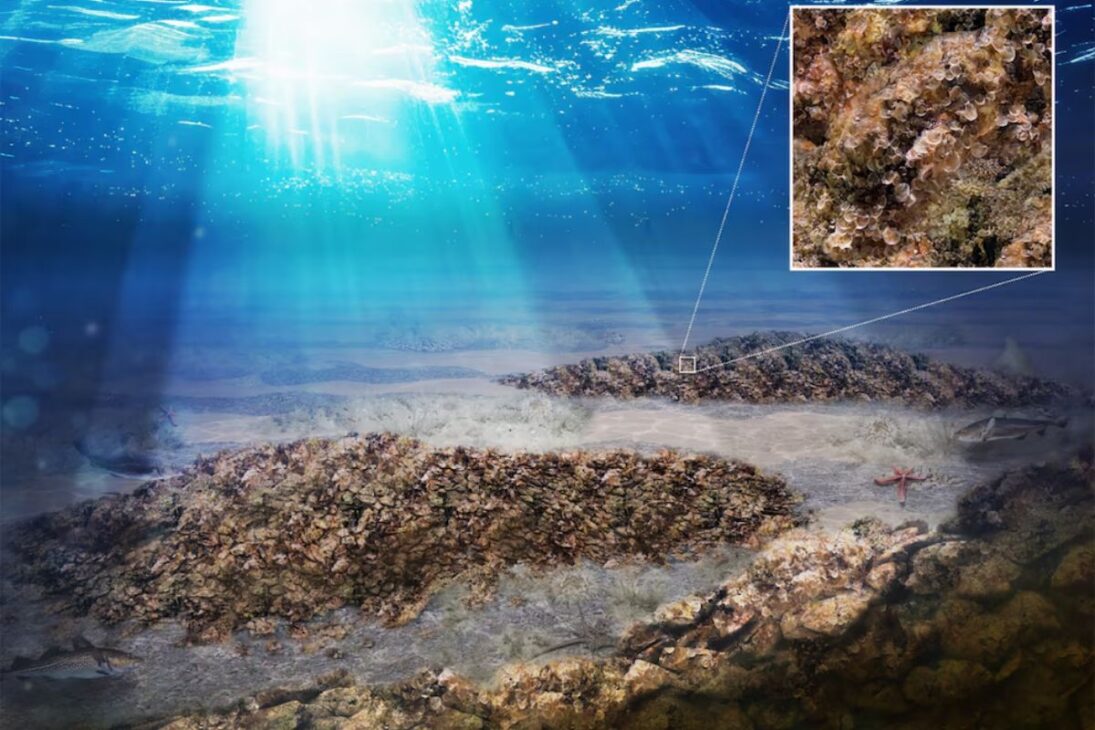
In an unprecedented action, Belgian scientists released 200,000 European flat oyster larvae onto the hull of a sunken ship in the North Sea. The goal: to transform the wreckage into a natural nursery to restore severely degraded marine ecosystems. The experiment, considered pioneering, could mark a milestone in the recovery of locally extinct species and the creation of sustainable artificial reefs without ongoing human intervention.
The operation took place in July 2025 at the wreck of the cargo ship Kilmore, submerged at a depth of 30 meters and located about 32 kilometers off the coast of Ostend, Belgium. The vessel, which sank in 1906, now hosts an ambitious ecological restoration project led by scientists, with funding from the Belgian government and the European Union.
Belreefs Project: Technology, Science, and Nature United
The initiative, named Belreefs, is the result of more than two years of cooperation between scientific institutions, environmental authorities, and companies in the offshore sector. One of the main project partners is the Belgian group Jan De Nul, specializing in marine construction and renewable energy. According to Vicky Stratigaki, engineer and coordinator of the action, the idea is to create a self-sufficient reef capable of expanding naturally over time, without the need for maintenance or external interference.
-
Offshore Wind Turbines Double as Artificial Reefs, Attracting Marine Life

-
Frozen Cave in New Mexico Defies Desert Heat with Ice Layer Up to 6 Meters Thick
-
Few Know This: Canada’s Flag Design, with its 11-Point Maple Leaf, Was Wind Tunnel-Tested for Clarity

-
Fish Rain from the Sky in Brazilian Cities During Storms, Puzzling Residents; Learn How Waterspouts Can Transport Animals Over Long Distances


“Our goal is to achieve long-term restoration of nature without needing to return to intervene,” said Stratigaki. The introduced larvae belong to the species Ostrea edulis, native to Europe and historically abundant in areas such as the North Sea — but virtually extinct in recent decades.
The authorities plan rigorous monitoring over several years to measure environmental impact, identify potential failures, and adapt the next phases of the project to other degraded areas of the region.
Source: Jan De Nul Group
A Sunken Ship That Now Houses Life
The Kilmore, besides being a submerged cultural heritage, offers ideal conditions for the experiment. According to Merel Oeyen, marine environmental policy advisor for the Belgian government, every wreck over 100 years old in the country’s waters is automatically protected by law, becoming an area closed to fishing.
“Every ancient wreck transforms into a biodiversity hotspot,” said Oeyen, who also highlighted the ecological importance of these abandoned structures at sea. The gravel bed where the Kilmore rests was once home to natural oyster reefs centuries ago, making the location ideal for the reintroduction of the species.
Oysters: Small Engineers of Marine Life
European flat oysters play an essential role in coastal ecosystems. Known as “ecosystem engineers,” they create structures that shelter various other marine species, help clean the water by filtering impurities, fix nitrogen, and protect the seabed from erosion.
In addition to direct ecological benefits, reef formation can attract other forms of life, stabilize the local ecosystem, and create a new point of marine diversity in an area severely impacted by human activities in recent decades.
From Abundant to Nearly Extinct
Before the 19th century, oyster reefs were common in European waters. However, overfishing, seabed dredging, and other forms of industrial exploitation devastated the species’ populations. The collapse intensified from 1979 when a deadly parasite, Bonamia ostreae, was introduced to Europe from California, causing the decimation of oyster beds in France, Belgium, and the Netherlands.
Today, European flat oysters are considered nearly extinct in much of the North Sea, highlighting the urgency of projects like Belreefs.
Survival and Ecological Legacy
Of the 200,000 released specimens, it is estimated that only about 30,000 will survive the first year. Despite the expected mortality rate, scientists are confident that this initial contingent will be sufficient to establish a functional reef, capable of reproduction and self-expansion.
The experiment will serve as a foundation for similar future actions, which could be applied to other protected wrecks or degraded areas of the North Sea and even other regions of Europe. Replication will depend on the success of this pilot and its ecological and economic viability.
The Belgian Minister of Justice, Annelies Verlinden, declared in support of the project:
“The North Sea is not only a strategic economic engine but also a unique ecosystem that we must protect. With initiatives like Belreefs, we aim to restore at least 20% of our North Sea by 2030.”
A European Model of Restoration
According to Smithsonian Magazine, Belreefs represents a new stage in how Europe approaches marine environmental recovery. By integrating science, public policy, and technology, the project could become a replicable model for countries facing similar challenges in their coastal areas.
In addition to seeking the restoration of a symbolic species, the program aims to prove that simple interventions, such as using wrecks as ecological platforms, can have profound and lasting impacts on global biodiversity.