Portuguese
  Spanish


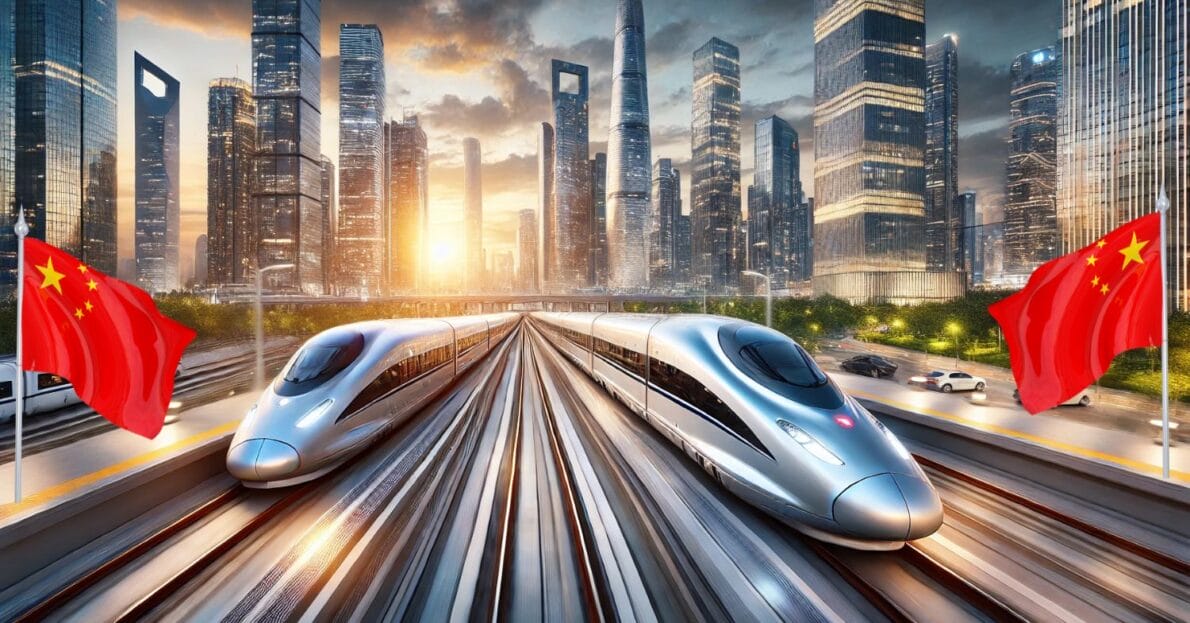

With the Largest High-Speed Railway Network in the World, China Establishes New Standards in Urban Mobility and Sustainability Surpassing the USA, Europe, and Japan.
If there is a country that is changing the rules of railway transport, that country is China. With over 160,000 kilometers of operational tracks — of which 46,000 are high-speed railways — China has already left giants like the USA, Europe, and Japan behind. While other countries still struggle to expand their networks, China has already built the largest and most modern railway system in the world, a global reference in urban mobility.
What Makes China Stand Out in Railway Transport?
What makes China stand out in railway transport? The answer lies in the scale and pace of expansion. Since 2012, the country has heavily invested in railway infrastructure, increasing the total length of its network by 64.2% and expanding high-speed lines by 392.2%. This growth is not just impressive; it positions China as the undisputed leader in the sector, both in technology and innovation.
To understand this leadership, just compare with other railway systems around the world. Japan, the pioneer of bullet trains with the Shinkansen, has about 3,000 km of high-speed tracks. In Europe, the railway network covers approximately 11,000 km and is dominated by lines such as the French TGV. In the USA, high-speed transport is limited to the Amtrak Acela line, with its 735 km, which still does not reach the speed and efficiency standards seen in China.
-
U.S. Women’s History Museum Stalled in Congress Amid Gender Identity and Diversity Debate

-
Chinese Manager Accused of Whipping Worker Sparks Protest by 1,200 Employees at Major Brazilian Factory

-
France Revamps 530 Social Housing Units with Large Balconies and Glass Facades Without Demolishing Existing Buildings
-
10-Year-Old Max Makes History with Paris Fashion Show, Launches Own Brand, Hires Staff, and Sets World Record as Youngest Runway Designer





And the progress doesn’t stop there. Li Jingwei, vice-chief of the China Railway Group, revealed that the country adds more than 3,000 kilometers of high-speed tracks each year. This continuous investment helps serve millions of people and connects 96% of Chinese cities with more than 500,000 inhabitants.
High Speed That Transforms Urban Mobility
Speed is a decisive factor in urban mobility, and China does not joke when it comes to speed. While railway lines in other countries average lower speeds, Chinese high-speed trains reach up to 350 km/h. And this means a huge difference for those who need to travel between distant cities.
For illustration, a trip between Beijing and Shanghai, which used to take 12 hours, is now completed in just over 4 hours. The route between Beijing and Guangzhou, which used to last 21 hours, can now be made in just 7 hours. With the reduction in travel time, millions of Chinese are able to make more of their time in their routines, facilitating commutes for work, leisure, and business.
Projects like the line connecting Guangzhou to Shenzhen and Hong Kong are essential for integrating the population and driving development in various regions. Additionally, lines that reach remote areas, such as the Lhasa-Nyingchi Railway in Tibet, prove the country’s commitment to connecting all regions, bringing development to more isolated areas.
The Advantage of Chinese Rail Transport
By offering a faster and more sustainable transportation option, China is not only promoting urban mobility but also contributing to environmental preservation. Compared to the use of cars and planes, rail transport emits far fewer pollutants, which is crucial for reducing carbon footprints.
Chinese high-speed trains are part of a broader solution to facing environmental challenges while keeping the country connected. With a network that meets different transportation needs, China has created a model that combines sustainability and efficiency. High-speed rail transport reduces reliance on private vehicles and helps keep large cities more accessible and organized.
Another important point is the accessibility of rail transport. With affordable prices and a vast network of stations, it becomes a viable alternative for millions of Chinese. The extensive connectivity of railway lines helps strengthen the local and regional economy, providing access to services and business opportunities in different parts of the country.
China Surpasses the USA, Europe, and Japan and Begins a New Era in Global Transport
China has achieved a unique position in global railway transport. With an impressive network of high-speed railways and a continuous commitment to innovation, the country has set a standard that is still far from being reached by other powers. The lack of investment and regulatory issues have delayed the progress of railway systems in countries like the USA and the UK, further highlighting China’s advancement.
Moreover, the pace of expansion continues: with plans to further extend high-speed lines, China demonstrates its intention to lead the future of railway transport. And while other nations are still debating the role of rail transport, China already considers it a fundamental part of its development.