Portuguese
  Spanish



Estimates Point to Billion-Dollar Losses Due to Fire Ants, Which Affect Farms and Cities, and Texas Is One of the Epicenters of the Problem
The fire ant, known in the U.S. as red imported fire ant and identified as Solenopsis invicta, is cited by studies and public agencies as one of the costliest invasive pests in the southern U.S.
Reports and technical materials cite impacts exceeding US$ 6 billion per year when control costs, repairs, and health expenditures in affected areas in the United States are totaled.
In Texas, however, the most repeated estimate by one of the leading research and extension programs on the subject is lower than the national figure but still very high. The Texas Imported Fire Ant Research and Management Project, linked to Texas A&M, estimates an impact of US$ 1.2 billion per year just in the state.
-
Stingless Bee Honey from Brazil Can Cost Up to $120 a Liter, Surprises with Flavors of Wood, Citrus, and Even Cheese

-
Woman Claims to Have Spotted a Technical Pattern in Recent FIFA Tournaments, Predicts Possible World Cup Winner
-
Chevrolet Offers Chance to Win a 2026 Sonic RS for Free via WhatsApp
-
Earthquake vs. Tsunami: Which Causes More Destruction and Why One Can Be Even More Dangerous


The divergence between numbers often leads to confusion on social media. Some figures refer to the U.S. as a whole, while others focus on Texas, specific sectors, or different time periods, which greatly alters the final total.
Billion-Dollar Losses and Why the Number Varies Between Texas and the United States
The figure above of US$ 6 billion annually appears in technical materials associated with the USDA, with the calculation including control costs, repairs, and medical expenses in infested regions.

In contrast, the Texas number of US$ 1.2 billion per year comes from the Texas A&M project that brings together research and management guidance in the state.
Besides the geographical scope, what is included in the calculation also weighs in. Some studies consider losses in agriculture, urban areas, infrastructure maintenance, and health impacts, while others focus on sectors like households, services, and livestock, which alters the outcome.
Another factor is the scale of infestation. The fire ant has already spread extensively throughout the southern U.S., and USDA publications indicate infestation covering about 300 million acres in areas of the country, indicating the size of the problem.
How Fire Ants Affect Cattle and Increase Costs in Ranching
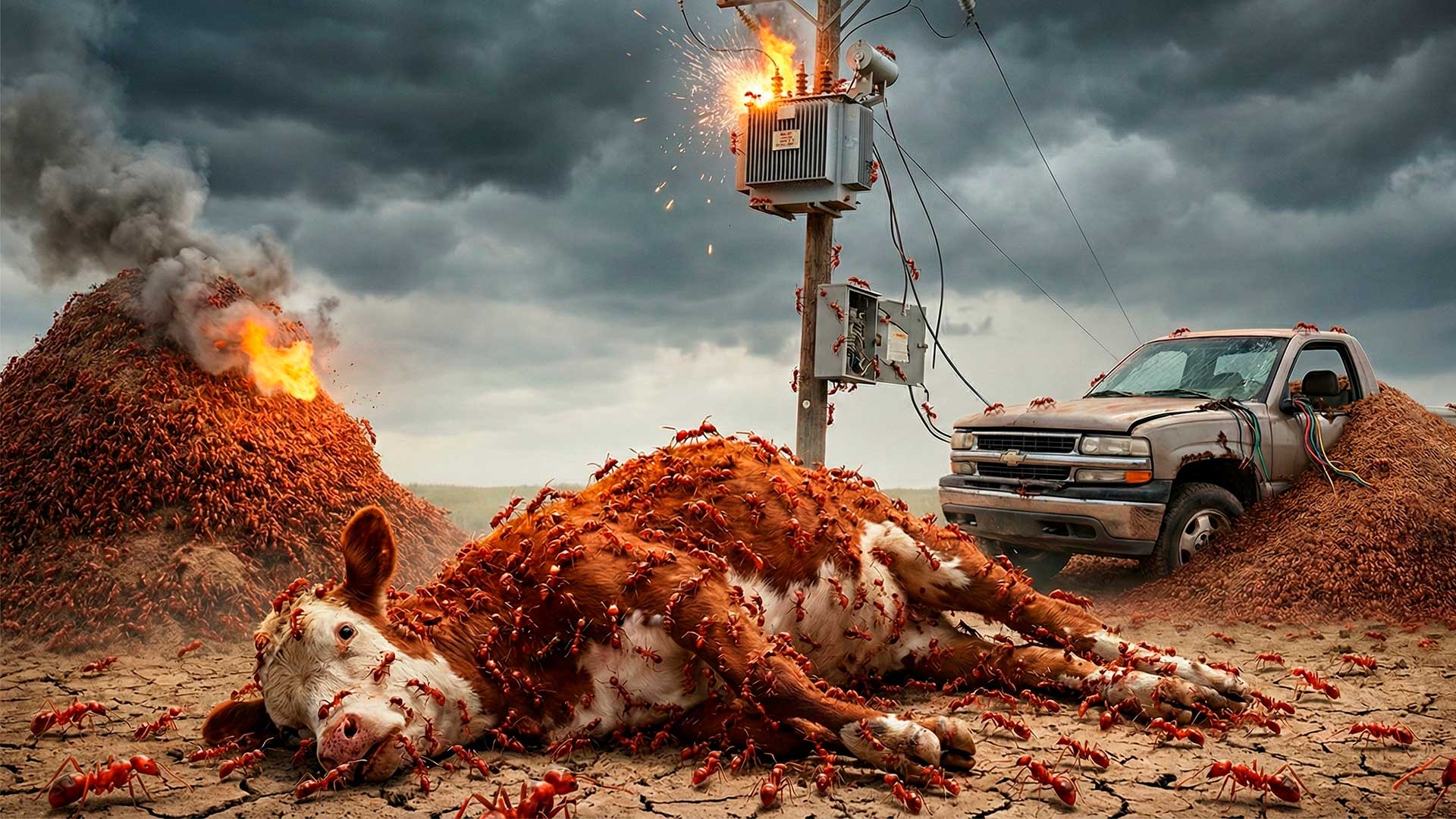
In practice, the losses in the field are not just a nuisance. The USDA warns that young and newborn animals are especially susceptible to stings, which helps explain why the pest concerns cattle producers in infested regions.
On farms, colonies can emerge in grazing areas, water troughs, and handling locations. When there is a high density of nests, the risk of attacks on the herd increases, as does the cost of control, since the producer needs to treat larger areas for longer periods.
In addition to stings, the mounds of dirt hinder operations and can damage equipment used in daily routines. In extension materials, there are reports of very high densities, with mounds reaching hundreds per acre under certain conditions, illustrating how control can become a recurring expense.

Why They Enter Electrical Equipment and Cause Failures
The urban impact also weighs in, and here comes a detail that seems exaggerated until it happens. Technical guides describe that the fire ant can infest electrical equipment and utility boxes by chewing through insulation, bringing soil inside, and contributing to short circuits and mechanical failures.
There is also evidence that they are attracted to electric fields, making them prone to invade various types of devices, from air conditioning units to signaling systems. The USDA describes the problem as capable of affecting different equipment and electrical contacts in areas where the species occurs at high density.
In the technical material associated with Texas A&M, the topic appears with specific guidance, precisely because treatment involves risk and usually requires professional care, as it deals with electrical networks and powered boxes.
What Works in Control and the Debate Over Poisons and the Environment
Extension specialists and public agencies tend to recommend integrated management, which combines baits, localized treatments, and preventive actions, rather than relying solely on one product. In urban settings, manuals outline step-by-step strategies and emphasize that the choice of method depends on the location, level of infestation, and risk to people and animals.
The debate, however, continues because controlling the pest is expensive, and at the same time, the repeated use of insecticides raises questions about environmental impacts and safety, especially in areas of recreation, schools, and backyards.
The pressure for more sustainable solutions also increases because the species continues to spread and requires constant control.
In practice, the central point is that there is no “silver bullet.” The cost rises when control is done only after the infestation explodes and decreases when there is monitoring and rapid response, especially in sensitive areas like pastures with calves, recreational areas, and electrical infrastructure.