Portuguese
  Spanish


The Brazilian Renewable Energy Industry Is Experiencing Its Worst Crisis: Bankruptcies, Layoffs, and Losses Question the Country’s Role in the Global Energy Transition
In the coming months, Brazil will be the center of the world’s attention as it hosts the planet’s most important climate summit. Ironically, the country that has always advocated for clean energy is seeing its main bets — solar and wind — collapse.
The crisis spread quickly. 2W Ecobank SA, a wind energy producer, filed for bankruptcy protection in April. Rio Alto Energias Renováveis SA, which works on solar projects, also sought legal protection to try to reorganize its debts. Aeris, the largest manufacturer of wind turbine blades in the country, cut more than 3,700 jobs while restructuring its debt.
A Global Problem with Local Aggravating Factors
What is happening in Brazil is not an isolated issue. Lack of transmission infrastructure, high interest rates, delays in environmental licenses, and a pressured supply chain are challenges common to other countries as well. However, here, the obstacles have gained larger proportions.
-
France Revamps 530 Social Housing Units with Large Balconies and Glass Facades Without Demolishing Existing Buildings

-
10-Year-Old Max Makes History with Paris Fashion Show, Launches Own Brand, Hires Staff, and Sets World Record as Youngest Runway Designer

-
Bolivian Female Construction Workers Form Association to Combat Discrimination and 38% Pay Gap in the Industry
-
Near Amsterdam, residents buy land and discover they must also build streets, manage drainage, handle waste, and grow food on half their plot.




Part of the problem is precisely the recent success. In 2023, Brazil was the third country globally to add the most solar and wind capacity. However, the rapid expansion caused an imbalance: during the day, generation exceeds what the grid can absorb, and the national operator began to cut production.
“We are experiencing the worst times for the industry,” said Elbia Gannoum, president of Abeeólica. “I have never seen a crisis of such magnitude and duration.”
Debts, Layoffs, and Cuts: The Real Impacts
The financial situation is so delicate that the associations Abeeólica and Absolar are appealing to banks and investors to renegotiate debts before the crisis worsens.
“Loans will be paid, but it is essential to understand that we are facing an exceptional situation,” explained Rodrigo Sauaia, president of Absolar. “It is in the interest of investors and banks to weather this storm alongside the sector.”
Banks like BTG Pactual, Santander Brasil, BNDES, and Banco do Nordeste are among the creditors. According to Luiz Abel, commercial director of Banco do Nordeste, there has been progress in negotiations:
“We have received some specific requests for negotiation due to production cuts and have managed to progress without stress, without default.”
Even so, the numbers are concerning. The basic interest rate, now at 15%, is the highest since 2006, and even with subsidies on some financing, credit tightness is evident. Between 2024 and 2025, according to Abeeólica, about 11,000 workers lost their jobs because of the crisis.
Stalled Transmission and Blackouts: The Structural Bottleneck
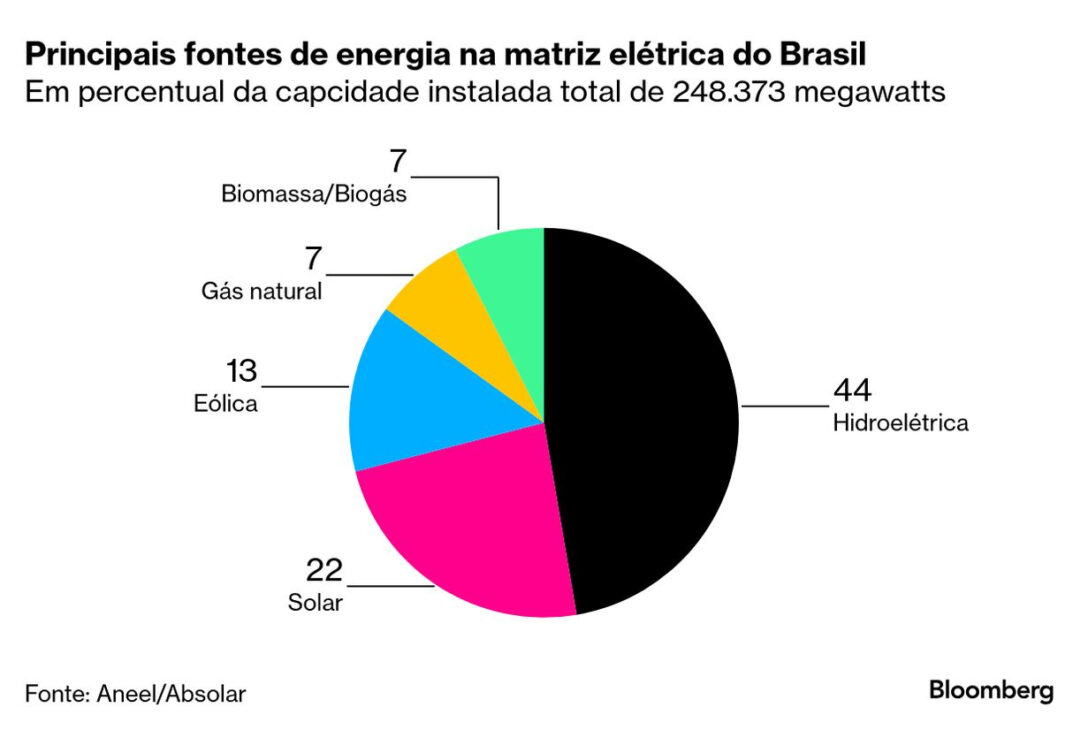
The logistical knot of renewable energy in Brazil is concentrated in the Northeast, where the solar and wind parks are located. But it is in the Southeast that most of the consumption occurs. And the infrastructure to channel this energy is still far from keeping up with demand.
Since the pandemic, production cuts have intensified. In 2023, a national blackout — partly caused by the instability of renewable sources — prompted the national operator to tighten production limits. In February 2025, the collapse of a transmission line only worsened the situation.
New Rules, Greater Losses
Until 2023, renewable energy producers received full reimbursement for losses caused by production cuts. However, a regulation from Aneel changed everything: now, companies can only recover a maximum of 3% of these losses. Thermal power plants continue to be fully reimbursed.
Absolar and Abeeólica have sued Aneel demanding reimbursement of R$ 4.8 billion (about US$ 873 million) in accumulated losses. No representative from the agency or the Ministry of Mines and Energy wanted to comment.
There Are Those Who Resist — But They Are Few
Renova Energia, which also underwent bankruptcy protection, managed to return to profitability and announced new investments to increase its installed capacity. However, examples like this are exceptions, not the rule.
“Unless we have a significant number of transmission lines to channel this energy, we will continue to see many cuts,” warned Thaina Cavalini from Fitch Ratings.
Elbia Gannoum from Abeeólica sees another problem: small solar producers who use subsidies to generate profitable energy — and are not affected by restrictions. “This type of generation does not face regulatory restrictions, which only impact large producers, and already represents over 15% of the total installed capacity,” she criticized.
Delayed Solutions and Missed Opportunities
The government has plans to acquire large-scale batteries that would help store excess energy. However, the auctions for these technologies have been postponed to the second half of the year. Additionally, according to Absolar, taxation on these systems can reach 85%, which makes investments unfeasible for many companies.
Fitch has placed three Brazilian renewable energy companies under negative outlook: Serra do Mel Holding, Itarema Geração de Energia, and the Morrinhos Complex, the latter controlled by CGN Brazil, a subsidiary of the Chinese state-owned enterprise. None of the companies have made a statement.
Others, like Equatorial Energia, are trying to sell their assets. In 2022, the company bought Echoenergia for R$ 7 billion and has now hired Banco Safra to try to sell it.
Factories Closing and Jobs Evaporating
The impact on the productive sector is also visible. GE Vernova, based in Massachusetts (USA), announced the closure of the wind turbine blade factory of LM Wind Power in Suape (PE), resulting in the layoff of 1,000 people. The justification: the drop in demand across Latin America.
Rodrigo Sauaia from Absolar summed up the sentiment of the sector with a clear metaphor:
“The patient is in intensive care”, he said. He added: before any recovery, the sector “needs to stop relying on life support.”