Portuguese
  Spanish





The Japanese manufacturer announces expansion in Manaus, with a billion-dollar investment, increased production capacity, and creation of new jobs, while the Brazilian motorcycle market records record volumes of production and sales.
The Honda will expand the motorcycle factory in Manaus (AM) with a R$ 1.6 billion investment in a new cycle that will last until 2029.
The plan raises the installed capacity to 1.6 million motorcycles per year starting in 2026, includes the launch of new models, and modernizes the manufacturing park in the Free Trade Zone.
The unit, inaugurated in 1976, is described by the company as the most verticalized in the group worldwide and employs over 9,000 workers.
-
Brazilian Steel Giant Partners with USP to Develop 40% Stronger Rebar for World’s Tallest Residential Building in Brazil’s Senna Tower

-
Oil Prices Drop to $72 as 20 Million Barrels Pass Through Strait of Hormuz in 24 Hours, Easing Supply Fears but Regional Tensions Keep Market on Edge

-
Brazil’s Ministry of Justice Investigates CazéTV for Betting Ads During World Cup Broadcasts

-
Brazilian Retail Giant Americanas Faces $10 Billion Asset Freeze Amid Investigation into Hidden Debts


About 350 new positions will be created to support the expansion.
The package also includes a review of production processes, installation of new lines, and layout changes focusing on efficiency.
In a statement, the brand’s management noted that the demand for mobility solutions “agile, versatile, and economical” remains high in the country and “continues to attract Brazilian consumers to motorcycles.”
The Manaus plant, which currently manufactures 20 models locally, will also undergo improvements in internal logistics and the work environment.
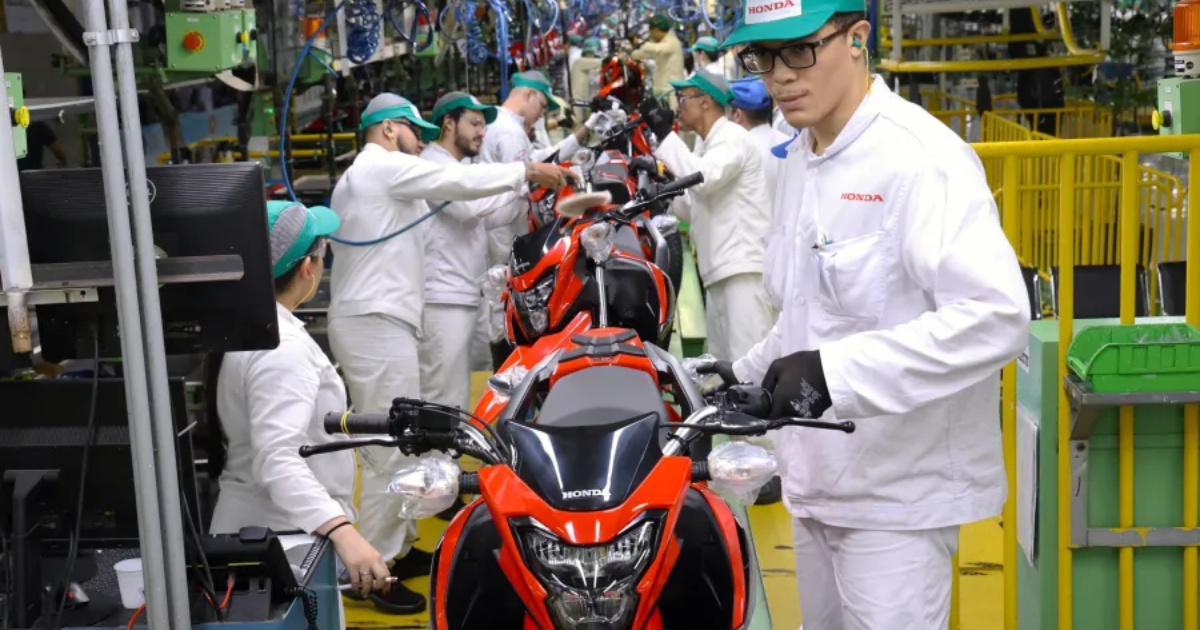
Capacity of the Manaus Factory and Global Position
The Amazonian unit is one of Honda’s largest motorcycle factories in the world and operates with a high level of integration of components, a feature that reduces external dependencies and increases production flexibility.
Federal government data indicates that the plant integrates a good portion of its parts internally, has a daily production exceeding 6,000 units, and an industrial cycle capable of assembling a motorcycle every 19 seconds.
The increase to 1.6 million units/year will be achieved starting in 2026, following the installation of new lines and the adoption of high-technology equipment.
The reinforcement comes at a time of strong growth in the motorcycle market in Brazil.
New Models and Technology in Highlight
The cycle includes new motorcycles and updates to existing models, emphasizing fuel economy, emissions, safety, and connectivity.
Meanwhile, specialized vehicles reported that Honda plans seven new models for Brazil, expected for 2025 and the first half of 2026.
The mentioned models include NC750X, CB750 Hornet, and XL750 Transalp.
Motorcycle Market on the Rise in Brazil
The movement of expansion accompanies the growth of the sector.
August 2025 recorded 185.9 thousand units produced in the Industrial Pole of Manaus, a 13.4% increase over August 2024.
From January to August, the industry summed 1,326,963 motorcycles produced, an increase of 12.5% year-over-year, the best result for the period in 14 years.
Registrations also grew: 185.5 thousand in August and 1,408,273 in the cumulative of eight months, a historic record for the interval.
In the domestic market, Honda maintains leadership with a near 68% share in 2025, according to industry surveys.
Yamaha holds the second position.
In some months, the brand’s share fluctuated between 66% and 69%, a level that confirms its historical dominance among manufacturers.
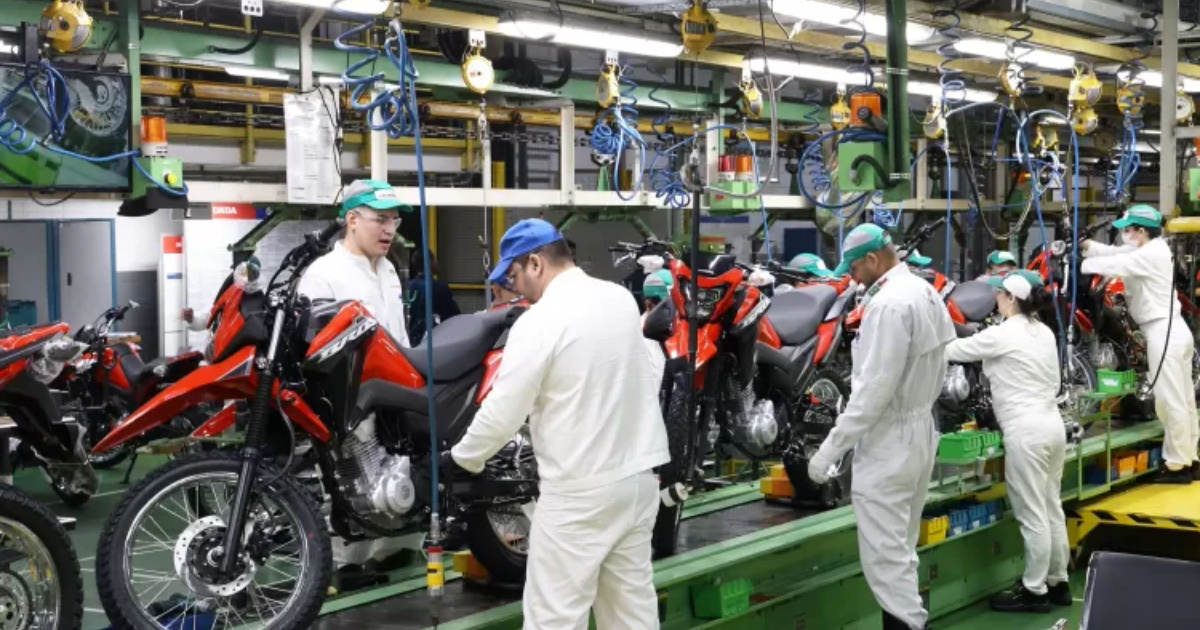
Employment, Portfolio, and Exports
The company employs over 9,000 people in Manaus and operates with a network of more than 1,100 dealerships in the country.
The portfolio includes 20 models produced locally and 7 imported, with displacements from 110 cc to 1,100 cc.
Exports serve 17 countries, including the United States, Australia, and Mexico.
The announced investment also aims for operational efficiency gains, with waste reduction and standardization of processes.
National Production and Recent Volumes
According to Abraciclo, the sector closed 2024 with 1.7 million units produced and is expected to reach 1.88 million in 2025.
In this scenario, Honda manufactured over 1.3 million motorcycles in 2024, according to balances released earlier this year.
The announced expansion is presented by the company as a strategy to meet the rising demand.
Reasons for Expansion in Manaus
Among the factors explaining the expansion are the market growth, the consolidation of the logistics network, and the specialized workforce in the Free Trade Zone.
The verticalized structure of the factory, which goes from chassis to engine, also provides cost predictability and reduces bottlenecks.
With the goal of 1.6 million units per year starting in 2026, the Brazilian operation will become one of Honda’s main global bases for motorcycles.
Although the new models have not yet been officially detailed, the company states that they will come with more efficient engines, additional safety features, and greater connectivity.
With confirmation that the 1.6 million capacity will be reached in 2026, the sector watches with anticipation which segments will be prioritized in the Manaus lines: urban-use motorcycles, higher-displacement models, or scooters with more embedded technology?