






 Portuguese
  Spanish


Oil retreated with Brent near US$ 72 and resumption in the Strait of Hormuz, after 20 million barrels in 24 hours, but mines, insurers, Iran, and OPEC keep investors attentive to global risk on supply, navigation, insurance, sanctions, and energy prices in the coming months of the international market
Oil returned to operate near US$ 72 this Thursday, June 25, 2026, after the market reacted to the resumption of flow through the Strait of Hormuz, one of the most sensitive maritime routes for global energy. The movement involved Brent crude, WTI, United States authorities, and operators attentive to the Middle East.
According to Exame, the improvement occurred after the U.S. Secretary of Energy, Chris Wright, stated that at least 20 million barrels passed through the Strait of Hormuz in the last 24 hours. The larger flow alleviated the immediate fear of shortage but did not eliminate the risks linked to mines, maritime insurance, Iran, Israel, and the future of OPEC itself.
Price falls, but the market still looks at Hormuz
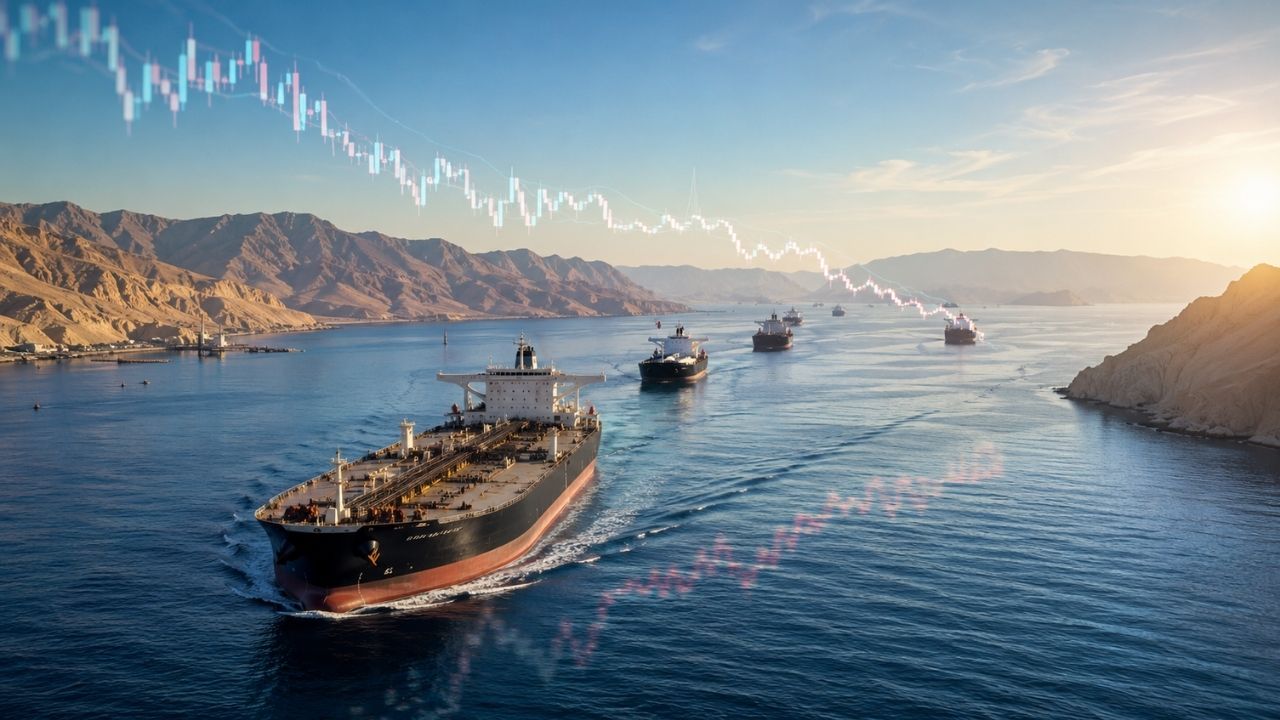
The retreat of oil drew attention because it brought Brent to levels close to those seen before the escalation of the war in Iran. The international reference for August fell by 1.46%, to US$ 72.66, while WTI, used as a benchmark in the United States, retreated 1.19%, to US$ 69.50.
-
Brazil’s Ministry of Justice Investigates CazéTV for Betting Ads During World Cup Broadcasts

-
Brazilian Retail Giant Americanas Faces $10 Billion Asset Freeze Amid Investigation into Hidden Debts

-
Does Your State Rank Highest? Brazil’s IBGE Reveals Salary Rankings and Worker Disparities
-
World’s Largest Women’s Coffee Collective Emerges in Southern Brazil with 2,179 Female Farmers, Generating $21.7 Million in Four Years, Led by a 103-Year-Old Farmer Ambassador


Shortly after, around 8:06 am Brasília time, Brent showed a slight recovery, at US$ 72.85, while WTI was at US$ 69.35. In practice, the market stopped pricing an immediate blockade, but continued charging a risk premium for the region.
The Strait of Hormuz is decisive because it concentrates an important part of maritime energy circulation. When signs of restriction, military threat, or insecurity on the route arise, the price of the barrel tends to react quickly, as any interruption can affect buyers, refineries, freight, and stocks in various countries.
This time, the news that 20 million barrels passed through the passage in just 24 hours acted as a relief signal. Still, the output volume does not mean complete normalization, because the entry of ships and the confidence of insurers remain fundamental parts of the mechanism.
Mines in the Strait prevent complete normalization
Despite the positive reaction of prices, traffic through the Strait of Hormuz still depends on the removal of mines and the full recovery of navigation conditions. Total normalization, according to the assessment published in the Exame report, should take a few weeks, precisely because the route does not return to 100% operation while there is a physical risk for vessels.
This point is central to understanding why oil fell, but did not enter a completely smooth trajectory. The market does not react only to the volume that left; it also observes whether new ships will have the security to enter, load, and circulate without extra costs.
According to Exame, the cited agreement to end the war opened space for the gradual resumption of navigation through the Strait of Hormuz. The report states that the understanding provides for a 60-day period of negotiations on issues considered sensitive, including the Iranian nuclear program.
Still according to Exame, caution remains because the normalization of the route depends both on physical security in the Strait and on the progress of political negotiations. Therefore, the relief in the price of the barrel does not eliminate the possibility of the market recalculating the risk if regional tension rises again.
According to Exame, based on information from Reuters, the US Secretary of Energy, Chris Wright, assessed that oil would continue to flow through the Strait even if the agreement did not hold. The statement was presented as a reading of the American government on Iran’s ability to again restrict the passage.
Insurers still hold part of the recovery
Another factor that prevents a completely optimistic reading is the stance of insurers. Analyst Giovanni Staunovo, from UBS, assessed that much of the recent improvement occurred in the outflow from the Gulf, with ships leaving the region. The advancement of incoming traffic, however, still depends on more confidence.
This confidence involves the removal of mines and the normalization of insurance premiums. When a maritime route is seen as dangerous, insurers tend to raise costs or restrict coverage, and this directly affects the price of transportation. Even with oil available, an expensive or unsafe ship also weighs on the final account.
The logic is simple: if operational risk increases, the cost to transport energy also rises. This cost can appear in freights, premiums, delays, preventive stocks, and more cautious contracts. Therefore, the market monitors both barrel prices and signs of logistical security.
UBS also adjusted its projections for Brent. The bank now expects $85 per barrel at the end of September and December 2026, in addition to $80 at the end of the first and second quarters of 2027. The reading shows that short-term relief does not mean a bet on cheap oil for a long time.
Iran, sanctions, and China factor into price calculations
Iran also weighs on the behavior of oil for another reason: the expectation of increased sales from the country. With Tehran eyeing a temporary relief from US-imposed sanctions, expiring on August 21, investors began to consider the possibility of more Iranian oil in the market.
This expected increase helped push prices down. When the market sees a chance of additional supply, the tendency is to reduce part of the premium embedded in the barrel. However, this reading is not automatic, because sanctions, available buyers, and maritime restrictions still limit the real reach of exports.
Goldman Sachs’ assessment, cited by Exame, is more cautious. The bank does not project a significant increase in Iranian production and considers that China should remain the main buyer of Iran’s oil, while European Union and United Kingdom sanctions on Iranian oil and ships remain in effect.
This creates a scenario of partially stalled supply. Iran may try to sell more, but part of the global market remains limited by rules, restrictions, and commercial risks. Therefore, the downward pressure exists, but still coexists with obstacles that prevent a simple reading of excess supply.
OPEC gains new point of uncertainty with Iraq’s threat
While Hormuz concentrates geopolitical attention, OPEC adds another layer of uncertainty to the market. According to Exame, citing information from Reuters, Iraq is evaluating options if its production quota within the organization is not significantly increased. The possibility of leaving the group appears as political pressure within the dispute for greater production space, not as a decided action.
The threat draws attention because Iraq is one of the founding members of the organization, created in Baghdad. A potential rupture would have symbolic weight and could increase questions about OPEC’s ability to maintain internal discipline among producers with different interests.
The tension also occurs after the decision of the United Arab Emirates to leave OPEC and OPEC+, a move reported by Reuters in April 2026. The episode increased the perception of internal fragility in the group, especially amid disputes over production quotas. For the oil market, any sign of division among major producers can alter expectations of supply, prices, and coordination capacity.
Even if the Iraqi exit does not happen, the pressure for higher quotas already serves as a warning. Producing countries want revenue, consumers want stability, and investors try to anticipate which side will have more strength in the coming months. This game explains why the barrel can fluctuate even when the immediate news seems positive.
Short-term relief does not eliminate the barrel risk
The drop in oil to near $72 shows that the market has reduced the fear of an abrupt interruption in the Strait of Hormuz. The flow of 20 million barrels in 24 hours was enough to calm some investors and, at least momentarily, dispel the scenario of immediate scarcity.
But the story is far from over. Mines need to be removed, insurers need to regain confidence, the regional agreement needs to survive, and OPEC faces new internal pressures. The barrel fell because the worst-case scenario lost strength, not because all risks disappeared.
For consumers and companies, this difference is important. A temporary drop in Brent or WTI can ease expectations, but fuels, freight, and energy costs depend on a broader chain, which includes exchange rates, refining, taxes, logistics, and commercial decisions of each market.
Therefore, the most relevant data is not just today’s price, but the behavior in the coming days. If the flow through Hormuz continues to advance and insurance normalizes, the relief may consolidate. If regional tension returns, oil may quickly regain part of the risk premium.
What to watch from now on
The first point to monitor is security in the Strait of Hormuz. The removal of mines and the expansion of incoming traffic will be stronger signs of normalization than just the departure of ships. The greater the operational confidence, the less fear there tends to be of an immediate supply shock.
The second point is the agreement mentioned by Exame involving Iran, the United States, and the regional environment. The 60-day negotiation period may keep the market in a waiting mode, especially because the Iranian nuclear program appears among the sensitive topics that still need to be addressed.
The third factor is within OPEC. If the threat from Iraq advances or if other countries push for more production, the group may face difficulty coordinating cuts, quotas, and messages to the market. This would have a direct impact on the outlook for future oil supply.
In the end, the barrel at $72 tells only part of the story. The other part is in the maritime routes, insurers, sanctions, decisions of producing countries, and the ability of the Middle East to navigate the coming weeks without a new escalation.
Oil drop brings relief, but leaves questions in the air
The retreat of oil after the passage of 20 million barrels through Hormuz brought immediate relief to investors, importers, and energy market agents. The route breathed again, the barrel eased, and the fear of scarcity lost strength in the short term.
Even so, mines, insurance, sanctions, Iran, Israel, and OPEC show that the market is still far from complete stability. And you, do you think this drop in oil prices is the beginning of a real normalization or just a pause before a new round of price tension?


